When exploring types of stand up pouches, you will often encounter two different perspectives. Some resources count five or seven types by what is attached to the bag: zippers, spouts, windows, shapes. Others compare Doyen versus K-seal bottoms as if that were the whole question. Both are correct, and both are incomplete, because each is counting a different axis. This guide sorts the two apart. It then clarifies the weight limits for different structures, ensuring you choose the right types of stand-up pouches packaging for your product’s needs. It ends with the exact specification sheet to send a supplier.
What a Stand-Up Pouch Is — and Why It Stands
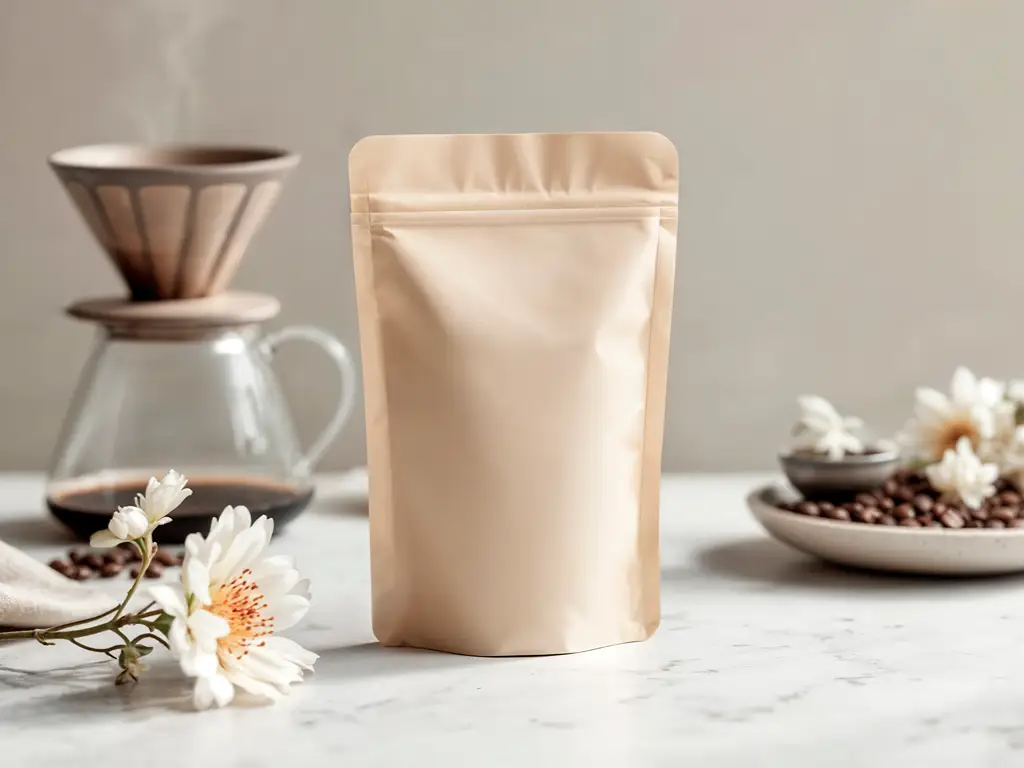
A stand-up pouch is a flexible bag made from laminated film, with a folded panel built into its base. That fold lets the bag rest upright on a shelf with nothing inside it but product. The folded panel is the bottom gusset, and it is the reason this format exists at all.
The standing mechanism is simple once you see it. The gusset folds out flat and becomes a supporting base. The filled product drives the center of gravity down into that base, and the pouch stands. When evaluating various stand up pouch types, you will find they vary in one of two things: how the base is formed and sealed, and what opening system the top of the bag carries.
It helps to know what is not in this family. Flat pouches and sachets, the three-side-seal bags used for single-serve portions, have no gusset and cannot stand. Roll stock film is the upstream form: material wound on a core, fed into automatic fill-and-seal lines to become pouches at the packer. Neither is a stand-up pouch, but both sit one step away from it, and buyers cross between them often.
One more thing to carry into the rest of this guide: standing is not unconditional. Load too much weight, or fill the bag with something dense and uneven, and the same structure that stood tall in a sample will slump in a carton. That constraint is where pouch types stop being a catalog and start being an engineering choice. The third section deals with it directly.
The Two Axes Behind All Stand Up Pouch Types
To make an informed choice, it is helpful to understand the underlying structure. Most stand up pouch types are described along two independent axes:
- Bottom structure: how the base gusset is cut and sealed. This decides whether the pouch stands, how much weight it carries, and how it presents on a shelf.
- Closure and features: what the top (or face) of the bag carries. This decides how the product is dispensed, whether it reseals, and how it looks.
The two axes are orthogonal. A K-seal bottom can carry a press-close zipper, a child-resistant zipper, or no closure at all; a spout can be mounted on a Doyen bag or a corner-seal bag. Any pouch you can buy is one value from each axis. When some resources state there are “five types,” they are counting closure values. When comparing Doyen and K-seal, you are comparing bottom values. Neither is wrong; they are just reading different rows of the same grid.
Axis 1 — Bottom structure
- Doyen (round bottom)
- K-seal (corner bottom)
- Plow (W-fold)
- Skirt seal
Axis 2 — Closure & features
- Heat seal + tear notch
- Press-to-close zipper
- Slider zipper
- Child-resistant zipper
- Spout + screw cap
- Tin-tie
Doyen (Round Bottom): The Default
The Doyen, also called round-bottom or doypack, seals the front and back films into a U-shaped curve that cradles a rounded bottom gusset. The curve distributes stress evenly, which makes it the cheapest and most reliable base to manufacture. Its soft silhouette is what most people picture when they hear “stand-up pouch.” It remains the volume leader: round-bottom pouches accounted for 40.32% of global stand-up pouch volume in 2025.
Its limit is load. The U-seal is built for lighter fills, roughly up to half a kilogram. Beyond that, the rounded base deforms and the bag loses its posture. Its other limit is aesthetic: the round base means rounded corners on the shelf-facing panel.
K-Seal (Corner Bottom): The Load-Bearer
The K-seal replaces the curve with two diagonal seals that rise from the bottom corners at an angle, forming a sideways “K”. Geometry does the work the curve did, but with a flatter, wider footprint. The base swells less when filled, so the same volume of product needs a slightly taller bag, and the filled pouch stands more squarely.
That sturdiness is why K-seal variants show up in high-load applications such as coffee and dog food, where pallet stability is non-negotiable. The trade-offs: the diagonal seals cost a little more to make than a Doyen curve, and the squared-off corners change the bag’s look. Arguably a sharper, more premium look, but a change nonetheless.
Plow Bottom: The Heavyweight
The plow bottom (also sold as corner-bottom or W-fold) has no separate bottom gusset web at all. The rear panel of film folds forward under the bag to form the base, the way a paper grocery bag does. That single continuous fold is what lets it take the heaviest fills; plow bottoms are generally recommended for 2 pounds and up. Because there is no bottom web, plow bags also run efficiently on vertical form-fill-seal equipment. That matters if your product will be packed automatically rather than pre-made.
Skirt Seal and the Rest of the Map
Two further names complete the picture so nothing surprises you mid-project. A skirt-seal pouch extends the gusset into a short “skirt” that bears the load, a mid-weight middle ground between Doyen and K-seal geometry. Box-bottom (flat-bottom) pouches and quad-seal pouches are the square-cornered members of the standing family. Structurally they are cousins that trade a rounded base for a flat, brick-like footprint and more printable panels.
That covers the bottom axis. The closure axis is wider but shallower, and most of it fits in one table:
Closure systems for different types of stand up pouches
| Closure | Best for | Watch out for |
|---|---|---|
| Heat seal + tear notch | Single-use portions, samples | No reseal; pair with a notched tear line for clean opening |
| Press-to-close zipper | Dry goods opened repeatedly (snacks, spices, supplement powder) | Standard zippers run about 13 mm wide and sit 30–35 mm from the top seal on typical catalog pouches |
| Slider zipper | Larger openings: pet food, protein powder, coffee | Bulkier seal; costs more than a press-close |
| Child-resistant zipper | Supplements, CBD, household products with compliance needs | Adds slide-and-squeeze mechanics; confirm certification expectations with your supplier before artwork |
| Spout + screw cap | Liquids: beverages, sauces, liquid supplements | Needs a dedicated spout-insertion step in production; incompatible with flat filling lines without the right fixtures |
| Tin-tie | Coffee and bakery bags with a fold-over top | Not airtight; usually paired with an inner liner |
Surface features (transparent windows, matte or metallic finishes, one-way degassing valves for coffee, hang holes) ride on either axis but rarely change the structural decision. Treat them as decoration and compliance, not as “types.”
Matching Pouch to Product Weight and Form
Structure selection is mostly load selection, and the industry sorts it into three bands:
Bottom structure by load class
| Load class | Structure | Typical products |
|---|---|---|
| Under ~0.5 kg | Doyen (round bottom) | Spices, snack servings, granola, tea, small supplement pouches |
| ~0.5–2.3 kg | K-seal (corner bottom) | Coffee beans, pet treats, larger dry goods, multipack snacks |
| Over ~2.3 kg | Plow / corner bottom, box bottom | Pet main food, rice and grains, bulk dry goods |
Now the part that often causes confusion: weight recommendations can vary. Some guidelines put Doyen at 2 oz–1 lb and plow at 2 lb and up. Others draw the lines at 0.5 kg and 2.3 kg, or place the K-seal band at 1–5 lb (about 0.45–2.25 kg). Those numbers do not agree at the margins, because the margins genuinely move. Where a band’s cutoff lands shifts with film thickness, laminate stiffness, and above all product density. Two pounds of puffed snack and two pounds of salt occupy wildly different volumes, and they load the base differently.
So treat any single threshold as a starting point and confirm it with two facts, not one: net weight and fill volume (or bulk density). A supplier who knows both can tell you within one conversation whether your product sits safely inside a Doyen band or needs the next structure up.
When fill weight alone does not settle the structure choice, use our pouch volume calculation guide to estimate how much space the actual product needs.
Ordering near a band edge — tell us the product and its fill weight, and we will confirm the structure band in one reply.
Get a Structure CheckProduct form adjusts the answer within a band. Powders that bridge and clump want a wide opening and a zipper you can pull fully apart. Liquids leave the standing dry-goods family almost entirely and go to spouted pouches. Products opened daily for weeks belong in the zipper family regardless of weight. And where shelf image leads the decision, as in premium retail and crowded categories, the square-cornered structures (K-seal, box bottom) present straighter panels than a round-bottom bag ever will.
The context matters more than it used to, because the category keeps compounding. The global stand-up pouch market is worth USD 15.27 billion in 2026 and is forecast to reach USD 19.76 billion by 2031, a 5.29% CAGR. Much of that growth comes from brands converting away from rigid containers, a switch that cuts packaging weight by 60–80%. Flat-bottom formats, prized for shelf stacking, are the fastest-growing structure at a 6.24% CAGR. A structure decision made today will likely be re-quoted at higher volumes within a few years. That is why the next section treats your spec sheet and your scale-up path as one document.
Stand-up pouch demand, 2026–2031
$15.27B
Global market, 2026
$19.76B
Forecast, 2031
5.29%
CAGR through 2031
6.24%
Flat-bottom CAGR, fastest-growing structure
The load ladder
<0.5 kg
Doyen — round bottom
0.5–2.3 kg
K-seal — corner bottom
>2.3 kg
Corner or plow bottom
Every cutoff moves with product density — confirm net weight and fill volume before you order.
How to Specify a Pouch to a Supplier
A structure band tells a supplier where to start. A specification tells them what to actually quote. The difference between a drifting, re-negotiated order and a clean one is usually the completeness of this first document.
The Minimum Spec Sheet
For a typical digitally printed stand-up pouch, the working parameters look like this. Every line prevents a specific class of misunderstanding:
The minimum pouch specification
| Parameter | Typical value on catalog pouches | Why the supplier needs it |
|---|---|---|
| Width × height + bottom gusset | e.g. 130 × 210 mm + 40 mm gusset | Fill volume and film yield are calculated from this, not from the bag’s height |
| Total thickness + layer structure | 100 µm, MOPP/VMPET/PE (a common digital-print structure); 120 µm mylar with metallized PET lining for high-barrier mylar bags | Barrier, stiffness and load behavior all follow from the laminate, not the thickness number alone |
| Seal width | 7–9 mm side and bottom seals | Seal width sets leak resistance and running speed on filling lines |
| Zipper type and position | Press-to-close, 13 mm wide, 30–35 mm below the top seal | Wrong zipper height breaks filling and closing equipment setups |
| Tear notch | 15 mm from the top | Position determines whether customers can open the bag cleanly |
State these five lines and a competent converter can return an accurate quote, a dieline, and a realistic sample plan. Omit them and every quote you receive is estimating, usually optimistically.
If you have not chosen width, height, and gusset dimensions yet, use the stand up pouch size chart to shortlist sizes before testing filled samples.
Process and MOQ: The Constraint Behind the Quote
The same pouch structure can be made on two very different production routes, and the route changes what ordering looks like. Digital printing runs without plates or cylinders from roughly 500 pieces per SKU, and some suppliers go lower for simple jobs. Orders turn around in 7–10 working days. Gravure printing delivers the lowest unit cost at scale but typically starts at 5,000–10,000 pieces with 15–20 working-day lead times, and it charges a cylinder per color.
Read those two lines as a decision rule, not a price list. If you are validating a product, running seasonal variants, or splitting a launch across SKUs, digital’s low minimum is what makes the structure worth ordering at all. If a SKU has proven steady volume, gravure reprices it. The practical mistake is choosing a structure that only makes sense on the route you are not using. Say, a heavily foiled, high-cylinder design for a product still in test-market quantities. Choose the structure and the route together, and leave yourself a path from the first to the second.
Structure × Scenario: Where Each Combination Fails
The matrix below is the decision tool this article has been building toward. Read your row before you commit to a purchase order; the right-hand column is the part suppliers rarely volunteer:
Structure × scenario boundary matrix
| Pouch combination | Fits | Carries & shows | Switch when / where it fails |
|---|---|---|---|
| Doyen + heat seal | Single-use dry portions up to ~0.5 kg: spice sachets, sample packs | Clean look, lowest unit cost | Fails for anything reopened; no reseal, so switch to zipper when repeat use is real |
| Doyen + press-close zipper | Light dry goods sold on repeat purchase | Rounded premium look; zipper at 30–35 mm suits most fillers | Over ~0.5 kg the U-base deforms; step up to K-seal |
| K-seal + press-close zipper | Coffee, pet treats, 0.5–2.3 kg dry goods | Squarer stance, steadier pallet columns | Square corners change shelf look; approve a printed proof before committing a run |
| K-seal + child-resistant zipper | Supplements and CBD in the mid-weight band | Compliance look without moving to rigid | CR zippers add cost and slow fill lines; confirm certification expectations in writing first |
| Corner/plow + slider | 2.3 kg+: pet main food, grains | Flat, brick-like stance; stacks tightly | Loses the rounded look entirely; overkill (and over-budget) below ~2 kg |
| Spout pouch | Beverages, sauces, liquid supplements | Controlled dosing, reclosable cap | Needs spout-insertion tooling; skip for dry goods where it adds cost for nothing |
| Kraft-look laminate structure | Natural/premium positioning in any light-load band | Paper-shelf presence with film-barrier performance | Kraft laminates hide the product; pair with a window only if the structure allows it |
Used honestly, this matrix does more than just list options: it tells you what exists and, just as important, what to walk away from.

What Goes Wrong and What to Check
Pouch failures cluster into four patterns, and all four are catchable before shipment if you know what to look at.
Bags that bulge at the base after filling usually trace to structure under load. The K-seal’s low-swell base helps, but any bag filled past its band will distort. The check that catches this is unglamorous: fill real product to real weight and measure the filled height and base width against the dieline, rather than judging by empty-bag dimensions.
Seal leaks come from seal width that is too narrow for the product’s weight and handling, or from product contamination in the seal zone during filling. Pull-test a sample of seals and inspect the seal area for product dust before accepting the run. Punctures show up with sharp-edged contents (jerky, coffee pods, hard candies) in film that is too thin for the job. Match the laminate to the content’s edges as much as its weight; a 100 µm digital structure behaves differently from a 120 µm metallized one. Pallet collapse is almost always a load-band violation: heavy product in a structure chosen for shelf looks.
Before you accept the shipment
- Fill actual product to stated net weight; measure filled height and base width against the dieline
- Pull-test seals from at least three positions per bag across the run
- Inspect seal zones for product dust or oil contamination
- Puncture-test one bag per 1,000 with your real content edges
- Pallet-test full case stacking to the height your warehouse actually uses
One question does more work than any of these tests: ask the supplier to state, in writing, what their in-process inspection covers. A production floor running 100% in-line inspection plus pre-shipment QC sampling will answer in one sentence and can usually show you the records. A supplier who answers vaguely has told you something too.
What This Means for Your Stand Up Pouches Packaging Business
If you distribute or resell different types of stand-up pouches packaging, the two-axis framework is not trivia. It is the shortest path to being useful to a buyer. Two questions locate almost any opportunity: how much does the product weigh and how dense is it, and is the pack opened once or daily? The first answer picks the row of the structure table; the second picks the closure. A buyer who hears those two questions asked before any quote is being dealt with by a consultant, not a catalog.
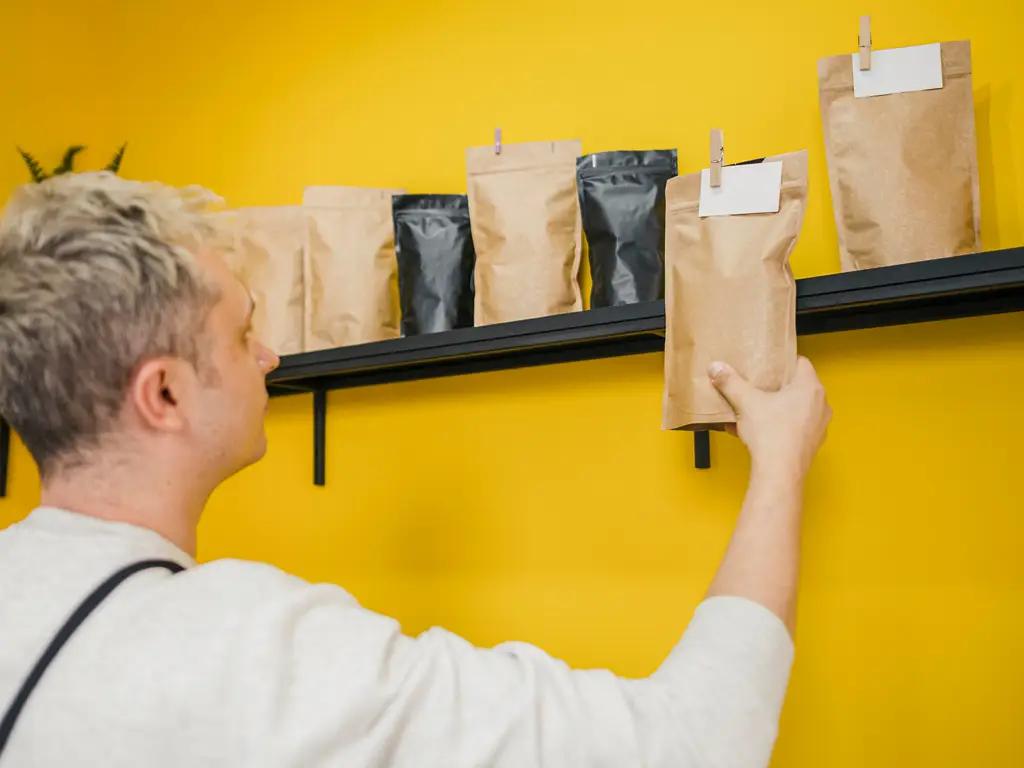
The same framework sorts your inventory logic. Round-bottom Doyen stock in common sizes is walk-in traffic: commodity volume priced to move. The margin lives one row up: K-seal and corner structures, functional zippers, and compliance closures. There the engineering is visible to the buyer’s own customers, and a stock-bag importer cannot price-match it. With the category growing at 5.29% a year through 2031, the demand side will keep feeding both rows. The defensible profit concentrates where structure and closure meet.
The third implication is temporal: match the production route to the customer’s stage. Startups validating SKUs need digital runs of a few hundred pieces in days, not weeks. Accounts with proven SKUs need gravure economics. A distributor who can quote both routes, and move a client between them without changing the bag shoppers already recognize, stops being a line item in a price comparison.
That is also the point where the manufacturing side of the table matters, so it is fair to say who is writing this. Baishen Pack runs digital printing (HP Indigo), flexo and rotogravure in one plant, with laminating, slitting and bag-making on the same floor. That is why we can quote a stand-up pouch program from 500-piece digital trials to 10,000-piece gravure runs without the structure changing under the client. We hold ISO 9001, BRC and SGS certification, and every quote we issue starts with the same two questions this article opened with. If you are comparing suppliers, bring the spec sheet from section four and the checklist from section five. Whoever you choose should welcome both.
From spec sheet to sample plan
From finding the right stand up pouch types to sizes, structures, and closures — one plant quotes your program from first sample to full run.
Start a Pouch QuoteReferences
- Mordor Intelligence. “Stand Up Pouches Market Size, Share & Industry Growth Report, 2031.” 2026.