
You have three numbers printed on a pouch — width, height, gusset — and one question that decides whether your product fits: what will this bag actually hold? Multiply the three numbers and you get an answer. Then a 250-gram bag of coffee beans goes into the “right-sized” pouch and stops two-thirds of the way up. A powdered blend that calculated perfectly inside the formula overflows the zipper the moment it settles. The math is not wrong. It was answering a narrower question than the one you asked.
This guide walks the full distance from the printed dimensions to a pouch you can order with confidence. You will measure the three dimensions, pick the formula that matches your bag, and reverse the lookup from grams to pouch size using product density. A final quote check keeps both sides measuring the same numbers.
What W, H + G Actually Mean — and How to Measure Them Right
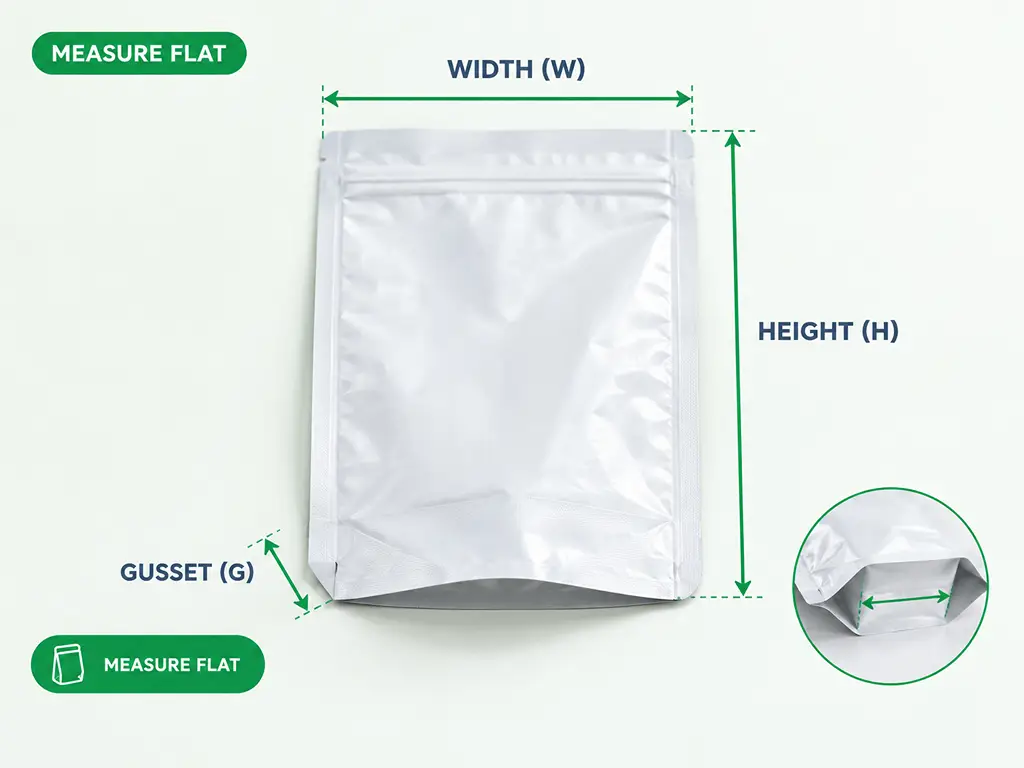
Every stand up pouch is specified by the same three dimensions, written in the same order: width × height + gusset. A listing like 160 × 230 + 80 mm means a bag 160 mm across the face, 230 mm tall, with an 80 mm bottom gusset. Measure them in that order and write them down in that order, because every chart and every supplier conversation assumes it.
Measure each one like this:
Width (W): lay the empty pouch flat and measure across the front face, edge to edge.
Height (H): measure from the bottom fold up to the very top edge of the bag.
Gusset (G): open the bottom so it flares out and measure from the front panel to the back panel along the base.
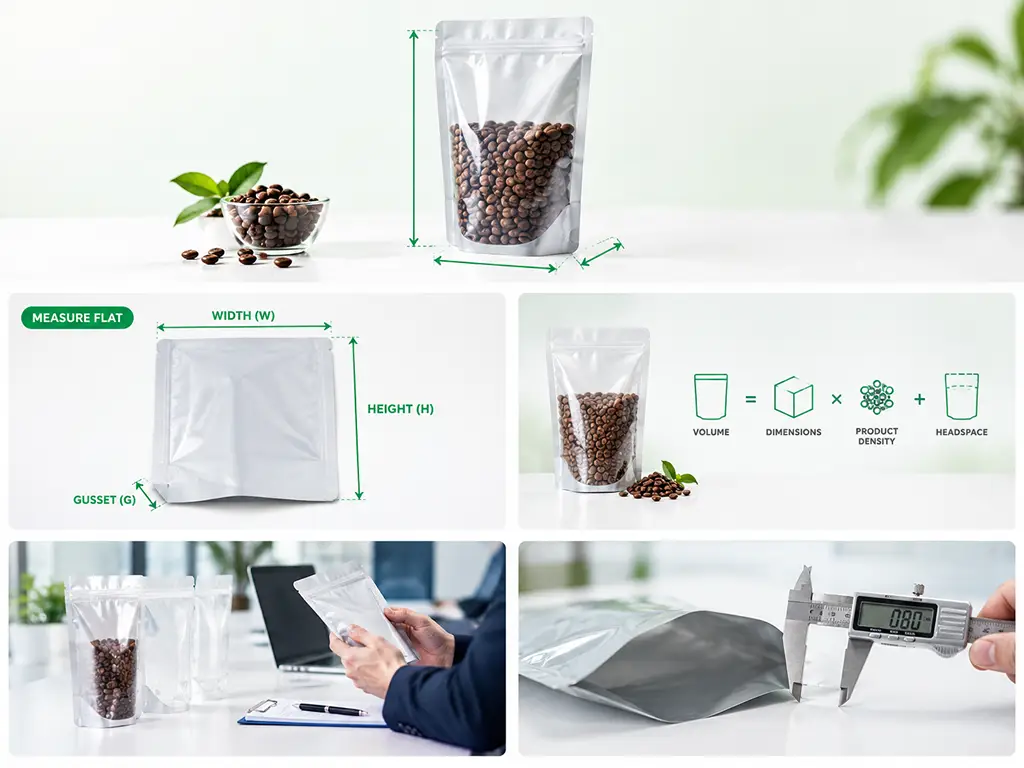
Two of those steps hide the mistakes that cost reorders. The gusset must be measured with the bag lying flat, unfilled, from the bottom fold up. It is a fold of film, not a rigid base, and guessing at it by eye is how buyers end up comparing numbers that were never measured the same way. The gusset you measure flat is also not the gusset you ship. A typical 2–3 inch gusset on a small pouch opens out to 4–6 inches once product pushes the panels apart. The labeled G describes the empty bag. The filled bag is a different shape.
One boundary case keeps the definitions honest: a flat pouch has no gusset line at all. If a listing has only two dimensions, there is no third number to argue about. The +G is precisely what makes a pouch stand up, and it is also where most of the volume confusion starts.
A bottom gusset changes both the pouch’s shape and its usable capacity. If you are comparing a Doyen base, K-seal, or other constructions, review the types of stand-up pouch packaging before applying the same volume estimate to different bag styles.
The Volume Formulas: Three Versions and When Each Holds
When calculating pouch volume, you will typically encounter three different formulas. They are not three truths in competition. They are three approximations of the same object, each with its own bias. Knowing which approximation you are holding matters more than the arithmetic itself.
Measure to the Fill Line, Not the Top Edge
Before any formula runs, one correction applies to the height figure. The usable, fillable area of a stand up pouch stops at the zipper or the seal line, not at the top edge of the bag. The top few millimeters are consumed by the closure itself and can never hold product. On a 200 mm tall pouch with a 13 mm zipper set 30 mm below the top, that closure zone is 15% of the height. Skip the correction and your volume is overstated by more than a tenth before the formula even runs.
Fill-line rule: run every formula on height measured to the zipper or seal line — the closure zone never holds product, and skipping it overstates volume by more than a tenth.
Three Formulas in the Wild
The three versions you will meet, and what each one assumes:
| Formula | What it assumes | Which way it errs | Use it when |
|---|---|---|---|
| V ≈ W × H × G | A perfect rectangular prism; nothing tapers | Overestimates — ignores taper, seal, closure | First-pass screening against a size chart |
| V ≈ (W × H × G) × 0.75 | Gusset folding and sealing eat ~25% | Still approximate; the 0.75 is a rule of thumb, not physics | Quick quotes for standard gusseted bags |
| V ≈ (W × D_side × H) + (D_bottom × D_side × H) | The bag is summed from panels — front/back plus gusset zones | Most faithful for side-gusset constructions | Bags with side gussets or box-bottom shapes |
When engineers and packaging technologists evaluate these dimensions, they agree that purely mathematical solutions are unreliable because the filled shape depends heavily on the film’s stiffness, material gauge, and fold style. The academic consensus, supported by literature from institutions like the Michigan State University School of Packaging, is that a mathematical formula provides only a baseline, which is why the next two sections replace precision math with verified physical testing.
A Worked Example: One Bag, Three Answers
Take the 160 × 230 + 80 mm pouch from the opening section and run all three:
Three defensible numbers, one bag. The spread between them, 2.21 to 2.94 liters, is wider than the gap between two adjacent sizes on most weight-to-size charts. Which is exactly why the raw answer should never travel alone: a volume without its measuring convention is a number waiting to be misquoted. For shaped pouches, all three formulas fail outright. The only calibration that works is filling a physical sample.
From Empty Volume to Actual Fill: Density, Settling, Headspace
A pouch calculated at 1.35 liters will not hold 1.35 liters of anything you sell, because “anything” is where the missing variable lives. The bag has one volume. Your product has a packing density, and density is the number that turns volume math into order quantities.
The Same Pouch Holds 4 oz of Coffee and 16 oz of Water
A simple comparison makes this clear. For example, a standard 5″ × 8″ × 3″ stand up pouch is typically rated for 4 oz (about 140 g) of dry products, but can hold up to 16 oz of liquid. The identical bag. A four-fold difference in what it holds. Liquid fills the space one-to-one; dry product rides on its bulk density. Grounds, beans, flakes, and powders each pack differently, and even the same coffee halves its density between whole bean and ground.
Same 5″ × 8″ × 3″ pouch
The label describes the bag; the fill is decided by the product.
Reverse Lookup: From Your Fill Weight to a Pouch Size
Working grams-first instead of formula-first is how buyers actually choose. As noted in industry characterizations by the Flexible Packaging Association (FPA), weight-to-size table logic provides a reliable starting point and transfers to any product line once you adjust for density:
| Size | Dimensions (W × H + G, mm) | Fill weight | Typical products |
|---|---|---|---|
| XS | 80 × 130 + 50 | 25–50 g | Samples, single-serve, travel |
| S | 100 × 150 + 60 | 50–100 g | Tea, small snacks, spices |
| M | 140 × 200 + 80 | 100–250 g | 250 g coffee, nuts, granola |
| L | 160 × 240 + 90 | 250–500 g | Standard retail, pet treats |
| XL | 200 × 300 + 100 | 500 g–1 kg | Family size, bulk |
| XXL | 250 × 350 + 120 | 1–2 kg | Large format, pet food |
Read it as a starting bracket, not a verdict. A dense powder like a protein blend fills the bottom of its weight band; an airy expansion product like puffed snacks fills the top and then some. Fine grounds settle tighter than beans. The same weight of ground coffee needs visibly less pouch than whole bean, which is why two coffee brands can sell the same 250 g in different-size bags and both be right.
Use this table to narrow the range, then compare your shortlist with the product-specific estimates in our stand-up pouch size chart. Both are starting points; a pouch filled with your actual product is still the final check.
Settling and Headspace: The Space You Plan to Leave
The last stretch of volume math is deliberate emptiness. Fresh-roasted coffee releases carbon dioxide for days or weeks after roasting. The headspace, the gap between product and seal, is where that gas goes before it escapes through a one-way valve. Without it, pressure builds until seals strain or pouches balloon. Fragile products use the same space as crush protection, which is why a chip bag feels half empty by design. The working rule: decide the headspace your product needs, subtract it from usable volume, and let the remainder, not the nominal figure, size the bag.
Where the dry/liquid conversion breaks down matters as much as where it works. Viscous pastes trap air and fill by weight. Carbonated or gas-releasing products claim headspace aggressively. Any product that expands after filling, think fermenting or off-gassing blends, invalidates the chart entirely. For every row below, treat the table as the starting bracket and a filled sample as the verdict.
| Product | Density & settling behavior | Size correction at same weight | Failure mode when mis-sized |
|---|---|---|---|
| Whole coffee beans | Low bulk density; off-gasses CO₂ | Up one size from powder-equivalent | Under-sized: valves overwhelmed, doming, seal stress |
| Ground coffee | Settles tight; degasses slower | Down one size from whole bean | Over-sized: slack space reads as half-empty on shelf |
| Flour-type fine powder | Compacts under vibration | Verify settled volume, not loose-fill | Under-sized: dust in zipper track, seal contamination |
| Pet dry food (kibble) | Large particles, high air gaps | Up one size; wide gusset helps | Under-sized: crushing at bottom, burst seams in transit |
| Snack pellets / puffed | Extremely low density, fragile | Up one to two sizes | Wrong math here doubles reorder risk |
| Low-viscosity liquid | Fills 1:1 by volume | Chart dry-weight rows don’t apply | Overfill past zipper: seal failure, leakers |
| Paste / viscous | Traps air; fills by weight | Volume conversion invalid | Void pockets, underfill by volume, leaking seals |
Reading a Supplier Quote: The Three Questions That Prevent a Mis-Order
Suppose the reverse table lands you on a 160 × 240 + 90 mm pouch, and two suppliers quote “the same” bag. They are almost never measuring the same thing. The industry never agreed on one convention. Three questions align the numbers before you compare prices.
Ask all three, every quote:
1Is this inside or outside measurement?
2Is the gusset listed at full length or half?
3Does the height run to the top edge or the zipper line?
These questions address common discrepancies in how manufacturers specify dimensions. According to standard terminologies and testing norms established by institutions like ASTM International, dimensions are conventionally listed as outside measurements, not the interior fillable space. Some manufacturers state the full gusset length while others state half of it. Two quotes that differ by 40 mm may be identical bags described in different dialects, or different bags described identically. Until the three questions are answered, cross-supplier comparison is noise.
After the answers, rebuild the interior. Subtract the side and bottom seals, on the order of 7–9 mm per seam on a typical build, from each face. What remains is the fillable box the formula should have run on. Bag shape shifts the remainder once more. A K-seal bottom, a round Doyen base, and a box-bottom bag with the same three printed numbers do not partition their interior the same way. The most reliable verification method always comes down to one final step: fill the actual pouch with your actual product to your target weight, and measure where it stops.
| Check | What to confirm | Pass condition |
|---|---|---|
| Measurement basis | Inside vs outside dimensions | Both quotes stated on the same basis, in writing |
| Gusset convention | Full length vs half length | Same convention, or one converted |
| Height basis | Top edge vs zipper/seal line | Fill-line height stated |
| Seal allowance | Seam width deducted | 7–9 mm order of magnitude confirmed |
| Physical sample | Filled with your product at target weight | Fill line and closure clearance verified |
The RFQ Spec Sheet: The Five Lines That Leave No Room for Ambiguity
Verification becomes effortless the moment the request itself is precise. A request-for-quote that carries five lines gets comparable, fill-accurate quotations back. One that just says “stand up pouch for 250 g” gets guesses. Write the RFQ in this order:
Internal dimensions: W × H + G in mm, marked “internal, gusset at full length, height to zipper line.”
Fill target: product weight, product form (whole bean / ground / powder / liquid), target headspace.
Closure spec: zipper type and width, distance from top, tear notch position.
Structure: material layers, total thickness, finish.
Tolerance: acceptable variance on each dimension, and the right to approve a filled sample before production.

For the closure and structure lines, a real published spec block shows the level of detail that removes ambiguity. One documented build reads 100 microns thick in a MOPP/VMPET/PE laminate with a matte finish. Its side and bottom seals run 7–9 mm. The tear notch sits 15 mm from the top, and a standard 13 mm zipper is set 30–35 mm from the top. Every one of those numbers exists because its absence once caused a question. The zipper width that didn’t match a filling machine’s jaws. The notch that tore too low. The seal too thin for the product’s weight. Your spec sheet doesn’t need those exact values. It needs that exact granularity.
Close the RFQ the way the verification section closed: request a sample filled to your target weight, and make the order conditional on it. Suppliers absorb this easily when the request is specific. It costs them one pouch instead of one production run.
Before you sign, send the quote to Baishen Pack — the three answers above are the ones they put in writing.
Have my quote verifiedThe Business Side: Sizing as a Sales Weapon
Read the trail backward and a pattern appears. Every failure in this guide, the coffee that didn’t fit, the quote that couldn’t be compared, the reorder that ate the margin, came from unverified numbers, not from bad bags. That has a commercial edge for anyone who sells packaging rather than just buying it. Distributors and wholesalers spend their days answering “will this size work for my product?”, and the honest answer is usually “probably.” The seller who can say “your 250 g of whole bean needs this internal dimension, with this headspace, verified on a filled sample” is no longer competing on unit price. They are supplying certainty, and certainty is the one line item buyers do not haggle.
It also changes how the unavoidable mistake lands. When a first estimate turns out wrong, and across a full product line some estimate always is, the damage depends entirely on the production path behind the order. This is where we close the loop at Baishen Pack. Our digital printing path runs from 500 pieces with 7–10 working-day turnaround. A sizing correction becomes a one-week, small-batch event instead of a warehouse of obsolete bags (low-MOQ digital printing lead times). For new SKUs and multi-SKU launches, that path is not just a print choice. It is insurance against the residual error that no formula eliminates.
The sizing math, in the end, is not packaging arithmetic. It is the difference between a supplier who quotes and a partner who answers, and that difference is where repeat orders come from.
Get a Filled Sample Before You Commit
Send your dimensions and target fill weight — Baishen Pack fills a real pouch against your spec before production runs.
Request a filled sampleReferences
- ASTM International. “Standard Terminology Relating to Flexible Barrier Packaging.” ASTM F17-07a, Committee F02.
- Flexible Packaging Association. “Flexible Packaging Industry Characterization Report.”
- Michigan State University School of Packaging. “Headspace and Bulk Density Variables in Flexible Food Packaging.”