
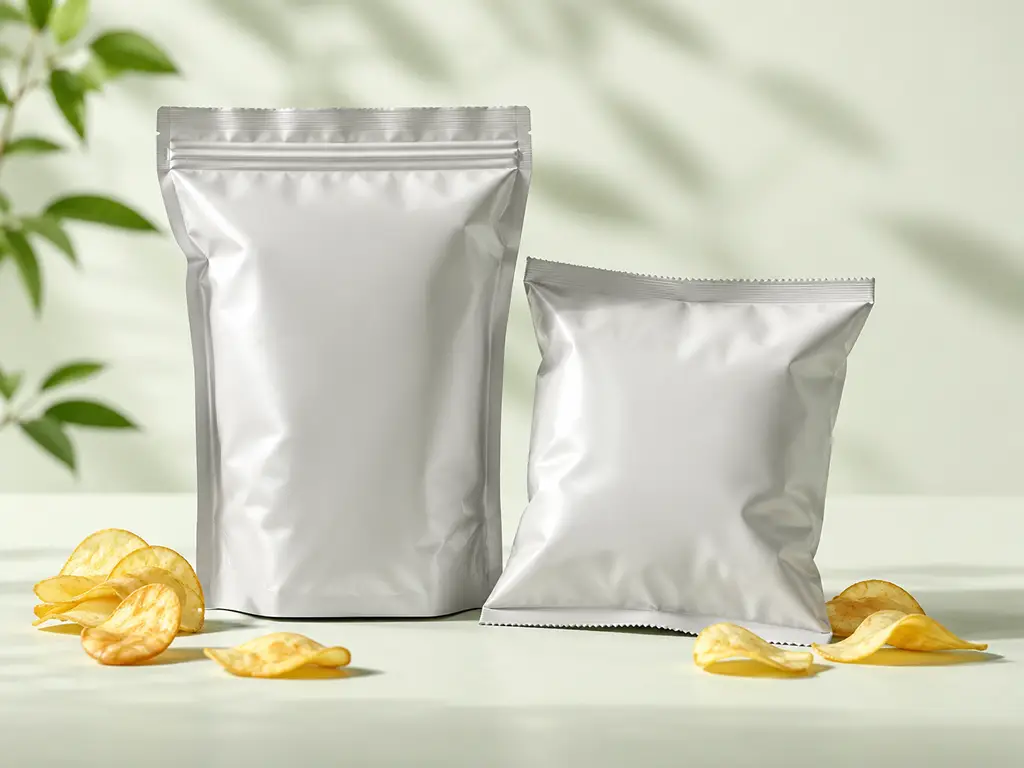
Potato Chips Packaging — The Complete Buyer’s Guide to Types, Materials, and Sourcing
A chip bag does more than hold your product. It blocks oxygen that would turn the frying oil rancid, stops moisture that would make every chip soggy, and shields the contents from UV light that degrades flavor — all while standing upright on a supermarket shelf and selling your brand in three seconds flat. If you’re launching a chip brand, switching suppliers, or scaling production, packaging isn’t a side detail. It’s the difference between a product that arrives crisp and one that arrives crushed.
This guide covers every layer of the decision, from bag formats and material science to supplier evaluation and the end-to-end procurement process.
Types of Potato Chip Packaging: From Pillow Pouches to Rigid Canisters
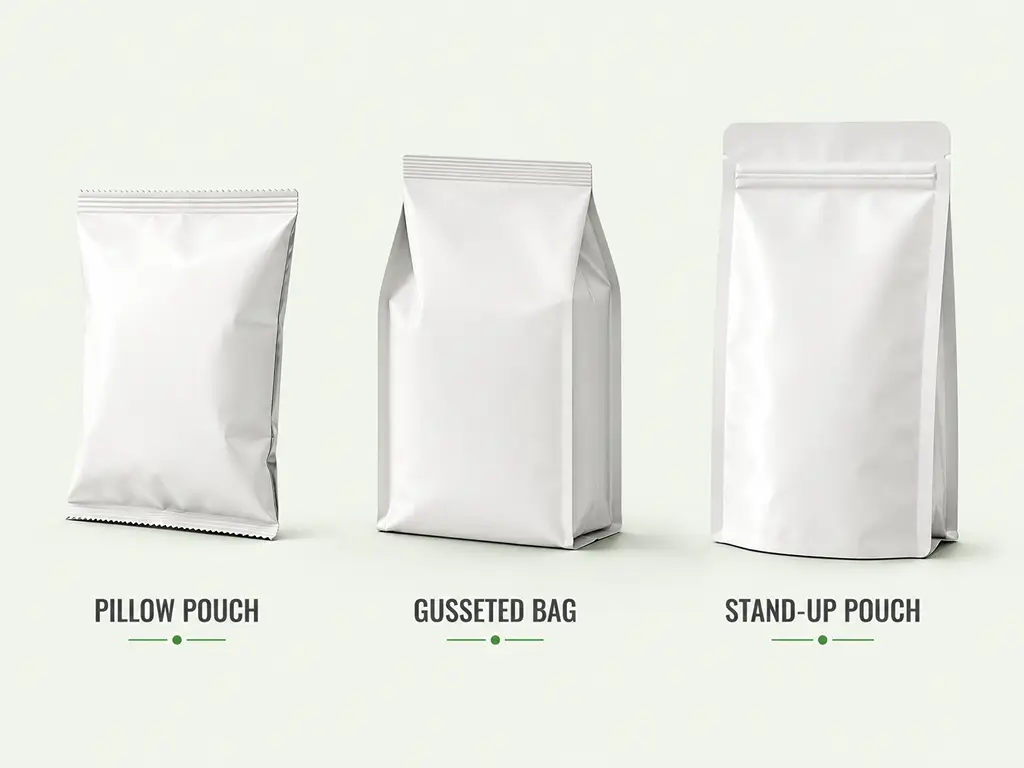
Before thinking about materials or suppliers, settle on a format. The bag type determines your production line compatibility, your shelf presence, and your unit cost. Three questions point you in the right direction: what filling equipment do you run (VFFS rollstock or pre-made pouches?), what’s your brand tier (volume play or premium?), and what’s your distribution channel (supermarket shelf or e-commerce direct mail?).
Pillow Pouch — The Industry Workhorse
The pillow pouch — produced on a vertical form-fill-seal (VFFS) machine — fills roughly 80% of the chip aisle. Rollstock film feeds into the machine, gets formed into a tube, filled with chips, nitrogen-flushed, and sealed, all in one continuous motion. The result is that familiar silver-lined bag with fin seals on the back and ends.
Why it dominates: lowest material cost, fastest production line speeds, and nitrogen flushing at ≥70% fill ratio keeps oxygen residue below 2%. If you’re producing standard fried chips at volume for supermarket distribution, this is almost certainly your starting point. Most Lay’s classic bags use this format.
Gusseted Bags — More Volume, More Shelf Presence
Gusseted bags add expandable folds — either on the sides or the bottom — that let the bag balloon outward when filled. The visual effect is immediate: the package looks bigger, feels more substantial in hand, and stands more stably on shelf.
The bottom gusset typically measures 50–80mm wide when expanded, and the inner layer uses a thicker 60–80μm LLDPE for stronger heat seals under the extra weight of family-sized portions. Think of it like the pleat in a pair of trousers — flat when empty, expanded to give the contents room when full. Kettle chip brands and family-size formats lean heavily on this structure because consumers perceive the larger visual volume as better value.
Stand-Up Pouch (Doypack) — Maximum Shelf Presence
The stand-up pouch, or Doypack, has a flat bottom that lets the bag stand on its own — no leaning, no flopping over. The entire front panel becomes a billboard facing the shopper, and the bottom gusset (usually 50–100mm) provides a stable base.
Stand-up pouches often include a press-to-close zipper for convenience: the consumer can reseal after opening, keeping chips fresher longer. The zipper needs to survive at least 10 open-close cycles in testing. Premium and craft chip brands — especially those selling direct-to-consumer online where the unboxing experience matters — gravitate toward this format. Per-unit cost runs roughly 50% higher than a pillow pouch, but the perceived quality jump often justifies it.
Canister & Rigid Packaging — Maximum Protection
The Pringles can is the textbook example: a paper-aluminum-plastic composite cylinder with internal stacking trays that separate every single chip. Protection is absolute — crush rate approaches zero during transport, and oxygen transmission drops to ≤0.01 cc/m²/day, roughly an order of magnitude better than flexible pouches.
The trade-off is cost. Rigid canisters run 2–3× the unit cost of flexible pouches, and they only work for uniform-shaped chips (stacked slices, not random-cut kettle chips). But for export markets with long supply chains, or premium gift packaging, the near-zero breakage rate and perfect stackability in shipping cartons can offset the higher packaging cost through reduced waste.
Specialty Finishes — When the Package Is the Marketing
Matte over-lacquer, holographic micro-embossing, soft-touch coatings, spot UV — these aren’t functional packaging features. They’re marketing weapons for the three seconds a consumer’s hand hovers over the shelf. A matte finish takes surface gloss below 10 GU (gloss units), creating a subdued, premium look. A soft-touch coating at 3–5μm thickness adds tactile sophistication. Holographic effects use micro-embossing at 200–400 lines per inch to catch light and attention.
These finishes work best for limited editions, seasonal releases, or premium sub-brands where the packaging itself communicates the upgrade before the consumer reads a single word.
The Science Inside the Bag: Materials and Barrier Properties
A chip bag is not “a plastic bag.” It’s a precision multi-layer engineering structure — closer to a three-layer sandwich than a single sheet of anything. Each layer performs a specific job, and if any one layer fails, the chips inside go bad.
The Multi-Layer Laminate: Why Chip Bags Aren’t “Just Plastic”
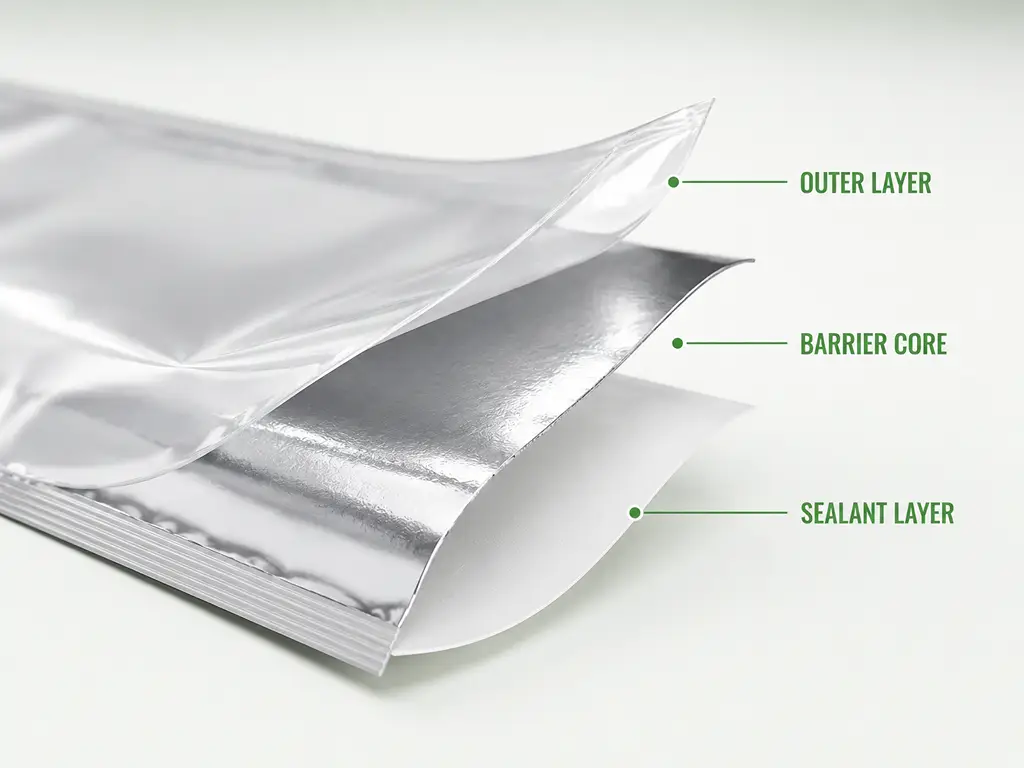
Every chip bag is a laminate — two or more films bonded together, each chosen for a specific function:
- Outer layer (PET or BOPP, 12–20μm): The print surface and mechanical shield. PET gives high-gloss print quality and tear resistance; BOPP is lighter and runs faster on high-speed lines.
- Barrier core (aluminum foil, METPET, or METBOPP, 7–12μm): The real workhorse. This layer blocks ≥99.9% of oxygen (with pure aluminum foil) or ~99% (with metallized film), stops moisture vapor, and reflects UV light. Without this layer, the oil in your chips would oxidize within days.
- Sealant inner layer (LLDPE or CPP, 40–60μm): The food-contact surface. It needs to be food-safe, non-reactive, and capable of forming an airtight heat seal at >35N/15mm seal strength.
Why can’t you just use a single-layer PE bag? Polyethylene alone has terrible oxygen barrier properties. Chips packed in plain PE bags go soggy within 24 hours — moisture gets in and nitrogen gets out. The multi-layer structure isn’t a luxury; it’s the minimum viable product for any chip with a shelf life longer than a day.
A single-layer PE bag lets chips go soggy within 24 hours. The multi-layer laminate isn’t optional — it’s the minimum viable product for any shelf life beyond a day.
For a comprehensive technical reference on multi-layer flexible packaging structures, see Gordon L. Robertson’s “Food Packaging: Principles and Practice” (3rd Edition, CRC Press).
Barrier Properties That Matter: Oxygen, Moisture, and Light
Potato chips have three enemies, and your packaging fights all three simultaneously:
Oxygen is the most aggressive. The frying oil coating every chip surface is chemically unstable — expose it to oxygen and lipid oxidation begins, producing rancid off-flavors. An aluminum foil barrier layer drops oxygen transmission to ≤0.5 cc/m²/day — effectively zero for practical purposes. Metallized PET (METPET) achieves roughly 99% blockage, sufficient for standard 6–9 month shelf life targets.
Moisture is what makes chips go soft. Even a tiny amount of humidity ingress — measured as Water Vapor Transmission Rate (WVTR) — turns crisp chips leathery within weeks. A good aluminum foil laminate keeps WVTR below 0.5 g/m²/day. Without this barrier, chips stored in ambient humidity lose their crunch in 7–14 days.
Light — specifically UV — degrades both the oil and any natural flavor compounds. The metallic layer (aluminum or metallized film) reflects or absorbs 99% of UV radiation, preventing photo-oxidation. This is why chip bags have that silver interior — it’s not decorative, it’s functional.
Nitrogen flushing ties all three protections together: after the bag is filled, nitrogen gas displaces the ambient air inside, dropping residual oxygen below 2%. The nitrogen is inert — it doesn’t react with anything — and it also acts as a cushion, protecting chips from crushing during transport at a fill ratio of ≥70%.
Common Material Structures and How to Match Them to Your Product
Different chip products need different laminate structures.
How to choose? Ask three questions: What’s your target shelf life? What climate does your distribution chain pass through? Is your brand positioned as value or premium? The answers map directly to the structure you need — there is no single “best” material, only the best match for your specific product and market.
How to Choose the Right Packaging for Your Potato Chip Product
By now you know the formats and you understand the materials. The question becomes: given your specific situation, which combination actually makes sense? Four steps turn knowledge into a decision.
Step 1 — Pin down your production reality. If you’re running a VFFS (vertical form-fill-seal) line, you need rollstock film — which eliminates pre-made stand-up pouches and canisters from consideration immediately. VFFS machines typically accept film widths of 200–600mm. If you’re using semi-automatic or manual filling, pre-made pouches become viable. Also look at your monthly volume: producing over 100,000 units per month? Rollstock + pillow pouch is almost certainly the cost-optimal path. Under 10,000 units? Pre-made pouches with digital printing may give you more flexibility without the line-speed penalty.
Step 2 — Match your brand positioning. A value-oriented supermarket brand fighting on price needs the lowest unit packaging cost — pillow pouch, PET/METPET/LLDPE, gravure-printed in large runs. A craft brand selling direct-to-consumer at a premium price point should invest in a stand-up pouch with matte finish and a resealable zipper — the packaging itself justifies the higher retail price. Look at what brands in your tier actually use: Kettle Brand uses gusseted stand-up pouches with matte finishes; Lay’s classic uses pillow pouches. Neither choice is wrong — they’re matched to different tiers.
Step 3 — Assess your distribution environment. How far does your product travel, and through what conditions? A chip brand sold within one state has different packaging requirements than one exported from a factory in Guangdong to a warehouse in Dubai. High heat + high humidity = maximum barrier required (PET/AL/CPP). Air-conditioned domestic supply chain = standard barrier sufficient. E-commerce direct mail faces an extra challenge: the package must survive courier handling without external retail carton protection — puncture resistance and drop-test performance become critical.
Step 4 — Calculate your unit cost tolerance. While exact pricing varies by order volume and specification, the relative cost ladder is consistent across the industry. Using the pillow pouch as a baseline (100%): a gusseted bag runs approximately 120%, a stand-up pouch roughly 150%, and a rigid canister about 250%. Specialty finishes add 10–30% on top of the base bag cost. The right question isn’t “which is cheapest?” — it’s “which format delivers the margin I need at the retail price my customers will pay?”
The best packaging isn’t the most expensive option on the menu. It’s the one where format, material, and cost all align with how you actually make, sell, and ship your chips.
Finding and Evaluating Flexible Packaging Manufacturers
Once you know what you need, the next question is who will make it. This is where most first-time buyers stumble — the SERP is full of manufacturers’ own marketing, but there’s almost no neutral guidance on how to evaluate them.
Supplier evaluation works a lot like hiring: the certifications and website are the résumé, the samples are the interview, and the trial order is the probation period. Don’t make a long-term commitment based on the résumé alone. Seven dimensions form a practical evaluation framework:
| Evaluation Dimension | What to Look For | Red Flags |
|---|---|---|
| Food Safety Compliance | ISO 9001, BRC (Grade AA/A), ISO 22000/HACCP certifications; FDA 21 CFR or EU 1935/2004 food-contact compliance with actual registration numbers; third-party test reports from SGS or Intertek | Cannot produce any certification documents; claims “equivalent to FDA” without a registration number; refuses to share test reports |
| Printing Capability | Multiple print methods (digital, flexo, rotogravure); supports ≥8 colors; digital proof turnaround within 24–48 hours; can match Pantone colors accurately | Only offers template-based designs with no customization; proof turnaround exceeds one week; cannot explain their color-matching process |
| Production Flexibility | MOQ that matches your scale (digital printing can go as low as 500 pcs); split-run capability for multi-SKU orders; clear sample policy (free stock samples + paid custom samples available) | MOQ is orders of magnitude above your needs with no flexibility; refuses to provide any samples before a bulk order; cannot handle multi-SKU runs |
| Quality Control | In-line inspection (metal detection, X-ray); per-batch testing covering ≥5 parameters (adhesion, puncture, tensile, burst, drop, visual); documented QC reports available; accepts third-party factory audits | No QC documentation available; refuses factory visits or video walkthroughs; vague about what they actually test per batch |
| Delivery Reliability | Clearly stated lead times; on-time delivery rate ≥95%; defined process for urgent orders; supports partial shipments if needed | Lead time is vague (“about 15–20 days”); cannot provide historical on-time delivery data; no contingency plan for delays |
| Communication | Dedicated account contact; response within 8 business hours; English-language capability (for international buyers); proactive status updates at key milestones | Responses consistently take over 24 hours; contact person changes without notice; significant language barrier with no solution offered |
| Value-Added Services | Offers material and structure recommendations based on your product type; provides design consultation; handles logistics coordination (FOB/CIF/DDP options) | No technical advice — just “send us your dimensions and we’ll quote”; no logistics support for international buyers |
A manufacturer that scores well across all seven dimensions is rare. Prioritize the dimensions that matter most for your specific situation: if you’re exporting to the EU, food safety compliance is non-negotiable. If you’re a startup testing multiple SKUs, production flexibility and low MOQ matter more than delivery speed.
From Design to Delivery: The Custom Packaging Journey
If this is your first time ordering custom packaging, the process can feel like a black box. It’s not.
Stage 1 — Requirements Finalization. Before contacting any supplier, prepare: your chip weight and dimensions, your target shelf life, your distribution geography, and your approximate monthly volume. If you have a design file, have it ready in AI, PDF, CDR, or PSD format at ≥300 DPI. If you don’t, most manufacturers offer design services — factor this into your timeline.
Stage 2 — Design & Proofing. Once you’ve communicated your requirements, the manufacturer produces a digital proof — typically within 24 hours for digital printing suppliers. Review the proof carefully: check dimensions, color accuracy, text spelling, and barcode placement. A mistake caught at the proof stage costs nothing; a mistake discovered after production costs the entire order.
Stage 3 — Sample Approval. Request physical samples before committing to bulk production. A free stock sample shows you the manufacturer’s general quality; a paid custom sample shows you exactly what your bag will look and feel like. Test the sample with your actual product: fill it, seal it, drop it, and run an accelerated shelf-life test if possible. The sample stage is your last chance to change specifications without financial penalty.
Stage 4 — Bulk Production. With the sample approved, production begins. Digital printing orders typically ship in 7–10 business days; conventional rotogravure printing takes 20–25 days due to cylinder engraving. During production, a quality-focused manufacturer runs batch-level tests — interlayer adhesion, puncture resistance, tensile strength, burst pressure, drop testing, and visual inspection — and can provide the QC report upon request.
Stage 5 — Shipping & Customs. Your manufacturer should handle freight coordination: FOB (you arrange shipping from the port), CIF (they cover cost, insurance, and freight to your destination port), or DDP (delivered duty paid to your door). Sea freight takes approximately 30–40 days to major Western ports; air freight takes 5–7 days. Make sure your supplier provides the full documentation package: commercial invoice, packing list, certificate of origin, and food-contact compliance declaration for your target market.
Stage 6 — Receiving & Partnership. When the shipment arrives, inspect it. Spot-check seal integrity, print quality, and dimensional accuracy against your approved sample. Share feedback with your supplier — the best manufacturer relationships are iterative. The second order should always run smoother than the first, because both sides have learned each other’s standards and preferences.
On sustainability: The flexible packaging industry is moving toward recyclable mono-materials, compostable barrier films (such as TIPA’s high-barrier laminates), and even fiber-based formats (PepsiCo’s SnackBox experiment with a rigid cardboard crisp box). These are real developments worth watching. But as of 2026, traditional multi-layer laminates still dominate for a reason: they deliver the best barrier performance at the lowest cost per unit. The smart approach is to choose a supplier who offers eco-friendly options today while delivering reliable conventional packaging — so you can transition when the economics and performance catch up to the ambition.
References
- Robertson, Gordon L. Food Packaging: Principles and Practice. 3rd Edition. CRC Press, 2012. routledge.com
- Baishen Flexible Packaging. “Digital Printing Capabilities.” bsflexpack.com
- Baishen Flexible Packaging. “About.” bsflexpack.com
- Baishen Flexible Packaging. “Contact.” bsflexpack.com
- Baishen Flexible Packaging. “Case Studies.” bsflexpack.com
- Baishen Flexible Packaging. Homepage. bsflexpack.com