
Introduction: How Many Cups of Coffee in a 12 oz Bag?
The question of how many cups of coffee one can yield from a standard bag of coffee is a frequent and practical inquiry among coffee consumers. In particular, there is a typical case of the ubiquitous 12-ounce bag. For people just starting to master the art of brewing coffee at home or those just trying to keep the household expenses in check, figuring out how much their purchase can yield is a must. A question such as this one appears to be quite simple, but in reality, it can be answered with many different approaches, which could drastically change the answer.
In this case, we are trying to answer the dilemma and provide the answer one way or another by examining the factors that affect the outcome. We will delve deep into the different standards of measurement and different brewing approaches in order to equip you with the skills that will enable you to estimate how much coffee is in a 12 oz bag of whole bean coffee. The beautiful thing about brewing coffee is that, in spite of the endless complexities, the variables can be controlled by the person doing the brewing.
Why Are 12oz Coffee Bags So Common?
The 12-ounce (340-gram) coffee bag has become the standard size in the specialty coffee market and rightfully so. It is a good balance between quantity, freshness, and convenience, hence it is the best option for both consumers and roasters who often discuss the ideal amount of grams coffee per brew. This is the reason why this size became the industry standard:
- ● Optimal Balance Between Quantity and Freshness
Most households would prefer the 12-oz bag. It offers an adequate total volume of coffee to consume 1-2 cups daily, and that means that an average consumer will complete the bag within two to four weeks. This is an ideal period considering that the freshness of roasted coffee is at its highest level. The bigger size bags will provide a cheaper per gram price, but they will run the risk of going stale before completing consumption.
- ● Ideal for Exploration and Variety
The 12 ounce bag of coffee is the ideal size for a person to try out different flavors on their home brewing journey without having to buy a bigger bag. It is the perfect size to sample different flavors, and there is no risk of the coffee being stale. You will be surprised at the possible combinations of roasts and blended flavors.
- ● Convenient for Roasters and Retailers
Particularly for roasters, the 12oz bag is more manageable than the larger 5lb bags used, on the avg. scale, in the commercial world. It is easy to handle at both the production and packaging, enabling the roasters to balance their stock and offer ample variety to their retail clientele.
- ● Market Standard for Consistency
The 12 oz bag’s widespread usage throughout time has led to its recognition as the class standard. It eases the decision-making process and guarantees uniformity in the provided supplies. It is also, most assuredly, easy for both businesses and home brewers to sustain their coffee stock.
Factors That Affect the Number of Cups in a 12 oz Bag
The number of cups of brew is not definite. It is a variable of numerous interacting factors. There are all kinds of ways to understand every important factor to be able to control the result and get the desired brew for your upcoming party.
Coffee-to-Water Ratio (The Golden Rule)
The coffee-to-water ratio is the most significant variable in the yield determination for the best result. This is the exact correlation between the weight of coffee grounds and the weight of water that is utilized to brew coffee. The industry standard, which is sometimes known as the golden ratio, is usually in the range of 1:15 to 1:18. This is using one gram of coffee with 15-18 grams of water.
Let us take an example of our 12 oz (about 340g) bag.
- ● 1: 15 ratio (stronger brew): 340g coffee/ 15g coffee/ serving = 22.6 servings.
- ● 1:18 ratio (weaker brew): 340g coffee / 18g coffee/per serving = 18.8 servings.
With that said, brewing using the metric system (grams for coffee and water) is the most consistent brewing system. Although it may seem complicated for a morning brew, weighing your coffee dose is the best method for a consistent brew. Any change to the dose ratio will change the strength, overall volume, and even extraction of coffee.
Your Definition of a “Cup” (Cup Size)
The policies of the phrase cup are very ambiguous. A standard cup (according to Specialty Coffee Association (SCA)) is 6 fluid ounces (approximately 180 ml). Many people, however, drink considerably larger mug sizes of coffee daily. An average American diner mug retains 10-12 fluid ounces, and most current mugs are even bigger.
Hence, the volume of your cup directly affects the volume of your servings. Assuming that our constant is the 340g bag of coffee, and we would use a medium ratio of 1:16 ml of water, then our amount of coffee per serving would be around 21.25 grams of coffee. This coffee quantity is to be used to brew approximately 340 ml of coffee (or 11.5 fluid ounces).
- ● If your cup is 6 fl oz, you will get nearly two cups from this single brew.
- ● If you use a 12 fl oz mug, you will get one full cup.
It shows that a simple count of the cups is not a reliable measure unless specifying the volume of the cup and the number of fluid ounces.
Your Brewing Method
The various processes of brewing are optimized for different amounts of coffee and water. The brew device that you consider greatly affects the yield of your bag.
- ● Drip and Pour-Over Coffee: These are easy to work with because they follow what is considered a normal ratio of 1:15 to 1:18, and these are what most calculations are based on. They can be used to brew the regular 8-12oz portions.
- ● French Press: The French press typically employs a reduced proportion (e.g., 1:12 to 1:15) in making a more bold brew. The volume of the press itself is a consideration, and you should brew the amount that fits in the carafe.
- ● AeroPress: It is a multipurpose brew machine. AeroPress recipes exist in various variants, as well as the inverted method, where the ratios are very broad. The AeroPress has a physical limit on the quantity of coffee and water that can be used within one press, though, as the device is physically limited by its chamber size.
- ● Espresso: Espresso works on another completely different principle. It operates at a very concentrated ratio, which is normally between 1:1 and 1:3. An average double shot of espresso may be made with 18 grams of coffee to create 36 grams of an espresso shot. Out of a 340g bag, it is possible to extract about 18 double shots of espresso.
Coffee Grind Size
Lastly, the grind size is of much significance in extraction. The overall rule is to achieve a ratio between the grind size and the time of brewing. Fine grounds, which are similar to table salt in consistency, are quicker to extract and have more surface area, which makes them appropriate to use in espresso. The coarser the grind, the longer the time of immersion, such as French press. Although grind size does not directly affect the weight of coffee in the bag, the proper grind size in your method will make sure that you are not wasting coffee by extracting too little (overly coarse) and extracting too much (overly fine and bitter). Optimizing extraction implies that you can produce a fulfilling strength without needing to consume an excessive amount of coffee.
A Practical Chart for Your Perfect Brew
To anyone who is not a math person and has to do without the complex calculations, the chart below can be used to estimate. We have done the calculations using a recommended 12 oz (340g) bag of coffee. All you need to do is cross-reference your desired level of brew strength with your usual mug or serving size in order to determine the approximate number of cups you would have.
The strengths are defined by their coffee-to-water ratio:
- ● Mild: A lighter-bodied brew, using a 1:18 ratio (1 gram of coffee for every 18 grams of water).
- ● Medium: A balanced and standard brew, using the common 1:16 ratio.
- ● Strong: A bolder, more robust cup, using a 1:15 ratio.
| Serving Size | Mild Strength (1:18 Ratio) | Medium Strength (1:16 Ratio) | Strong Strength (1:15 Ratio) |
| 6 fl oz (177 ml) SCA Standard Cup | ~32 cups | ~28 cups | ~26 cups |
| 8 fl oz (237 ml) Small Mug | ~24 cups | ~21 cups | ~20 cups |
| 10 fl oz (296 ml) Standard Mug | ~19 cups | ~17 cups | ~16 cups |
| 12 fl oz (355 ml) Large Mug / Travel Mug | ~16 cups | ~14 cups | ~13 cups |
| 16 fl oz (473 ml) Large Travel Tumbler | ~12 cups | ~11 cups | ~10 cups |
These are calculated with consideration of the amount of water that is absorbed by coffee grounds as it brews (around 2g of water to 1g of coffee) in order to better explain the amount of liquid that is actually in your cup.
12oz Coffee Bags: Which Packaging Materials Are Best?
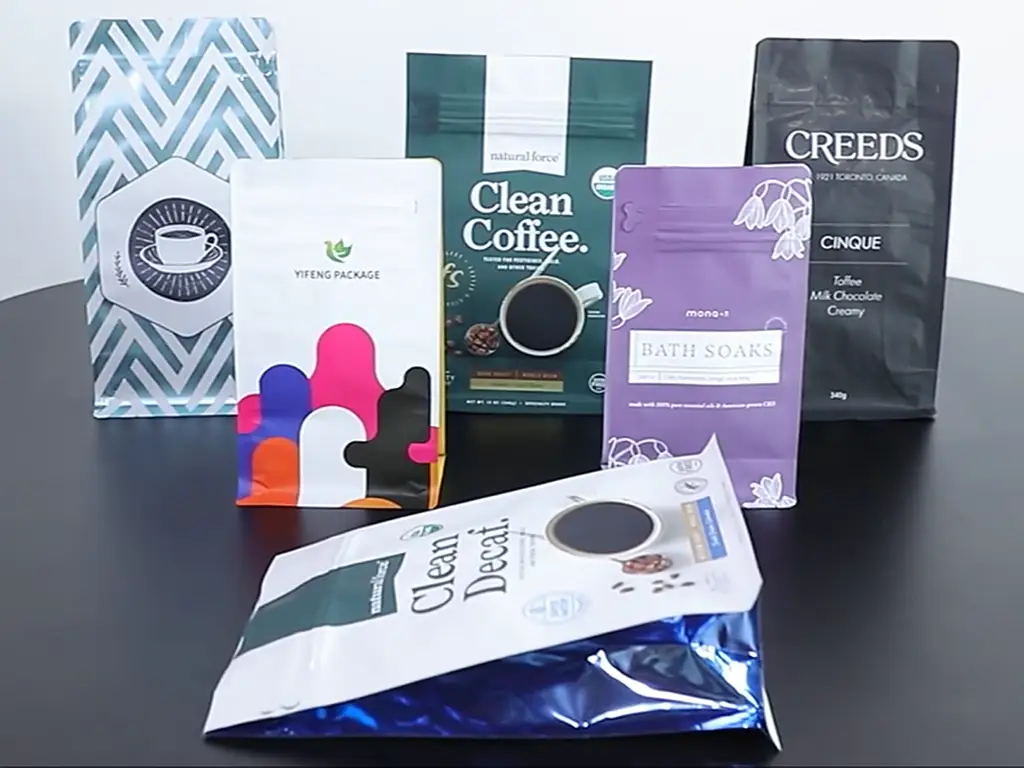
After the roasting process, oxygen, moisture, and light are the biggest enemies of coffee. The packaging is not a minor aspect; thus, it is important in the preservation of the flavour and aroma of the beans. A 12 oz coffee bag of high quality must possess a number of characteristics.
Optimal bags are those made using multi-layer films that form a high barrier in regard to environmental factors. Layers of foil, PET (polyethylene terephthalate), and LLDPE (linear low-density polyethylene) are commonly used as materials. The foil layer is better at resisting oxygen and light. One of the most important is the single-way degassing valve. Fresh coffee is roasted, and a few days later, it releases carbon dioxide, and this valve will help the CO₂ escape outside the bag without oxygen coming in, and the beans are not exposed to oxidation.
Lastly, an effective resealable fastening is essential, e.g., a zipper or a tin tie. After the bag has been opened, the fact that the bag can be closed tightly reduces the exposure to oxygen that follows afterwards, implying that the shelf life of the coffee is greatly increased. To any serious coffee drinker, the packaging is a straightforward test of the quality that is delivered by the roaster.
If you want to know more information about coffee bag materials, you can read our other blog: Top 7 Types of Coffee Bag Material and Their Pros and Cons.
Maximizing Your 12 oz Coffee Bag: Tips and Tricks
To maximize the value and pleasure of your purchase, you may consider the following practices:
- ● Buy Whole Beans: Pre-ground coffee contains exponentially higher amounts of surface area to oxygen and becomes stale much quicker. The best brew method is to grind before brewing, which is the best thing you can do to improve flavor.
- ● Store Properly: Store the bag in a cool, dark, and dry location such as a pantry. The refrigerator or freezer should be avoided because the condensation may add moisture and destroy the beans. The original packaging should be used when it is of good quality and resealable.
- ● Measure Accurately: Use a digital scale to weigh your coffee and water. Only in this way can it be guaranteed that the ratio is steady day by day. It enables you to grind the exact amount of grams of coffee, medium or fine, that you require, and none of it goes to waste.
- ● Adjust and Refine: If your coffee is weak, you can use a finer grind to increase your dose, or use a larger scoop. Adjusting these factors saves a lot of coffee.
Conclusion
How much coffee is in a 12 ounce bag of coffee beans? The short answer is that it is between 20 to 40 cups of filter coffee or French press coffee. The bag is not as important as the brewer in dictating this range.
How many cups you get will depend on your ratio of coffee vs water, the size of your daily cup of coffee, and your brewing method. For a lot of people, understanding and controlling these different factors allows you to predict how your supply will last and perfectly tune the perfect cup to your tastes. That 12 ounce bag has the potential to be transformed into 20 bold mugs, or 40 delicate cups — it is your decision.
FAQs
What is the most popular size of coffee bags?
The 12-ounce (340g) bag is the most sold retail size of specialty coffee, then the 16-ounce (1 lb) bag.
How many cups of coffee can you get out of a 12 oz bag?
As a rule, one can have 20-40 cups, depending on your strength preferences, as well as the cup size you choose.
How long does a 12 oz coffee bag stay fresh after opening?
To have the best taste, it is advisable to drink the coffee within 2-3 weeks of the time the bag. It can be stored in a cool, dark place in an airtight container to assist in preserving its freshness.
Is 12 ounces of coffee a lot?
For an individual who drinks one cup of coffee per day, a 12-ounce bag will last for approximately one month, making it a very common and manageable quantity.
How many cups of coffee does a normal bag make?
Suppose the weight of an average bag is 12 ounces and the weight of an average cup is 8 fluid ounces, then it will produce about 23 cups of medium strength coffee.
What is the best way to store a 12 oz coffee bag?
It is best to keep the beans in the original bag, resealable, provided the coffee bag has a valve that allows the gases to release the gases. Get out as much air as you can and then seal it and keep it in a cool, dark cabinet without heat or moisture.