
The packaging supply chain is difficult to navigate. To the procurement managers and brand owners, the transition from rigid packaging (like plastic bottles or cans) to flexible pouch packaging is not merely a change of design, but a change of the logistics, cost structures, and material science.
This manual is a technical summary of flexible pouch packaging. We are going to break down the terminology, examine the cost drivers, and discuss machinery optimization and manufacturing peculiarities that make a project successful or unsuccessful. This is aimed at providing you with the knowledge needed to make informed choices when sourcing packaging solutions for food products, beverages, or consumer goods.
Flexible Packaging vs. Pouch Packaging
Terminology can be a source of friction in the first sourcing stage in the industry. The distinction between the general category and the particular product application is important.
Flexible packaging is the umbrella term often referenced by groups like the Flexible Packaging Association. It is any package or section of a package that can easily be altered in shape. This involves non-rigid materials like shrink sleeves, lidding films, and roll stock applied on Form-Fill-Seal (FFS) machines.
Pouch Packaging is a particular type of packaging. These are ready-made bags which are shaped, closed, and cut by the manufacturer and sent to you to fill.
The following table clarifies the relationship and different types:
| Feature | Flexible Packaging (Roll Stock) | Pouch Packaging (Pre-made Bags) |
| Format | Continuous film wound on a core. | Finished individual bags, including pillow pouches or flat pouches, ready to fill. |
| Filling Equipment | Requires expensive Form-Fill-Seal (FFS) machinery. | Can be filled manually or with simpler weigh-fill machines. |
| Capital Expenditure | High machinery cost; lower per-unit packaging material cost. | Low machinery cost; slightly higher per-unit material cost. |
| Ideal For | High-volume, high-speed automated production lines. | SMBs, co-packers, or brands requiring flexible packaging solutions. |
When you are buying film to use in your own equipment, you are buying Flexible Packaging roll stock. When you are purchasing bags to pack products in, you are purchasing Flexible Pouch Packaging. This manual is devoted to the latter: the ready-to-wear pouch.
Why Switch? Flexible Pouches vs. Rigid Containers
The shift of the rigid packaging (glass jars, metal cans, rigid plastic tubs) to the flexible pouches is not often motivated by aesthetics. It is typically a logistical and financial choice, though there are plenty of other perks.
- The Logistics of Volume
Freight and warehousing are the most immediate effects of the change to flexible pouch packaging. The 1:20 rule is the industry standard comparison. One truckload of flat, unfilled flexible pouches has about the same packaging capacity as 20 truckloads of empty rigid glass bottles or jars.
In the case of a business that is expanding its operations, this math is directly translated to the bottom line and lower costs:
- Warehousing: You take up significantly less space, saving up to 95 percent of storage space.
- Freight: You consume fewer natural resources in transit, resulting in fewer greenhouse gas emissions. This significantly lowers the carbon footprints and shipping costs associated with inbound materials.
- Shelf Impact and Real Estate
The label is restricted to rigid containers. With a bottle, the branding can only be done on the particular area where the label is placed.
Flexible pouches are made using the full package as a canvas. The bottom gusset and side gusset can be printed on the front, back, and bottom. This 360 coverage enables bigger graphics, more detailed nutritional information, and transparent windows that enable the product to demonstrate its quality. The pouch maximizes the visible marketing space in a retail setting where store shelves’ impact is associated with conversion, but does not expand the footprint. This results in excellent shelf appeal.
The Complete Pouch Anatomy: Materials and Components
A pouch is not a monolithic material. It is an engineering marvel, made up of several layers of film bonded to create strong barrier protection. The layers have different functions. This structure will assist you in troubleshooting quality problems and choosing the appropriate specifications for your food packaging.
Material Science: The 3-Layer Lamination Structure
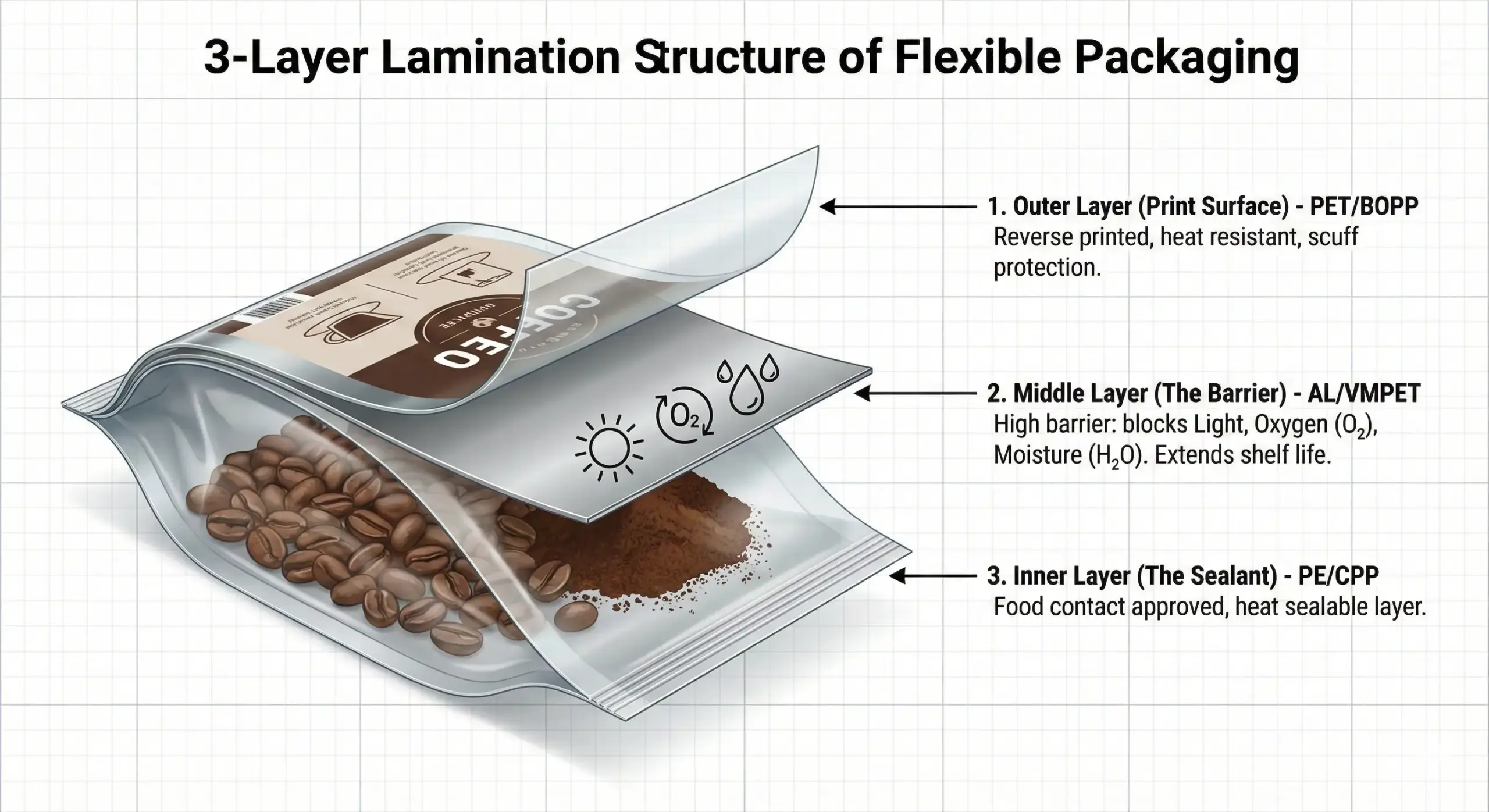
A majority of high-quality pouches are multi-layered. We refer to this as a laminate. The sheets are glued together with adhesives to form one sheet.
- The Outer Layer (Print Surface): Typically of PET (Polyester) or BOPP (Biaxially Oriented Polypropylene). This layer is heat resistant and strong. More importantly, printing is carried out on the other side of this outer layer. This implies that the ink is enclosed between the outer layer and the middle layer, which prevents the design from being scratched or scuffed during transit.
- The Middle Layer (The Barrier): This is the working center of the pouch. In food products that need high barrier protection (coffee beans, pet food, nutritional supplements), this layer may be AL (Aluminum Foil) or VMPET (Metalized PET). This layer prevents light, oxygen, and moisture. It is important to prevent the ingress of oxygen to avoid the rancidity of fats (oxidation) and to prevent the clumping of dry food powders by preventing the ingress of moisture. This directly extends shelf life.
- The Inner Layer (The Sealant): It is typically PE (Polyethylene) or CPP (Cast Polypropylene). This is the only layer that is in contact with food. It should be food-grade certified. It has a major role in structure: as the pouch seams are heated, this layer melts and fuses with the others to form an airtight seal.
Top Features: Zippers, Spouts, and Tear Notches
The consumer experience is determined by the functionality of the pouch upper section.
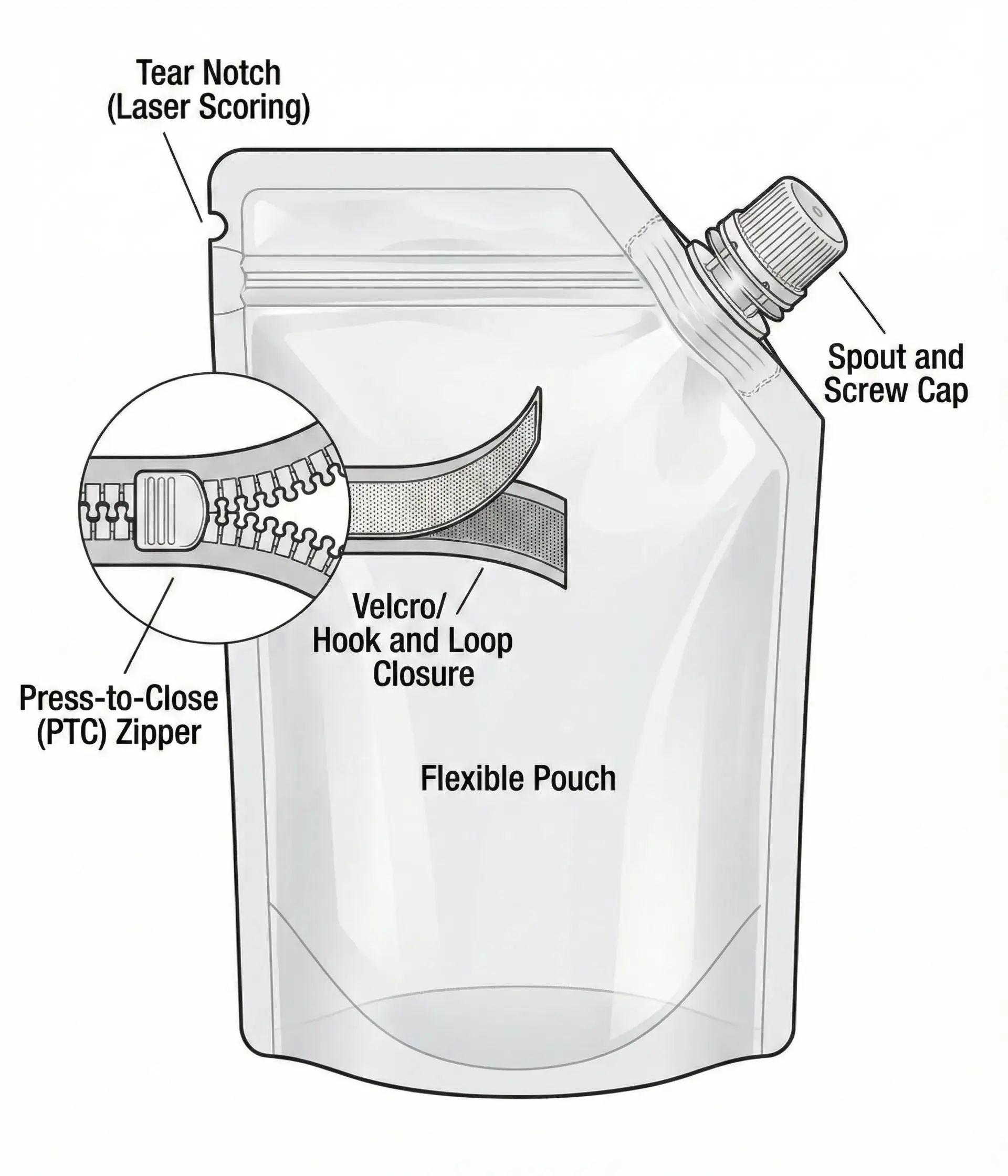
- Resealable Zippers:
- Press-to-Close (PTC): The type of zipper that is used on the majority of snack foods. Reliable and cost-effective.
- Velcro/Hook and Loop: This is necessary with fine powders (protein mixes, flour). Hook and loop closures are also able to close even when particles are present, unlike PTC zippers that may become clogged and fail to close.
- Tear Notches: Little holes on the side that enable the customer to open the package without the use of scissors. Laser Scoring is used in high-end manufacturing to make sure that the tear across the top of the bag is perfectly straight, not jagged, and it does not destroy the branding.
- Spouts and Screw Caps: Plastic attachments that are welded to the pouch. These transform a stretchable bag into a pourable container, which is suitable for liquids, infant food, and automotive fluids. A flexible food service pouch often utilizes these for bulk dispensing.
Bottom Gusset Styles: Comparing K-Seal vs. Doyen
The bottom gusset defines the way the bag will stand on the shelf and the amount of weight that it will be able to hold.
- Doyen (Round Bottom): The gusset is sealed to the front and back panels in a U-shape.
- Pros: Aesthetically pleasing; creates a very stable base for lighter products.
- Cons: Stability is lost when heavy weights (more than 1kg/2lbs) are used.
- Use Case: Snacks, candy, small volume supplements.
- K-Seal: The bottom corner seals are in the shape of K. This relieves the seals of the stress of the weight and puts it on the film itself.
- Pros: Excellent strength; enables the product to lie flat, giving maximum volume.
- Cons: Slightly more industrial look than the Doyen.
- Use Case: Bulk pet food, large bags of rice, heavy granular products.
Manufacturing Process: Printing Technologies and Production
To know lead times and costs, one needs to know the production workflow. The process follows a linear path: Printing → Lamination → Curing → Slitting → Converting (Bag Making).
The decision on printing technology is the most important in this process. This option determines your initial investment and your unit profitability.
| Feature | Rotogravure Printing (Traditional) | Digital Printing (HP Indigo) |
| Mechanism | Physical copper cylinders are engraved for each color channel. | Direct printing from digital files without physical plates. |
| Setup Costs | High. Requires a significant one-time investment in cylinder fees (approx. $150-$200 per color). | Zero. No plates or cylinders are required. |
| Unit Cost | Lowest. Costs drop significantly as volume increases. Ideal for long runs. | Higher. Fixed per-unit cost remains stable regardless of volume. |
| Flexibility | Low. Changing a single letter in the text requires engraving a new cylinder. | High. Designs can be changed instantly. You can print 10 different SKUs (flavors) in a single run. |
| Best For | Mass production (>10,000 units) and complex finishes (metallic, spot matte/gloss). | Market testing, seasonal runs, and startups (<5,000 units). |
Do not consider this as a dichotomy. A large number of them employ a graduation strategy.
- Launch: Begin with Digital Printing to experiment with the market, work out formulas, and provide a variety of flavors with minimum initial risk.
- Scale: When a particular SKU has developed a steady, high-volume sales velocity, convert that particular design to Rotogravure to maximize the margin and minimize unit costs.
Cost Factors: What Influences Your Pouch Price?
The price is not arbitrary when suppliers offer a quote for flexible pouch packaging. It is a computation that is founded on three major drivers. Knowing these enables you to bargain or compromise on your specifications to fit your budget.
- Raw Material Fluctuations
Derivatives of petrochemicals are plastic resins (PE, PET, PP). As a result, the cost of packaging materials is linked to the world crude oil prices. A quote that was given six months ago might not be valid anymore if the oil market has changed. Moreover, the cost is directly proportional to the thickness of the material (in microns). A 10-micron reduction in the layer thickness can be saved, but it must be engineered to ensure that the barrier properties are not affected.
- MOQ and Economies of Scale
The fixed costs of packaging production are high (setting up of machines, waste in the process of calibration).
- When you order 5,000 bags, the setup cost is amortized over a few units, which means that the unit price is high.
- When you order 50,000 bags, the setup cost will be insignificant per unit.
- The cost curve is typically U-shaped; it decreases normally until it reaches a level at the optimum speed of machinery.
- Cylinder Fees
As stated in the manufacturing section, cylinder fees are a single investment. They are, however, specific to the design size and artwork. Even a 10mm change in the size of the pouch or a change of logo will require new cylinders to be engraved. It is thus important to complete artwork and sizing prior to making a commitment to cylinder production to prevent doubling the cost of tools.
Main Categories of Pouch Packaging
The choice of the pouch format depends on the physical condition of the product (solid, liquid, powder) and the type of consumer interaction that is required. Here are typical product applications and types of flexible pouches:
| Pouch Category | Structure Description | Best Suited Applications |
| Stand-Up Pouch (Doypack) | Sealed on three sides with a bottom gusset. Stands vertically. | General Use: Snacks, dried fruit, nuts, candy, small pet treats. |
| Flat Bottom Pouch (Box Pouch) | It has a flat bottom and side gussets. Resembles a box. | Premium/Volume: Coffee beans, premium pet products, bulk granola. Offers maximum shelf stability. |
| Spout Pouch | Stand-up pouch fitted with a rigid plastic nozzle and cap. | Liquids/Pastes: Baby food, fruit puree, automotive fluids, liquid detergents, beverages. |
| 3-Side Seal Pouch (Flat Pouch) | No bottom gusset. Lays flat. | Single Serve: Beef jerky samples, sheet masks, small spice packets, test samples. |
Although these are the conventional types, tailor-made shapes and composite forms can be used. The implication of each format on filling speeds and shelf density is different.
For a detailed visual guide on custom packaging specifications for each type, please refer to our dedicated technical column: Types of Pouches.
Future Trends: Sustainability and Recyclable Materials
The flexible packaging sector is now experiencing the greatest change in terms of sustainability. The conventional sandwich design mentioned above (PET + AL + PE) is very efficient in terms of protection but is infamously hard to recycle. The layers are not easily reprocessable due to the fact that it is a combination of three chemical families.
The industry solution is Mono-material PE/PE structures. This entails designing the whole pouch: outer print layer, barrier layer, and inner seal layer, all made entirely out of Polyethylene (PE). The whole pouch is of the same polymer family and can be recycled in the existing PE streams (like shopping bags).
One should have realistic expectations. Although mono-material technology is being developed, it is not as good as aluminum foil in terms of barrier performance. Mono-material pouches are good for dry goods, snacks, and confectionery. However, they are now grappling with high-temperature (retort/sterilization) or products that need very high oxygen barriers to have a multi-year shelf life.
In the context of sustainability, the discussion should be balanced between environmental objectives and the need to avoid food spoilage that is absolute.
Conclusion: Choosing the Right Manufacturer
The benefits of flexible pouch packaging are quite strong: it is cheaper in terms of logistics, better placed on shelves, and offers better protection to the product. Nevertheless, the technical nature of laminates and printing needs a manufacturing partner that is more of a technical extension of your team, rather than a vendor.
Baishen Pack is in a special place in this landscape. Baishen has been in the business of custom flexible packaging since 2012, filling the gap between the high-volume industrial and the boutique brand demands. Baishen is a one-stop solution that handles the whole lifecycle of converting and printing to international logistics.
- Technological Flexibility: We have both HP Indigo digital presses with low MOQs/rapid prototyping and rotogravure lines with mass production, which helps us to support brands at any stage of development.
- Quality Assurance: Utilizing FDA/SGS certified food-grade materials and rigorous ISO-standard quality controls, we ensure safety and consistency.
- Speed: Digital orders can be completed within 7-10 business days, which is fast enough to enter the market.
If you are evaluating a transition to flexible pouch packaging or looking to optimize your current supply chain, technical validation is the first step.
Contact us today to request a free custom sample kit or speak with one of our packaging engineers about optimizing your material structure for cost and performance.