
Coffee is a volatile, complicated product. The process between the roaster and the cup of the consumer is perilous. In the vast coffee industry, coffee is an agricultural product that is living, breathing, and volatile. Since the exact instant the roasting process is over, a complicated chain of chemical reactions starts, oxidation, degassing, and moisture uptake, which instantly threatens to ruin the flavor profile that roasters have labored so hard to achieve, depending on the specific roast level.
To coffee roasters, co-packers, and specialty coffee brands, the packaging choice of this sensitive product is not just a marketing gimmick; it is an important engineering problem and a business-level choice. The coffee packaging plays a crucial role as a fortress against environmental aggressors, a billboard in a busy coffee marketplace, and a convenient device for the end-user.
The choice of the best coffee packaging solution must be holistic and balanced between three different operational mandates: Physical Protection, Brand Identity, and Consumer Convenience.
Failure in physical protection results in spoiled coffee beans and wasted stock. Branding failure makes the product invisible on the shelf. Failure at convenience disappoints the customer and does not allow him to make repeat purchases. This is a detailed roadmap to the technical and strategic challenges of flexible packaging solutions, material science, and supply chain sourcing to design the ideal solution to your coffee brand.
Key Features of High-Performance Coffee Packaging
In order to know what makes up the best-in-class packaging, we have to know the enemy: environmental instability. Roasted coffee is the only product that is sensitive, unlike dry goods such as pasta or rice, which have a shelf life. High-performance coffee packaging solutions are characterized by their capacity to counter four threats, namely Oxygen, Carbon Dioxide, Moisture and Light, while increasingly addressing consumer demand for sustainable practices.
Oxygen Barrier Technology: Degassing Valves and Hermetic Seals
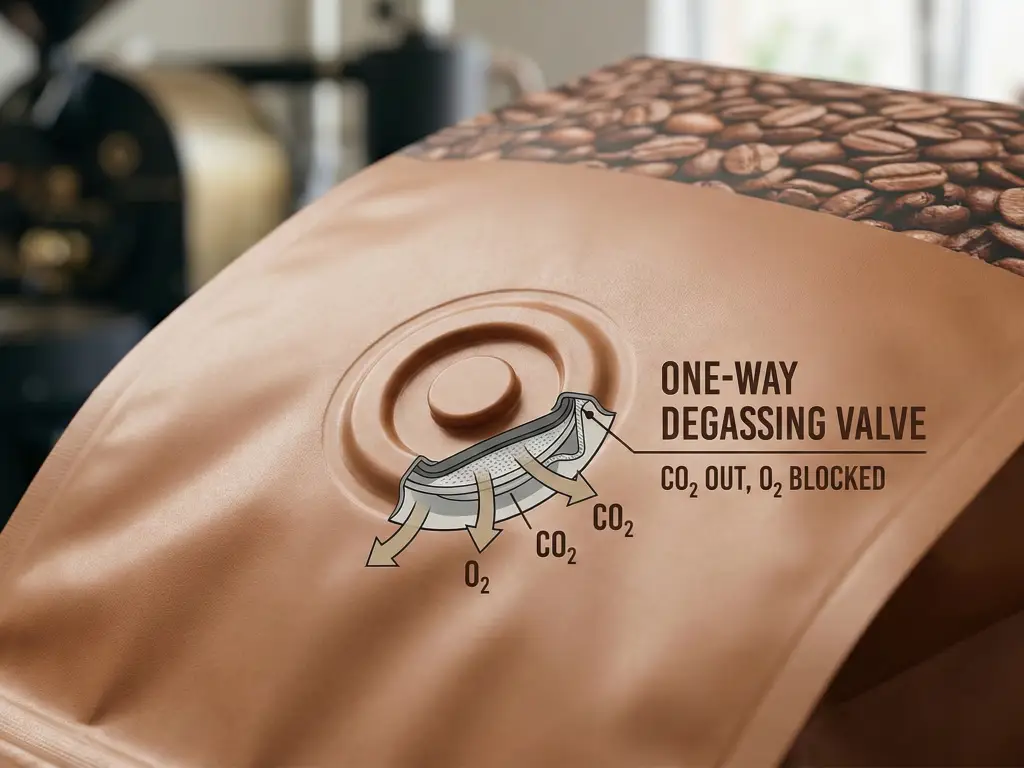
The main factor that causes degradation of flavor in roasted coffee products is oxidation. The oxidation of coffee oils causes them to become rancid, and the fine flavors of the roast are destroyed. Nonetheless, it is not enough to put fresh coffee in an airtight coffee bag since roasted beans release CO₂ +(degassing). This accumulation of gases will lead to the inflation and subsequent bursting of the bag without a release mechanism.
The greatest enemy to coffee freshness is oxidation. When coffee lipids and oils are exposed to oxygen, they become rancid, and the volatile aromatic compounds, which give a roast its floral, fruity, or nutty flavor, evaporate or decompose. Research indicates that ground coffee may lose much of its aromatic strength in a few days, or even hours, when it is exposed to open air.
But it is not as simple as putting fresh coffee in an airtight vacuum bag right after roasting. This is because of the effect of degassing. Coffee beans release carbon dioxide (CO₂) as a byproduct of the Maillard reaction after roasting. A typical 12oz package of fresh roasted beans has the capacity to emit CO₂ to the extent of filling the bag like a balloon. The internal pressure will lead to the rupture or breaking of the seal without a release mechanism.
The One-Way Valves are the industry-standard solution.
- The Mechanism: This is a small injection-molded part that usually comprises a valve body, a rubber disc or oil-sealed membrane, and a filter. It is heat sealed on the bag laminate film.
- The Function: As the internal pressure of the CO₂ accumulates, it forces the rubber disc open, and the gas escapes. More importantly, once the pressure is equalized, the valve will close, and no outside oxygen will get into the bag.
- The Value: The technology enables roasters to package coffee right after roasting (sealing in the best flavor) without the danger of bag explosion. This is an ingredient that cannot be compromised by any brand that sells whole bean or fresh ground coffee to maintain coffee quality.
The Hermetic Seal is above the valve. The top seal (applied after filling) and the bottom and side seals of the manufacturer must be perfect. Good packaging production means that the sealing jaws are used to provide uniform pressure and heat, which forms a bond that is not permeable to microscopic leakages to ensure food safety. A pinhole leak can even balance the internal atmosphere with the outside environment, making the valve useless.
Moisture Control and Seal Integrity
Roasted coffee is hygroscopic, that is, it easily absorbs moisture in the air. High humidity increases the rate of chemical degradation and may cause mould growth. The packaging material should possess a low Water Vapor Transmission Rate (WVTR).
Roasted coffee is hygroscopic, i.e., it actively attracts and retains water molecules in the surrounding environment. This is a major risk in humid climates or when transporting ocean freight.
- The Risk: Higher moisture levels in roasted coffee will speed up chemical degradation (staling) and, in the worst-case scenario, provide an environment that supports the growth of molds and the formation of mycotoxins.
- The Barrier Requirement: Simple kraft paper or polyethylene (PE) are standard porous material with high Water Vapor Transmission Rates (WVTR). They breathe, and this is a disaster to the shelf life of coffee.
- The Solution: High-performance packaging involves the use of high-barrier interlayers. The gold standard is aluminum foil, which has a WVTR of practically zero. In the case of brands that do not want to use metal, high-barrier metallized polyester (VMPET) or EVOH (Ethylene Vinyl Alcohol) coating is used to form a “moisture lock.” However, with the rise of sustainability goals, many brands are now exploring sustainable and recyclable materials that still offer decent barrier protection while reducing the environmental impact and carbon footprint.
Multi-Layer Materials to Prevent Oxidation and Contamination
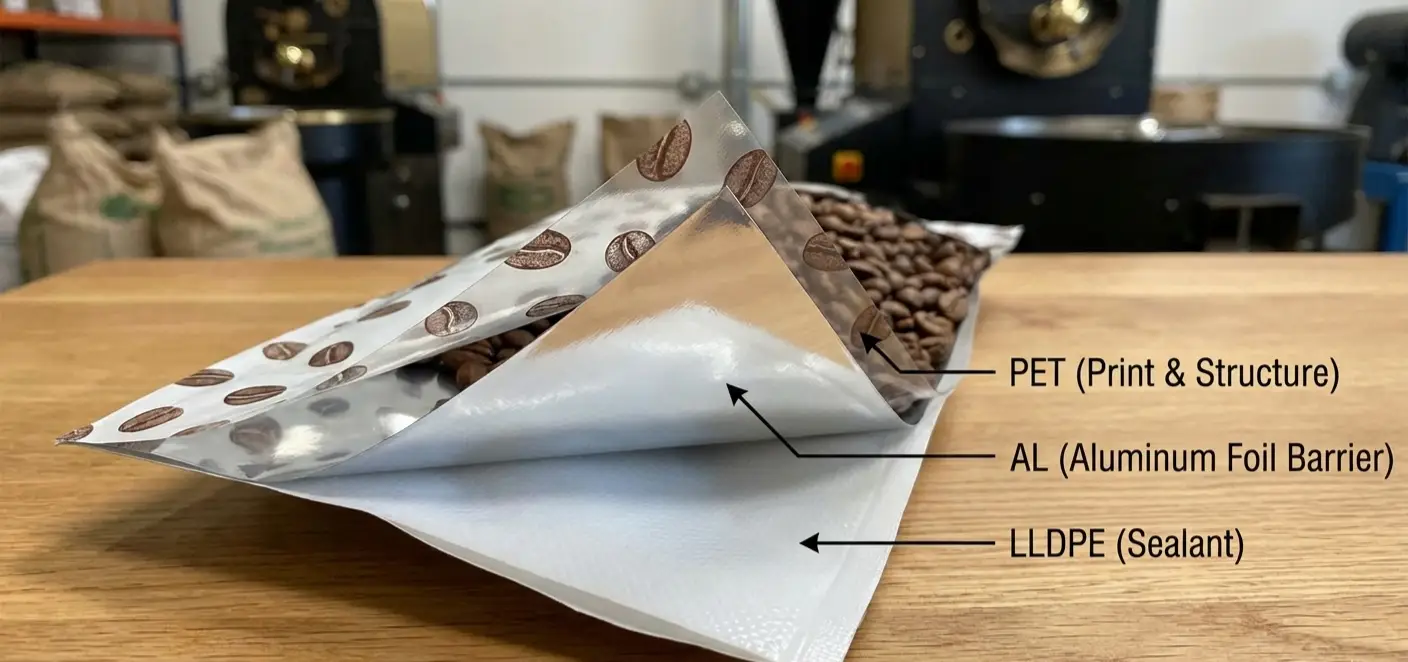
Modern flexible packaging is based on Laminated Structures to provide the wide range of physical properties needed, including strength, sealability, printability, and barrier protection. This is done by gluing several layers of composite materials that are different to form one sheet.
An average high-quality coffee bag design (e.g., PET/AL/PE) works in the following way:
The Outer Layer (Print & Structure)
It is typically composed of Polyester (PET) or Biaxially Oriented Polypropylene (BOPP). This layer is very strong in tensile strength, heat resistant (to ensure that the sealing jaws do not melt the bag), and smooth to allow high-resolution rotogravure or digital printing.
The Barrier Layer (The Shield)
Sandwiched in the middle is the barrier material.
- Aluminum Foil (AL): The ultimate barrier. It prevents 100 percent of oxygen, moisture, and light. It is stiff and has a dead fold shape.
- Metallized PET (VMPET): A plastic film that has been sprayed with a thin coating of metal. It is less expensive and more adaptable than foil but has a little less (but normally adequate) barrier quality.
- ALOX/SIOX: Transparent high-barrier coatings are used when a window is required, though less common in premium coffee due to light sensitivity.
The Inner Layer (The Sealant)
Typically Linear Low-Density Polyethylene (LLDPE). A plastic film that has been sprayed with a thin coating of metal. It is less expensive and more adaptable than foil but has a little less (but normally adequate) barrier quality.
This compound structure guarantees that the coffee only reacts with food-safe plastic and is shielded by the structural and barrier layers.
Light Resistance and Anti-UV Properties
Although a clear window on a coffee bag may be attractive to enable consumers to see the quality of the coffee, it is operationally disadvantageous to the product. Photodegradation catalysts are ultraviolet (UV) and visible light. The energy of light decomposes the fats, vitamins, and proteins in the coffee bean and results in the quick formation of off-flavors, commonly referred to as skunky or flat.
This is why 95 percent of the premium coffee packaging is completely opaque. When a brand wants the look of natural paper, a plain paper bag will not be enough. Kraft Paper Laminate is the solution. This type (e.g., Kraft/VMPET/PE) gives the feel and appearance of paper on the surface, but uses the metallized layer hidden in the middle to ensure that the rays of light are completely blocked. This will make sure that the packaging design does not affect the chemical stability of the roast and the quality of your coffee.
Matching Packaging Solutions to Specific Coffee Forms
The product has ceased to be confined to whole beans in the varied terrain of the contemporary coffee industry. The coffee brands are expanding into ready-to-drink (RTD) liquids, concentrates, single-serve pods, and steep bags.
In manufacturing and engineering terms, there is no such thing as a universal package. The mechanical properties, packaging solution, and points of interaction with consumers depend on the physical form of the coffee, which can be solid, powder, or liquid.
Whole Bean and Ground Coffee: Essential Air Protection
To the traditional heart of the coffee market, the major dilemma is the ability to balance shelf presence and volume efficiency.
Flat Bottom Bags (Box Pouches)
The Profile: This is generally regarded as the high-end specialty coffee. It is made with a flat bottom and gussets on either side, so that it stands erectly on store shelves, even when of a lightweight.
The Advantage: It has five printable surfaces (Front, Back, Side Left, Side Right, Bottom), which maximizes branding space. The box shape is also economical in shipping since it can fit more units in a carton than the irregularly shaped bags.
Side Gusset Bags
The Profile: The traditional coffee packaging classic. It swells as it is filled, but tends to need the pressure of the coffee to support itself.
The Advantage: It is very cost-efficient when it comes to larger quantities (1kg / 2.2lb or wholesale quantities). It is easy to palletize. It usually does not have an inbuilt zipper, however, and may need a tin-tie or adhesive tape to be resealed by the consumer, with a lower barrier to opening.
Stand-Up Pouches (Doypacks)
The Profile: This is an oval-shaped pouch with a tapered top.
The Advantage: Smaller retail sizes (12oz / 250g) and sample packs are very popular on retail shelves. They are easy to wear, nearly always have a zipper, and are cheap to produce.
Quad Seal Bags
The Profile: This is like the side gusset bags except that it has seals on all four corners, which makes it have a stronger structure that maintains its shape better than the normal side gusset bag.
In the case of Ground Coffee, increased surface area is a challenge. The oxidation of ground coffee is exponentially higher than that of whole beans. Thus, pre-ground coffee packaging frequently involves the use of Vacuum Brick Packs (must use high-nylon content film to withstand puncture under vacuum) or Nitrogen Flushing pouches in which the remaining oxygen content is mechanically lowered to less than 1 percent at the time of filling.
Liquid and Cold Brew: Spouted Pouches and Durability
The liquid concentrate and Ready-to-Drink (RTD) cold brew is the fastest-growing coffee industry segment. In the past, this market used glass bottles or hard plastic. Nevertheless, there is a colossal change to flexible Spouted Pouches, which is motivated by e-commerce and sustainability logistics.
- Logistical Superiority: A glass bottle is heavy and fragile. It is not efficient to ship water (coffee) in heavy glass. A flexible pouch is light and strong. It greatly lowers freight expenses and breakage rates in e-commerce for the last-mile delivery.
- Barrier Performance: A spouted pouch can be constructed using aluminum foil layers, unlike clear PET bottles. This gives complete light protection, which is essential in avoiding oxidation in cold brew concentrates that could be stored on shelves for months.
- Thermal Processing: Spouted pouches of high quality are designed to resist different filling temperatures. Regardless of whether the process is done by using Hot Fill (pasteurization) or Cold Fill (High-Pressure Processing – HPP), the adhesive and film structure should be selected to avoid delamination under thermal stress.
In the case of liquid coffee, seal strength and the burst strength are the most important quality control parameters. The pouch should withstand the pressure of the liquid during transportation without leaking at the spout insertion point or the bottom gusset.
Single-Serve Formats: Drip Bags and Capsule Lidding
The convenience trend has blown up the single-serve format market, which demands a very specialized coffee packaging.
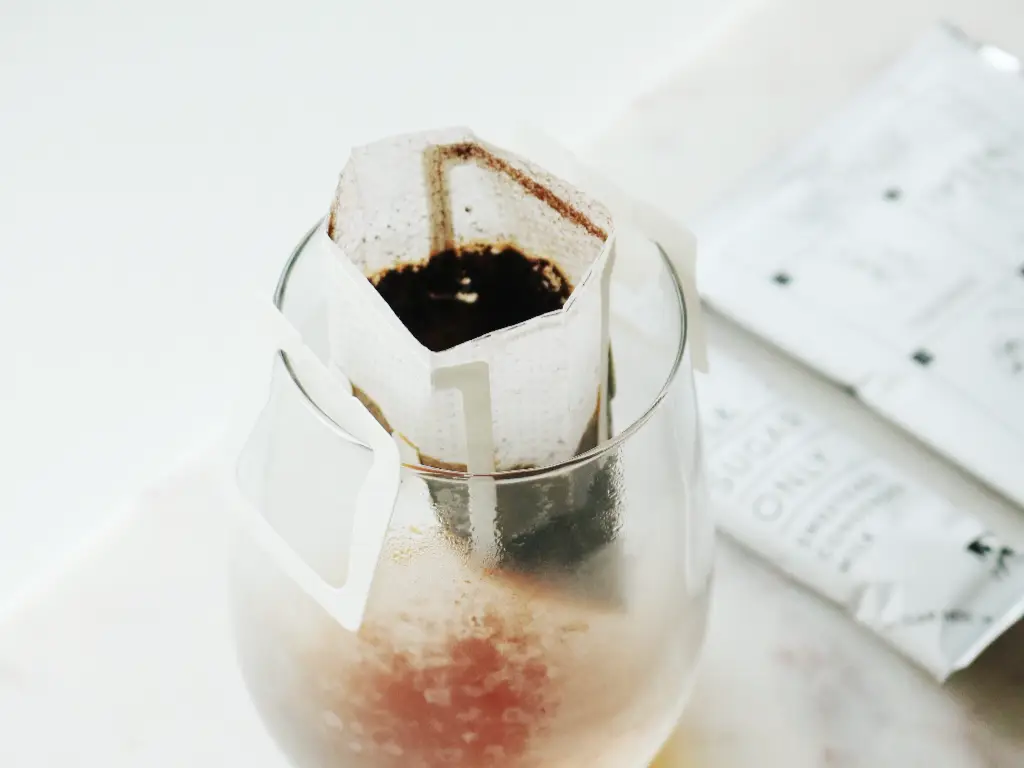
- Drip Coffee Bags: It is a product that has a two-packaging system. The inner bag is a porous filter (non-woven fabric). The filter, however, has zero protection. This is the outer sachet that is the only barrier between the fresh coffee and the air. It should be made of high-barrier Rollstock (e.g., PET/AL/PE) and nitrogen flushed. When a brand is packaged in low-barrier material on the outer sachet, the single-serve product will become stale in less than two weeks.
- Capsule Lidding: In the case of K-Cup or Nespresso-compatible pods, it is the Lidding Film that is of interest. This is a complicated equilibrium of physics. The film should be tightly sealed to the capsule body (Polypropylene or Aluminum) to avoid oxidation within 12-18 months. It should, however, be fragile enough to be easily pierced by the needle of the coffee machine when extracting it. This exact functionality is attained with specialized rollstock using engineered peel strength lacquers or different thicknesses of aluminum.
Elevating Brand Aesthetics with Coffee Packaging Design
After the technical specifications are achieved, the packaging has to carry out its marketing role. Structural innovation, graphic fidelity, and tactile finish determine shelf impact and help tell the brand story.
The Digital Printing Technology has transformed the way coffee shops and brands design. In the past, high-quality printing (Rotogravure) used costly metal cylinders (plates) per color. This implied high setup costs and high Minimum Order Quantities (MOQs), which restricted design changes.
Digital printing (with technologies such as HP Indigo) does not use plates at all. The computer is connected to the press, and the design file is transferred to the press.
- High-Definition Imagery: Digital presses can reproduce photo-realistic images, complex gradients, and small text with perfect registration.
- Unlimited Variations: A brand can print ten different SKU designs (e.g., Ethiopia, Colombia, Brazil) in a single run without stopping the machine.
- Rapid Response: Seasonal blends (e.g., “Holiday Roast”) or Limited Edition collaborations can be produced in days rather than weeks.
This feature enables small and medium-sized brands to compete aesthetically with multinational companies, making their packaging look like it is of high quality of the beans contained.
Smart Sourcing Strategy: Balancing Cost, MOQ, and Quality
In the case of new and developing coffee companies, finding effective coffee packaging is as significant as procurement strategy. The financial calculation that affects profitability is balancing unit cost, cash flow, and inventory risk.
Low MOQ Advantage
Minimum Order Quantity (MOQ) is usually the largest obstacle to the entry of new coffee brands.
A conventional factory may require 20,000 bags per SKU as an MOQ. In the case of a startup that has 4 roasts, this would require the purchase of 80,000 bags initially. This commits huge capital in stock that may be stored in a warehouse and may become obsolete (e.g., when FDA regulations are changed or the logo is redesigned).
When a supplier of Low MOQ Digital Printing is sourced, the math is different. Brands have the option of ordering as few as 500 or 1,000 bags. This changes the expenditure model of CapEx (Capital Expenditure) into OpEx (Operational Expenditure). It enables A/B testing of various designs to determine the right coffee packaging.
Scalability
Growth is accommodated by a strategic supplier relationship. A brand can begin with digital printing because it is flexible. When the sales volume reaches tens of thousands of units per SKU, the supplier must provide an avenue to shift to Rotogravure or Flexographic printing. These conventional approaches have lower unit costs at large volumes.
A smart sourcing partner is one which is capable of managing the lifecycle of a brand.
- Phase 1 (Launch): Use Digital Printing for low volumes (500-5,000 units). Higher unit price, but zero plate fees and low risk.
- Phase 2 (Growth): Once a particular blend (House Blend) is gaining momentum and volume reaches 20,000+, the supplier can move that particular SKU to Rotogravure printing. This reduces the unit price to a large extent, which justifies the initial plate cost.
- Phase 3 (Diversification): The brand continues with its core products on Rotogravure but with Digital on seasonal, limited production.
The collaboration with a manufacturer such as Baishen Pack, which has both digital and traditional capabilities, will guarantee a smooth transition without the necessity to requalify new suppliers or materials.
Cost-Effectiveness and Total Cost of Ownership
In the assessment of suppliers, do not consider just the Price Per Bag. You need to compute the Total Cost of Ownership.
- Warehousing: Storing 50,000 bags costs money in rent and climate control.
- Obsolescence: When you are forced to dispose of 10,000 bags due to a change in design, your cheap bag has now become extremely costly.
- Lead Time: When a supplier takes 8 weeks to deliver, you may run out of coffee, which will cost you revenue. A supplier that has a 10-day turnaround will enable you to run on a Just-in-Time inventory model, which will enhance cash flow.
Ensuring Product Integrity During Distribution
The supply chain is a rough environment. Coffee packaging should be able to resist vibration, compression, and temperature changes during transportation.
Puncture Resistance and Physical Strength
In the case of e-commerce sales, whereby the individual bags are delivered via mailers, the physical strength of the film is the most important. An ordinary PET/PE structure might not be adequate.
The laminate structure is enhanced with a layer of Nylon (OPA) that greatly enhances puncture resistance and tensile strength. This helps to avoid bursting of the bag in case it is dropped or when the edges of the coffee beans are sharp, and they are pressing against the film. In the case of bigger bags (1kg+), drop testing is a common quality control measure to make sure that the seals and the material can withstand the impact.
Tamper-Evidence
Perception of consumer safety is essential. Tamper-evident features should be included in the packaging.
- Heat Seals: A heat-sealed header on top of the zipper ensures that the product has not been opened since it was at the roastery.
- Tear Notches: Precise laser-scored or mechanical tear notches allow the consumer to open the heat seal cleanly without destroying the zipper or the bag structure.
These characteristics give visual assurance of integrity, which establishes trust between the brand and the consumer.
Conclusion
The best coffee packaging is not necessarily the one that has the most appealing artwork. It is a computed amalgamation of material science, structural engineering, and supply chain strategy. It demands a high-barrier laminate to maintain volatile aromatics, a format that is appropriate to the particular state of the coffee (bean, ground, or liquid), and a production process that is consistent with the financial phase of the business.
In the case of contemporary coffee brands, the capacity to switch gears fast and create high-quality, sustainable packaging in lesser amounts is a competitive edge. It enables freshness not only in the product, but in the customer experience.
Partnering for Success
Baishen Pack stands at the intersection of manufacturing expertise and digital innovation. With over 15 years of industry experience, we offer a comprehensive suite of flexible packaging solutions—from high-barrier Mylar bags and flat-bottom pouches to spouted pouches and rollstock. Our investment in HP Indigo digital presses enables us to offer industry-leading low MOQs, helping brands of all sizes launch faster and scale smarter. Combined with our ISO and BRC-certified food-grade materials, we ensure your coffee is protected by global safety standards while looking exceptional on the shelf.
Ready to elevate your coffee packaging? Contact our engineering team today to discuss how we can tailor a solution that protects your roast and amplifies your brand.