Effective dry food packaging solutions begin with the product’s failure mode, not a catalog of bag shapes. Crackers and powders need moisture control; nuts, coffee, and pet treats may need stronger oxygen and aroma protection; spices can also lose color and volatile flavor compounds through light exposure. The package must maintain those qualities through filling, transport, storage, opening, and—when a zipper is used—repeated consumer access.
This guide connects those needs to barrier structures, pouch formats, closures, testing, food-contact documentation, and production economics. The goal is a specification that a supplier can quote and a quality team can verify, rather than a vague request for a “high-barrier food pouch.”
What Dry Food Packaging Actually Has to Solve
Here, dry food packaging means flexible pouches and rollstock used to pack commercial products such as snacks, cereals, coffee, powders, spices, dried fruit, jerky, and pet treats. The product formulation and process establish the starting condition; packaging helps preserve it. A bag cannot correct a product that entered the pack with excessive water activity, active microbial contamination, damaged fats, or an unsuitable oxygen level.
Three mechanisms commonly drive quality loss:
- Moisture transfer. Water vapor moves in response to the humidity gradient between the product and its environment. Absorption can soften crisp foods and cake powders; moisture loss can harden products that are intended to remain chewy. Water activity, rather than total moisture alone, is the more useful indicator of how much water is available for reactions and microbial growth.
- Oxygen ingress. Oxidation turns nuts rancid, flattens coffee aroma, and bleeds flavor from spices. It’s slow, cumulative, and invisible until a customer tastes it.
- Light. UV degrades color, flavor compounds, and vitamins. That’s why “looks great in a clear window” and “lasts twelve months” can be opposing requirements.
The FDA explains that water activity depends on the vapor pressure of the food relative to water under the same conditions, and that it changes with temperature. Its guidance also emphasizes that formulation and water-binding behavior must be controlled during production and maintained during storage. Microbial stability, sensory quality, oxidation, and texture do not share one universal threshold, so the target must be established for the actual product rather than copied from another dry food.
Packaging therefore protects an established product state; it does not create that state. The useful design question is how much moisture, oxygen, aroma, and light exposure the product can tolerate over the intended shelf life and distribution climate.
How Barrier Structures Block Moisture, Oxygen and Light
Flexible structures divide several functions across films, coatings, adhesives, and sealants. A printable outer web can provide stiffness and scuff resistance; a foil, metallized film, EVOH layer, or coating can add barrier; and an inner web creates the heat seal and often contacts the food. These functions may be delivered by one coextruded film or by multiple laminated webs. A structure written as MOPP/VMPET/PE is normally read from outside to inside, but the material names alone do not reveal grades, individual gauges, adhesives, barrier values, or seal performance.
The real decisions happen in the middle layer. Four routes dominate dry food, and each one buys something and pays for it:
Aluminum foil laminates: the barrier ceiling
Aluminum foil can provide extremely high oxygen, moisture, aroma, and light barrier when it remains intact. It is often considered for sensitive products and long distribution routes, but it is opaque and can be affected by pinholes or repeated flexing. The finished pouch still includes seals, folds, closures, and possibly a valve, so “contains foil” is not proof of finished-pack performance. Ask for barrier data on the proposed structure and verify flex and leak resistance on converted packs.
Transparent high-barrier: EVOH and coated films
Transparent high-barrier options include EVOH-containing structures and oxide-coated films. Their performance varies with layer thickness, protection from flex damage, temperature, and humidity; EVOH’s oxygen barrier is especially sensitive to moisture unless surrounding layers protect it. If the package needs a window or a fully clear face, request OTR and WVTR at stated conditions that represent the worst expected lane. Do not apply a transmission value from one generic EVOH or coated film to every finished pouch.
PE- or PP-dominant structures: a program-specific route
PE-dominant and PP-dominant structures are designed to align more closely with defined recycling streams, sometimes using compatible coatings or limited barrier components. Whether a complete pouch qualifies depends on the rules of the target program, including thresholds for other polymers, adhesives, inks, zippers, and valves. Barrier performance is also formulation-specific. A shorter target does not automatically make a mono-material pouch suitable, and a longer target does not automatically rule it out; the decision needs measured performance and product testing.
Kraft paper laminates: the organic trade-off
Kraft paper can contribute stiffness, opacity, machinability, and a tactile shelf appearance, but moisture, grease, sealing, and gas-barrier performance depend on the complete coated or laminated construction. Two kraft-look bags can therefore behave very differently. Ask for the full layer structure and recovery route instead of treating the word “kraft” as either a barrier specification or a recyclability claim.
Put the four routes side by side:
Barrier routes for dry food: what each buys and what it costs
| Route | Position in laminate | Strength | Cost / penalty | Fails when | Typical dry food fit |
|---|---|---|---|---|---|
| Aluminum foil laminate | Barrier layer within a laminate | Very high gas, moisture, aroma, and light barrier | Opaque; flex and pinhole risks; recovery route may be limited | Folds, seals, valves, or handling compromise the finished pack | Sensitive products and demanding shelf-life targets |
| Transparent high-barrier | EVOH or coated barrier component | Product visibility with controlled gas transfer | Performance depends on humidity, coating protection, and flexing | Data conditions do not represent the distribution lane | Snacks, dried fruit, granola, and visible products |
| PE- or PP-dominant design | Complete structure designed for a target stream | Potential alignment with a defined recycling program | Qualification and barrier are structure-specific | Other components exceed program design rules | Projects with a named recovery route and validated shelf life |
| Kraft paper laminate | Paper outer plus coating or sealable structure | Tactile appearance, stiffness, and opacity | Barrier, sealing, and recovery depend on the full construction | “Kraft” is treated as a complete technical specification | Bakery, granola, and natural shelf positioning |
The sustainability question has no global answer. Compostable structures, recyclable designs, paper combinations, and conventional high-barrier laminates serve different recovery systems and shelf-life requirements. Name the destination market and intended recovery route, verify the complete package against that program, and make only claims the available evidence supports. Preventing product waste is part of the decision as well: a lighter package is not an improvement if it causes premature staling or rejected shipments.
Structure is the “how well.” The next layer of the decision is “in what shape,” and this is where most first-time buyers either overpay or under-protect.
Send us the product, fill weight, target shelf life, pouch format, and destination market. We will recommend a structure direction and show the material, closure, and test assumptions on the quote.
Request a Structure QuoteMatching Formats and Features to Your Dry Food
Pouch format families: same barrier, different jobs
The format should follow shelf presentation, filling equipment, portion size, and consumer use. Stand-up pouches provide a display panel and can support a zipper for multi-use products. Three-side-seal pouches suit samples, single portions, and compact spice or snack packs. Rollstock feeds horizontal or vertical form-fill-seal equipment and requires specifications for web width, repeat length, unwind direction, core, coefficient of friction, and registration. Flat-bottom and quad-seal bags offer more panels and stability for larger fills. Foil, metallized, clear, paper-look, or PE-dominant structures can be converted into several of these formats; “foil bag” and “stand-up pouch” describe different dimensions of the decision.
A dry food flexible packaging brief should also state fill weight and bulk density. Five hundred grams of dense seasoning and five hundred grams of cereal occupy different volumes and load the seals differently. Confirm headspace, gusset opening, pack-out dimensions, carton fit, and the way operators or machinery handle the unfilled bag. Capacity charts can narrow the first sample size, but only a fill test with the real product confirms it.
Features are convenience — and new failure points
Every feature you add to a pouch is a place where the barrier you paid for gets interrupted:
- Zippers protect the product after opening, but only if the zipper profile, flange anchoring, end seals, and placement suit the film and fill. A closure that feels secure can still leak around its attachment.
- Tear notches and laser scores control the first open. Their position and depth must preserve the top seal and barrier while producing a predictable tear.
- One-way degassing valves let coffee vent CO₂ without pulling air in. No valve on fresh-roast coffee means pillowed bags and stressed seals; the valve, not the laminate, becomes the barrier decision.
- Transparent windows trade barrier for visibility. A window on a light-sensitive product undoes the light protection your foil layer was bought for.
- Seal bands carry stacking, drop, and handling loads. Width, temperature, pressure, dwell time, contamination tolerance, and cooling all influence integrity; there is no universal width that replaces a validated seal window.
Features are bought interruptions. Every zipper, window, valve, tear notch and seal band replaces barrier film with a seal or a slit — treat each one as a spec line to verify on the quote, not a free upgrade to stack.
A complete quotation should identify the proposed structure outside-to-inside, total and individual thicknesses where relevant, finished dimensions and tolerances, seal and gusset geometry, zipper or valve type and position, surface finish, printing route, quantity per design, and the tests or compliance documents included. Baishen’s stand-up pouch options show how one format can combine different structures and accessories, but the final specification still has to be built around the product and filling process.
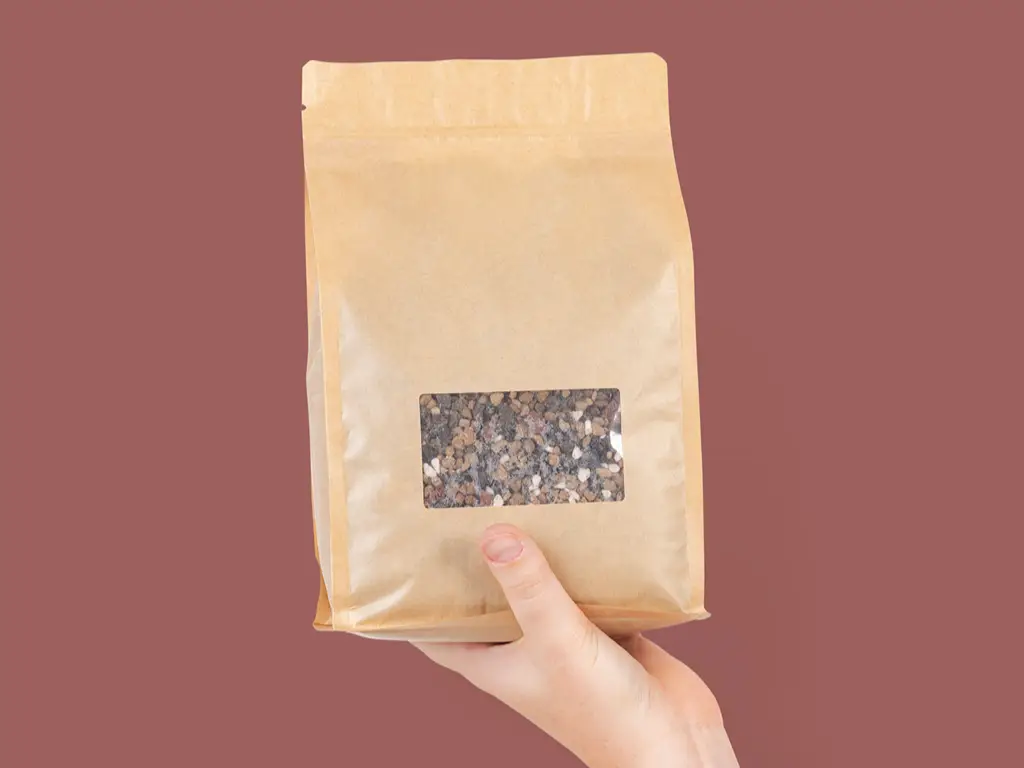
The matching matrix
Now put products, structures, features and failure modes in one place:
Dry food structure, features, and where it fails
| Dry food | Recommended barrier | Key features | Fails when / boundary check |
|---|---|---|---|
| Coffee beans & ground | High barrier selected to the roast and target life | One-way valve when degassing requires it; zipper for reclosure | Confirm valve performance, residual oxygen, finished-pack leaks, and aroma retention |
| Nuts & salty snacks | Foil or EVOH-class high barrier | Nitrogen-flush-compatible seals + zipper | Weak OTR fat rancidity; confirm OTR data, not claims |
| Protein powder & flour | Foil or high-barrier, robust film gauge | Wide seals, sturdy zipper | Moisture caking; check WVTR for humid-climate retail |
| Jerky & meat snacks | Foil laminate, puncture-resistant | Heavy-duty seal bands | Fat migration and odor transfer through weak layers |
| Dried fruit & vegetables | Barrier matched to moisture, oxygen, and light sensitivity | Zipper for multi-use packs | Track texture, color, oxidation, and moisture migration through shelf life |
| Pet kibble | Puncture-resistant structure with suitable fat and aroma barrier | Large-format closure where reclosure is needed | Confirm drop, puncture, seal, odor, and food-contact performance |
| Spices & seasonings | Foil (light barrier) | Small flat formats | Aroma loss via OTR; light bleeds color |
Read row by row, the matrix answers three questions at once. What form does your product need (①)? Where does that choice break (②)? And which line items do you demand on the quote: seal widths, zipper spec, valve, laminate structure (③)? What the matrix can’t answer is whether any of it is true of the bags you’re actually offered. That takes verification.
Verifying Before You Commit
Structure-on-paper becomes structure-in-your-warehouse only through a short, strictly ordered process. Buyers who skip a step usually pay for the whole batch:
Set the target and name the worst lane
Shelf life in months, plus the hottest, most humid route your product will actually take.
Translate target barrier requirement
Ask suppliers for WVTR/OTR test data on the proposed structure, at high RH if your lanes are humid. A claim is not a spec.
Sample with real product
Fill converted samples with the real product and run product-specific shelf-life, seal, handling, and line trials.
Pilot, then scale
A smaller run can verify artwork, converting, filling, and distribution handling before a large inventory commitment.
Shelf-life testing should track the attributes that determine rejection for the product: water activity or moisture, texture, oxidation markers, aroma, color, headspace oxygen, microbial limits where relevant, and sensory acceptance. Real-time testing under the labeled storage condition remains the anchor. Accelerated testing can support development only when the temperature and humidity model has been justified for that food and failure reaction; a generic medical-package aging formula cannot establish a food shelf life by itself.
Barrier numbers also need context. OTR and WVTR reports should identify the test method, temperature, relative humidity, specimen orientation, and units. Compare data from the same conditions, then evaluate the finished package because seals, folds, scores, valves, and repeated flexing can dominate the result. A dry domestic lane can behave differently from a tropical export lane, and an empty-film report cannot predict every interaction with a fatty or aromatic food.
When failures reach the field, sort them by evidence before changing the film. Leakers may trace to seal contamination, wrinkles, punctures, or accessory welds. Stale-but-sealed products may indicate insufficient barrier, excessive initial oxygen, or a product problem. Caking points toward moisture gain but can also reflect the starting water activity and powder formulation. Zipper complaints may come from flange anchoring or from particles trapped in the profile. Retain samples, lot codes, production settings, and storage history so a complaint can be investigated rather than guessed.
Food-contact documents must match the intended use
“Food grade” is not a complete purchasing specification. The FDA separates dry solids with free surface fat or oil from dry solids without it, and its conditions-of-use tables distinguish room-temperature filling and storage from hot filling, refrigeration, freezing, irradiation, and cooking. That matters because authorization and migration support are tied to the material, food type, temperature, and contact conditions. Nuts, jerky, oily pet treats, and low-fat powders should not automatically share the same documentation package.
For U.S. projects, ask for the regulatory basis of the relevant food-contact components and confirmation that it covers the intended conditions of use. The FDA notes that the overall status of a food-contact material depends on the individual substances expected to migrate, including polymers, adhesives, coatings, colorants, and other components. For EU sales, request the declarations and supporting information required for the complete construction under the applicable framework, GMP, plastics, and national rules. A report for the inner PE film alone does not automatically cover the adhesive, ink, coating, zipper, or finished article.
Finally, separate certifications from test reports. A quality-management or packaging-safety certification describes a management system and audit scope. A migration, residual-solvent, seal-strength, or barrier report records a specific material and test result. Request the document name, issuing body, scope, structure code, date, and applicable market before approving production.
Build an RFQ that produces comparable quotes
A supplier cannot price dry food packaging solutions consistently if the brief says only “500-gram stand-up pouch, high barrier.” Start with the food category, surface fat or oil, starting water activity where relevant, fill temperature, fill weight, bulk density, target shelf life, storage condition, and destination markets. Add the pouch style, preferred dimensions or required fill volume, opening and reclosure features, packing method, and any nitrogen-flush or valve requirement.
Next, define the commercial scope. State the total quantity, quantity per design, number of SKUs, forecasted repeat frequency, artwork status, required delivery date, and whether the quote should include cylinders, plates, freight, testing, or samples as separate lines. For rollstock, include the machine type, web width, repeat, unwind direction, maximum roll diameter, core, splice limits, and registration requirements. For premade pouches, include finished tolerances, packing count per carton, and carton or pallet constraints.
Ask each supplier to return the same technical fields: structure and thickness, OTR/WVTR values with test conditions, sealing range or recommended settings, closure specification, print method, test plan, food-contact support, production tolerance, lead time, and change-control procedure. If a supplier proposes an alternative, require the differences to be marked rather than silently substituted. That turns quotations into a like-for-like comparison and prevents a cheaper price from hiding a thinner film, lower barrier, different zipper, or missing report.
The one remaining question is commercial: what does all this look like when you’re not buying one bag, but building a product line or stocking one?
From Pilot Order to Volume Production
Production planning should follow specification maturity as well as demand. A new product may still be changing its formula, artwork, size, or SKU mix; a mature product may have stable forecasts and an established shelf-life file. These two situations should not be forced into the same printing route or order quantity.
Digital printing removes plate or cylinder setup and can make smaller, mixed-design orders practical when the designs share compatible material and dimensions. It is useful for commercial pilots, regional launches, seasonal artwork, and product lines with many flavors. A pilot can reveal problems with artwork, bag conversion, filling, case packing, shipment, and consumer handling. It does not, by itself, validate a twelve-month shelf life.
Gravure or flexographic production can offer better unit economics at sustained volume, but the crossover depends on dimensions, material, colors, quantity per design, repeat frequency, and tooling. Request both quotations against the same approved structure; otherwise a lower unit price may simply reflect a different barrier or gauge.
Two-stage launch math: digital vs. plate printing
Digital trial run
500 pcs
Lead time: 7–10 days
Cylinder fee: none
Mixed SKUs: split-run together
Plate-scale production
Quote by job
Lead time: confirm by specification
Tooling: list separately
Mixed SKUs: price each design
Use the smaller route while specifications or demand are changing; scale when both are stable.
At Baishen, our digital printing service starts from 500 pieces for suitable projects, lists a 7–10-business-day production window, and supports split runs when designs share the same material and size. We can quote that launch route alongside a volume route using the same dry food flexible packaging specification, so the buyer can compare tooling, quantity, timing, and unit economics without changing the barrier construction between quotes.
Whether you’re launching one product or filling a category wall, start from the failure mechanisms, hold the barrier tier to a real shelf-life target, and buy verification before volume. The quotes will sort themselves out from there.
Quote the Trial and the Scale Stages Side by Side
Send us your product details, target shelf life, SKUs, and forecast. We will quote an appropriate launch route and a volume route against the same material specification.
Get a Dry-Food Packaging QuoteReferences
- U.S. Food and Drug Administration. “Water Activity (aw) in Foods.”
- U.S. Food and Drug Administration. “Food Types & Conditions of Use for Food Contact Substances.”
- U.S. Food and Drug Administration. “Determining the Regulatory Status of Components of a Food Contact Material.”
- Türksever, C. et al. “Sustainable Alternatives in Multilayer Packaging: Storage Stability of Pudding Powder Under Accelerated Storage Conditions.”
- European Union. “Regulation (EC) No 1935/2004 on Materials and Articles Intended to Come into Contact with Food.” 2004.