Paper food packaging ranges from wraps and cartons to paper-faced pouches and printed roll stock. The formats look related because paper supplies the visible surface, but they do not protect food in the same way. Fiber type, coating, barrier layer, adhesive, sealant, closure, and intended conditions of use determine whether a package can handle grease, moisture, oxygen, heat, freezing, filling, and distribution.
This guide focuses on retail food packaging—especially flexible paper pouches, bags, and roll stock—and shows how to translate a product’s shelf-life and production requirements into a structure a supplier can quote and document.
What Paper Food Packaging Includes
Paper packaging for food falls into two broad groups. Food-service formats include wraps, liners, cups, trays, takeaway cartons, and bakery sheets designed for service or relatively short contact. Retail formats include folding cartons, paper cans, sachets, flat and stand-up pouches, box-bottom bags, and roll stock that must survive printing, filling, transport, and a stated shelf life.
The paper vocabulary describes different properties rather than guaranteed performance. Kraft paper is valued for strength and a natural appearance. Grease-resistant and parchment-style papers use fiber processing or treatments to control oil and heat. Glassine is dense, smooth, and translucent. Coated paperboard adds stiffness and a printable surface. None of those names alone proves suitability for a specific food, temperature, or storage period.
Food-contact rules apply to the finished use. In the United States, the FDA treats packaging components, coatings, adhesives, and colorants as potential food-contact substances; the regulatory status of the finished material depends on the status and intended use of its components. In the EU, Regulation (EC) No 1935/2004 provides the general safety and traceability framework, while good manufacturing practice and applicable national rules also matter. The European Commission’s food-contact overview explains that material-specific Union legislation covers certain materials, while national legislation applies to others. Paper and board do not have one fully harmonized material-specific EU measure, so the destination market must be checked rather than assuming one document covers every country.
Bare paper can work for selected dry products and short contact, but it usually offers limited resistance to water vapor, oxygen, oils, and sealing heat. For most retail pouches, paper is therefore one part of a coated or laminated structure rather than the entire package.

Choose the Format Before You Choose the Paper Structure
The package format sets the mechanical job the paper-based material has to perform. A wrap bends around food and may never need a hermetic seal. A carton supplies stiffness but often relies on an inner bag. A stand-up pouch must seal, flex at the gusset, support printing, and remain stable on shelf. Roll stock must also run through forming and filling equipment at production speed.
| Format | Best Fit | What Paper Contributes | What Else Must Be Specified |
|---|---|---|---|
| Wrap or liner | Bakery items, sandwiches, short-contact service | Foldability, print surface, handling | Grease resistance, wet strength, contact temperature |
| Folding carton | Cereals, frozen foods, secondary retail packs | Stiffness, stacking, large print area | Whether an inner bag or coating supplies the barrier |
| Flat or stand-up pouch | Coffee, snacks, powders, pet treats | Appearance, stiffness, tactile surface | Barrier film, sealant, zipper, valve, gusset and seal width |
| Box-bottom bag | Coffee, flour, premium dry foods | Paper-bag appearance and broad panels | Bottom-seal design, lining and filling compatibility |
| Paper-faced roll stock | Automated form-fill-seal production | Brand surface within a machineable laminate | Web width, repeat, winding direction, coefficient of friction and seal window |
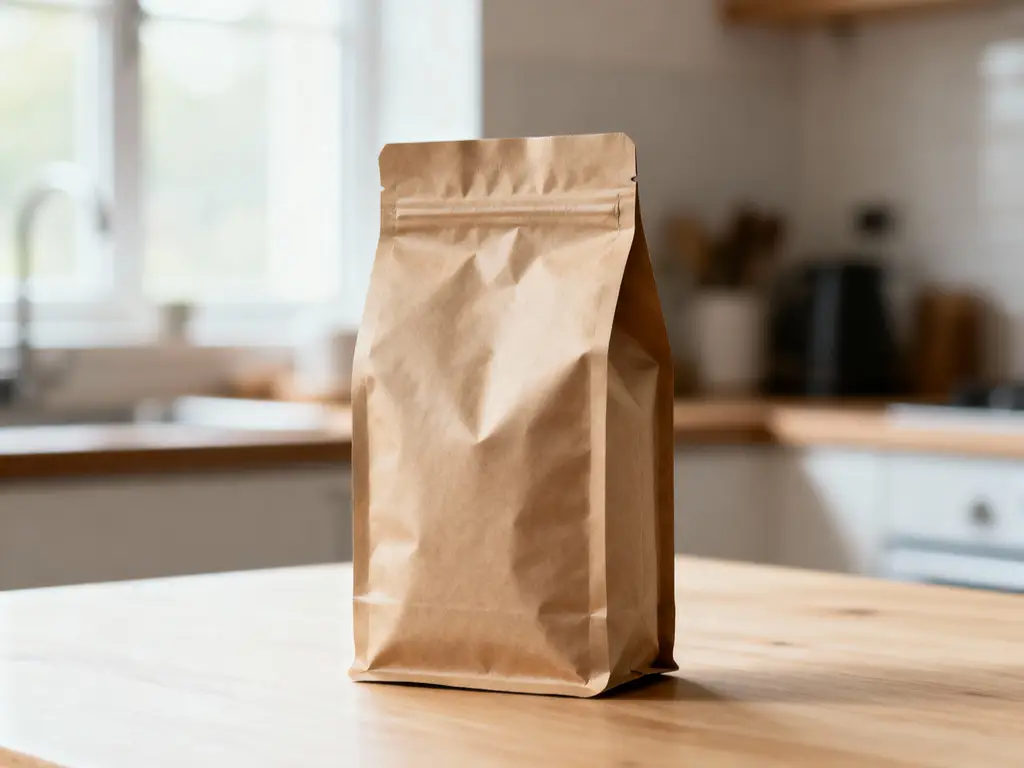
Kraft paper food containers include folding cartons, box-bottom bags, lined pouches, and other formats in which paper provides structure or shelf appearance. They should not be treated as one material category because each format can use a different coating, lining, closure, and food-contact surface.
Before requesting samples, define the product form, fat and moisture content, fill temperature, pack weight, target shelf life, distribution environment, filling method, and sales market. These conditions decide whether the paper needs only a light coating, a heat-seal lining, or a higher-barrier laminate.
Coatings and Linings: Where Paper Packaging Gets Its Barrier
Paper fibers create porosity. Without treatment, liquid, grease, water vapor, oxygen, and aromas can move through the sheet or weaken it. Converters address that limitation in several ways, and each route changes sealing, recycling, appearance, and food-contact documentation.
Kraft Paper for Food Packaging: What the Paper Layer Can and Cannot Do
Kraft paper food packaging is usually a coated or laminated system rather than a package made from paper alone. The kraft layer supplies appearance, stiffness, printability, and a tactile surface; coatings or additional films normally provide the grease resistance, barrier, and heat-seal performance required by the food.
Fiber treatment and sizing improve the sheet itself and may be enough for wraps or short-contact dry foods. Wax or functional coatings can add grease or moisture resistance but may affect printing, heat sealing, repulping, and temperature range. Extrusion or laminated polymer layers provide dependable sealing and stronger moisture resistance. Foil, metallized film, or high-barrier coatings are added when oxygen, light, or aroma protection drives the shelf-life requirement.
The correct question is therefore not “Is the bag paper?” but “What is the complete material structure, and which layer performs each function?” Ask the supplier to identify the paper grade, coating or film, adhesive, sealant, ink system, total thickness, and any barrier values used in the shelf-life design. If a window, zipper, valve, or spout is added, include it in the review because it can change both performance and end-of-life claims.
Grease resistance also deserves a current regulatory check. The FDA states that PFAS-containing grease-proofing substances are no longer being sold in the U.S. market for paper food packaging and that, in January 2025, 35 related food-contact notifications were determined no longer effective because those uses had been abandoned. For U.S.-bound packaging, request the regulatory basis for the chosen grease-resistant treatment rather than accepting a generic “oil-proof” description. The FDA’s PFAS grease-proofing phase-out overview provides the current background.
Barrier values should be tied to test conditions. An OTR or WVTR number without the complete structure, units, temperature, relative humidity, and method cannot be compared reliably. The final acceptance criterion should come from the product’s target shelf life and distribution test plan, not from the most impressive number on a generic data sheet.
The Barrier Ladder: Structure Decides What the Pouch Can Hold
Two products described as “kraft pouches” can use very different coatings, barrier films, sealants, adhesives, and total thicknesses. Those hidden layers affect shelf life, sealing, machinability, recovery options, and cost more than the brown outer appearance does.
Rung 1: Bare and coated paper
Bare or lightly treated paper may suit dry bakery products, tea, wraps, liners, or fast-turning goods when the required contact conditions and barrier are limited. Paper weight is stated in GSM, but a higher GSM does not automatically mean a better oxygen or moisture barrier. Standard paper also lacks a dependable heat-seal layer, so the closure may rely on folding, adhesive, stitching, or a separate sealable coating. Request the paper grade, basis weight, treatment, and intended food-contact conditions instead of choosing by color or thickness alone.
Rung 2: Paper with a lining (the workhorse)
A sealable lining or coating adds grease and moisture resistance and allows the package to close under controlled heat and pressure. PE is common; other sealants or dispersion coatings may be used for particular performance or recovery goals. A zipper can be incorporated into an appropriate pouch construction. Total thickness and layer selection should come from the product and filling process rather than a standard “kraft pouch” recipe.
This rung also creates an environmental-claim boundary. A paper outer layer does not make the finished laminate recyclable, compostable, or biodegradable. The coating, adhesive, zipper, valve, inks, and local collection system all affect the claim. Ask whether the statement applies to the paper component or the entire finished bag and request the test, certification, or recycling pathway that supports it.
The honesty check
Ask which layer the claim covers — the paper, or the finished bag.
Rung 3: High-barrier lamination
Aluminum foil, metallized PET, EVOH, and other barrier technologies can reduce oxygen, moisture, aroma, or light transmission. Products such as oily nuts, coffee, sensitive powders, and some pet foods may need this level, but the correct choice depends on the required shelf life and distribution conditions. Structures such as paper/VMPET/PE or PET/AL/PE illustrate the principle; the actual layer gauges, adhesive system, and sealant must be specified and validated for the product.
The one thing to remember
Same “kraft paper bag,” three structures: bare paper for dry cookies; a PE lining for ground coffee; foil lamination for nuts and wet fills.
Structure, not paper type, decides what a pouch can hold.
Put your own product on the ladder before you talk to suppliers:
| Product | Sensible rung | Boundary to check |
|---|---|---|
| Fast-turning bakery and dry snacks | Rung 1-2 | Any real oil content pushes you to Rung 2 |
| Ground coffee | Rung 2 (PE-lined) plus one-way valve | Aroma loss without valve and barrier |
| Specialty coffee beans, longer distribution | Rung 3 (AL/VMPET) | Oxygen transmission target and valve quality |
| Pet kibble | Rung 2-3 | Fat content at the seals pushes toward Rung 3 |
| Supplements and powders | Rung 3, child-resistant zipper where the market requires | Moisture caking; CR rules by country |
| Nut butters and wet fills | Rung 3 | Greaseproof paper alone will fail |
Over-specifying wastes money exactly where under-specifying loses product. Foil lamination on a fast-turning granola SKU is a donation to your supplier. A PE-lined bag on nut butter is a returns cycle in progress.

Digital or Gravure: Your Quantity Picks the Path
Structure settled, the next fork is production. The same pouch design can run on two different manufacturing systems, and the system you land on decides your minimum order, your setup cost, your calendar, and your unit price.
The two paths, line by line
Print-route thresholds are converter-specific. The table below describes Baishen’s published digital and gravure ranges so buyers can compare like with like; it should not be read as a universal industry standard.
| Factor | Digital path | Gravure path |
|---|---|---|
| MOQ | Baishen: from 500 pieces per SKU | Baishen: typically 5,000-10,000 pieces; project-specific quote |
| Setup cost | none, no cylinders | one cylinder per color per design |
| Turnaround | Baishen: 7-10 working days after approval for qualifying jobs | Baishen: typically 15-20 working days |
| Unit price | higher per bag | lowest per bag at volume |
| Color handling | Full-color digital workflow; confirm achievable brand-color match | Separated colors within available press stations; cylinders follow the artwork separations |
| Multiple SKUs | split-run: several designs share one production run | each design runs separately |
What “Low MOQ” Should Mean in the Quote
A low minimum is useful only when its basis is clear. Confirm whether the quantity is per design, per SKU, per size, or across a split run; whether all designs must share the same material and dimensions; and whether freight, finishing, zipper, valve, or setup charges change at the minimum. Baishen’s digital route starts from 500 pieces per SKU and supports several SKUs in one run when the material and size match. One 30-SKU launch case shows why that matters: digital production avoided a separate cylinder set for every design and allowed the brand to test a wider line before moving to higher-volume printing.
Which path fits your quantity?
Send us the structure, dimensions, SKU count, and target volume. We can compare digital and gravure using the same specification so the price difference reflects the print route rather than a different bag.
Compare Both Print RoutesThree conditions that justify switching to gravure
- One design, frozen, with stable and predictable demand.
- Volume consistently past roughly 5,000 to 10,000 pieces per run.
- Unit cost pressure dominates, typically retail-chain placements.
When all three conditions are present, request a gravure crossover quote and compare the total landed cost. If demand is uncertain, designs change frequently, or SKU quantities differ, digital may still cost less overall after cylinders, obsolete inventory, proofing time, and cash tied up in stock are included.
Reading a Quote: What to Lock Down Before You Pay
Choosing paper for food packaging requires more than comparing color and GSM; buyers also need to specify coatings, barrier layers, sealing conditions, dimensions, and food-contact documentation.
Quotes for what looks like the same bag vary wildly because most of them are not describing the same bag. Four steps keep the comparison honest.
- Freeze the structure in writing. Put the ladder rung, the layer list (kraft/PE or PET/AL/PE, for example), the total thickness, and the exact dimensions into your request. “Kraft pouch, good quality” invites a supplier’s choice; “kraft/PE laminate, 110 microns total, 130×210+40×2 mm” invites a quote you can actually compare.
- Sample against an agreed test plan. Confirm dimensions and print, cycle the zipper, test seals using a defined method, fill the pouch with the actual or representative product, and reproduce the expected temperature and handling conditions. Informal squeeze or drop checks can reveal obvious defects, but they do not replace validated shelf-life, migration, seal-strength, or distribution tests where those are required.
- Verify documents, not logos. Check certificate holder, site address, scope, issuing body, and validity. ISO 9001 indicates a quality-management system but does not by itself prove food-contact suitability. BRCGS Packaging Materials Issue 7 is packaging-specific, yet the actual structure still needs an appropriate regulatory basis and supporting documentation for the intended market and conditions of use.
- Read the hidden lines. Cylinder or plate fees, freight terms, payment terms, and split-delivery options move the real total more than the per-bag price does.
Before comparing price, lock the paper grade and GSM, complete layer structure, total thickness, seal width, zipper or valve specification, dimensions and tolerances, print route, and acceptance tests. Otherwise, the lowest quote may simply describe a different package.
Before you sign
- Structure rung and layer list written into the RFQ
- Total thickness and dimensions fixed
- Closure, seal and handling tests defined for the application
- Actual product and storage conditions included in validation
- Environmental claims tied to the complete structure and destination market
- Certificates verified by holder, site, scope and validity
- Food-contact regulatory basis and supporting documents on file
- Cylinder fees, freight, and payment terms in the comparison
At Baishen Pack, we use the same specification when comparing digital and gravure so the buyer can see what the production route—not a thinner or simpler bag—does to the total cost. Our HP Indigo digital-printing route starts from 500 pieces per SKU and supports split runs when designs share the same material and size. We can also state the paper, laminate, seal, zipper, finishing, lead-time, and sampling assumptions in the quote for direct comparison.
How Paper Packaging Fails (and the Checks That Catch It Early)
Failure in paper-based pouches is not random. It repeats in five patterns, and each has a checkpoint that catches it before your customers do.
Grease staining or soft paper indicates that the product, humidity, or contact time exceeded the coating or lining’s resistance. Correct the material structure and validate it with the real food under the expected temperature rather than relying on a dry empty sample.
Zipper and opening failures come from dimensional variation, poor alignment, weak end seals, or a closure incompatible with the pouch and filling method. Specify zipper type and position, opening force where important, and the acceptance method. Child-resistant closures require the relevant market-specific evaluation; width alone does not establish compliance.
Seal splits, channels, and delamination occur when temperature, dwell time, pressure, contamination, adhesive cure, or laminate design falls outside its working window. Record the filling-line settings used for qualification and define seal-strength, leak, burst, or drop tests appropriate to the package. Pay particular attention to gusset intersections, zipper ends, valves, spouts, and other areas where multiple layers meet.
Staling and aroma loss mean the oxygen, moisture, or aroma barrier is insufficient for the required shelf life—or that leakage through seals and closures bypassed the film barrier. OTR and WVTR values are useful only when the units, temperature, relative humidity, test method, and complete structure are stated. Convert the shelf-life target into a validated barrier specification instead of using one universal “high barrier” threshold.
Unsupported environmental claims arise when “paper,” “recyclable,” “compostable,” or “biodegradable” describes only one layer or ignores local infrastructure. The FTC Green Guides summary advises against broad unqualified environmental claims and explains that compostable and recyclable claims require specific substantiation and qualification. Review the complete package—including coatings, adhesive, zipper, valve, and ink—before approving front-of-pack language.
Assign every failure to the right party. If the structure was too light for the product, that is a selection error, yours or your supplier’s advisory failure. If a zipper fuses shut or a seal splits at the specified settings, that is a manufacturing defect and it belongs to the supplier’s QC. Naming the category correctly is what turns a complaint into a fix.
| Product type | Sensible structure | Where it typically fails | Check before shipment |
|---|---|---|---|
| Dry bakery, fast turnover | Bare or PE-lined kraft | Grease bleed on oily inclusions | Overnight oil-hold on the sample |
| Ground coffee | PE-lined kraft plus one-way valve | Aroma loss, valve failure | Valve function check, seal squeeze test |
| Specialty coffee, long shelf life | AL or VMPET laminate | Oxygen creep past spec | OTR spec on file, batch seal test |
| Pet kibble | Lined, laminate if high-fat | Fat migration at seals | Seal width at or above 7-9 mm, fat-hold test |
| Supplements and powders | VMPET laminate, CR zipper where required | Moisture caking, CR mechanism failure | Moisture test, zipper cycled 20 times |
| Nut butters and wet fills | Full laminate | Grease through the lining | Warm oil-hold test, drop test on filled pouch |
Run the last column against every production batch and the five failure patterns stop reaching your customers.
Stocking by Structure, Not by Bag Shape
If you distribute or wholesale packaging, the stocking question usually gets asked wrong: which shapes to carry. Stand-up, flat, box-bottom; that is merchandising. The structural rung is what sets your risk, your turns, and your margin, and the market keeps confirming the category is widening underneath you.
Volume belongs in Rungs 1 and 2: flat pouches and basic kraft/PE stand-ups. Unit costs are low, shelf-life promises are forgiving, and the buyer base is wide, from granola and bakery brands to tea sellers who reorder steadily. Writeoff risk on this stock is the lowest in the category, which is exactly what you want under your highest-velocity SKUs.
Margin belongs in Rung 3 plus functional zippers: high-barrier laminates, child-resistant closures, small-batch digital runs for brand tests. The lamination spec, the seal windows, the CR mechanics, and the color management behind these cannot be price-shopped out of a quote, which is precisely why they defend your margin. The 500-piece digital tier doubles as your client-acquisition instrument. A brand’s first test order costs it very little, and the relationship compounds. When one of those designs stabilizes past the 5,000-10,000-piece threshold, the account upgrades naturally. Quoting that switch point with the client’s own volume numbers is the strongest renewal conversation you can have.
Stock the volume tier
Rungs 1-2: flat pouches, basic kraft/PE stand-ups
Low unit cost, forgiving shelf-life promises, wide reordering buyer base — the lowest writeoff risk in the category, under your highest-velocity SKUs.
Stock the margin tier
Rung 3 + CR zippers: high-barrier laminates
Engineering that cannot be price-shopped. The 500-piece digital entry upgrades past the 5,000-10,000-piece threshold.
Two disciplines make the whole approach pay. Quote by structure parameters, not by bag shape: rung, layers, GSM, thickness, seal width, certifications. That filters out buyers who only compare shapes, and it defends the price on real engineering. Watch the inventory mix by rung as well. High-barrier stock carries higher unit cost and longer shelf-life promises, so a slow Rung 3 SKU ties up cash differently than a slow Rung 1 SKU ever will.
Review slow-moving inventory by structure as well as by size. A basic lined pouch may serve many food categories, while a specialized high-barrier laminate, valve position, or child-resistant closure can narrow the buyer pool. Separating common constructions from application-specific ones makes reorder points and sample programs easier to manage.
If you already have a paper-pouch specification, send it to us with the product, target shelf life, dimensions, and expected quantity. We can review the layer structure, identify missing quote assumptions, and provide stock samples or a custom sampling route before full production.
Turn Your Paper-Pouch Idea Into a Verifiable Specification
Tell us what the package must protect, how it will be filled, and how many SKUs you plan to launch. We will help match the structure, print route, and sampling plan.
Discuss Your Paper PackagingReferences
- U.S. Food and Drug Administration. “Food Packaging & Other Substances that Come in Contact with Food—Information for Consumers.”
- U.S. Food and Drug Administration. “Market Phase-Out of Grease-Proofing Substances Containing PFAS.”
- European Commission. “Food Contact Materials.”
- European Union. “Regulation (EC) No 1935/2004 on materials and articles intended to come into contact with food.” 2004.
- Federal Trade Commission. “Environmental Claims: Summary of the Green Guides.”
- BRCGS. “BRCGS Packaging Materials.” Issue 7.