The stand up pouch trends shaping 2026 are practical rather than cosmetic: recyclable mono-material structures, shorter print runs, more functional closures, tighter proofing and stronger evidence behind sustainability claims. Each trend changes at least one purchasing variable—material performance, minimum order, unit cost, shelf life or quality acceptance—so it should be evaluated against the product and SKU plan rather than adopted as a styling exercise.
Why Stand-Up Pouches Keep Gaining Shelf Space
A stand-up pouch is a flexible package with a bottom gusset that opens into a stable base after filling. A printed outer film carries the design, a barrier layer controls moisture, oxygen and light, and an inner sealant layer closes the package. Conventional multi-material lamination protects coffee, pet food and supplements effectively, but the fused layers are difficult to separate for recycling. The strongest 2026 trends are attempts to balance that product protection with recyclability, convenience and shorter production commitments.
The format keeps winning for plain physical reasons. Empty pouches ship flat, so a single truck carries roughly 5 to 10 times more units than rigid packaging, which cuts freight cost and emissions per unit (Towards Packaging, 2026). On the shelf, a pouch offers a large, printable face. In the pantry, a zipper lets the customer reseal it.
Market forecasts support continued adoption. Fortune Business Insights values the global stand-up pouch market at $36.77 billion in 2025 and projects $76.76 billion by 2034. Towards Packaging estimates $38.54 billion in 2026 and an 8.15% annual growth rate through 2035. The exact totals differ because the studies use different market definitions, but both point to sustained expansion rather than a short design cycle.
The category, in numbers
projected global market by 2034, from $36.77B in 2025 (Fortune Business Insights)
annual growth to $78.01B by 2035, from $38.54B in 2026 (Towards Packaging)
more empty pouches per truck than rigid packaging (Towards Packaging)
Five Stand Up Pouch Trends That Change the Specification
A pouch trend matters when it changes the material structure, closure, print route, data function or acceptance evidence. These five developments affect cost and performance differently, so each needs a clear boundary in the specification.
Material structure is the first and most consequential decision. Three routes are developing in parallel, and they are not interchangeable:
| Material route | What it is | Barrier performance | Cost signal | Watch-outs |
|---|---|---|---|---|
| Conventional multi-layer laminate | Printed PET or MOPP + barrier (AL or VMPET) + heat-seal PE | Strongest; the default for coffee, pet food, supplements | Lowest at volume | Hard to recycle; regulatory exposure in the EU from 2030 |
| Recyclable mono-material PE or PP | Polyolefin-based build designed for an applicable recycling stream | Improving, but product and barrier requirements must be qualified | Mid; structure-dependent | Check local collection, sortability, barrier components, inks, adhesives and closures |
| Bio-based / compostable film | Structures partly or fully derived from renewable feedstocks, or certified for defined composting conditions | Varies by construction and product | Often higher; capacity remains limited | Bio-based does not automatically mean compostable or recyclable; verify the exact claim and disposal route |
Sustainability receives the most attention, but market share still favors established resins. Towards Packaging attributes 35% of 2025 demand to PE, 25.3% to PET and 18.5% to PP, while biodegradable or bio-based films account for 6.7%. That does not make newer films irrelevant; it means they should be selected against a verified barrier target, converting process and end-of-life route rather than treated as the automatic replacement for every laminate.
Compostable, biodegradable, bio-based and recyclable describe different properties. A renewable feedstock does not guarantee compostability, and a technically recyclable structure may still lack collection in the market where it is sold. Regulation is raising the design threshold: the EU Packaging and Packaging Waste Regulation is in force and aims to make packaging placed on the EU market recyclable in an economically viable way by 2030. Claims therefore need evidence for the complete pouch, including inks, adhesives, barriers and closures.
Trend 1: Mono-Material Structures Move From Claim to Engineering Brief
Mono-PE and mono-PP are becoming specification routes rather than generic sustainability labels. The current CEFLEX design principles prefer mono-polyolefin structures where possible, but they also set compatibility limits for barrier layers, coatings, adhesives and inks. RecyClass updated its PE and PP flexible-packaging guidance again in March 2026, including printing-ink criteria. A buyer should therefore request the precise layer composition and the design-for-recycling assessment used for the target market instead of accepting “recyclable” as a standalone statement.
The commercial boundary is shelf life. Dry snacks may tolerate a recyclable polyolefin structure with a moderate barrier. Coffee, oily pet food and oxidation-sensitive supplements may require stronger oxygen, moisture or light protection. Run shelf-life and distribution tests before replacing a proven laminate, because reducing material complexity is not an improvement if product loss increases.

Trend 2: Digital Printing Turns More Designs Into Viable SKUs
Digital printing is changing portfolio economics as much as package appearance. Without cylinders, several flavors, languages or seasonal designs can share a material and size while running as separate artwork files. That makes limited editions, regional claims, launch tests and frequent regulatory updates easier to schedule. Variable data can also add batch-specific graphics, serial codes or campaign versions without creating a separate plate set for each design.
The limitation is not print quality; it is the cost curve. Digital remains attractive when flexibility, speed and multiple SKUs matter more than the lowest unit cost. Gravure remains stronger for one stable design produced repeatedly at high volume. Treat digital as a portfolio tool and select the route per SKU rather than applying one printing method to the entire brand.
Trend 3: Closures and Formats Must Earn Their Complexity
Press-to-close zippers, sliders, child-resistant closures, spouts, handles and shaped profiles can improve usability or compliance, but each component changes cost, converting steps and recycling compatibility. A zipper is valuable when the product is consumed over several occasions; it adds little to a single-use portion. A spout suits liquids and controlled dispensing but may complicate sorting if its material does not align with the pouch body. Child-resistant closures should be selected against the applicable market requirement and supported by test documentation.
Transparent windows, soft-touch surfaces, metallic effects and paper-look finishes are now familiar options rather than differentiators on their own. Their value comes from how well they support the product positioning without reducing barrier, seal performance or recyclability. The useful trend is deliberate specification, not adding every available feature.
Trend 4: Proof Behind the Claim Becomes Part of the Package
Buyers increasingly need more than an artwork proof. A defensible pouch specification links each claim to evidence: a barrier report for shelf life, seal and burst data for distribution, migration documentation for food contact, closure testing for functionality, and a recognized design-for-recycling assessment for environmental claims. This shifts value from decorative novelty toward documented performance. Suppliers that can return the proposed structure, test plan and acceptance limits with the quote make trend adoption easier to control.
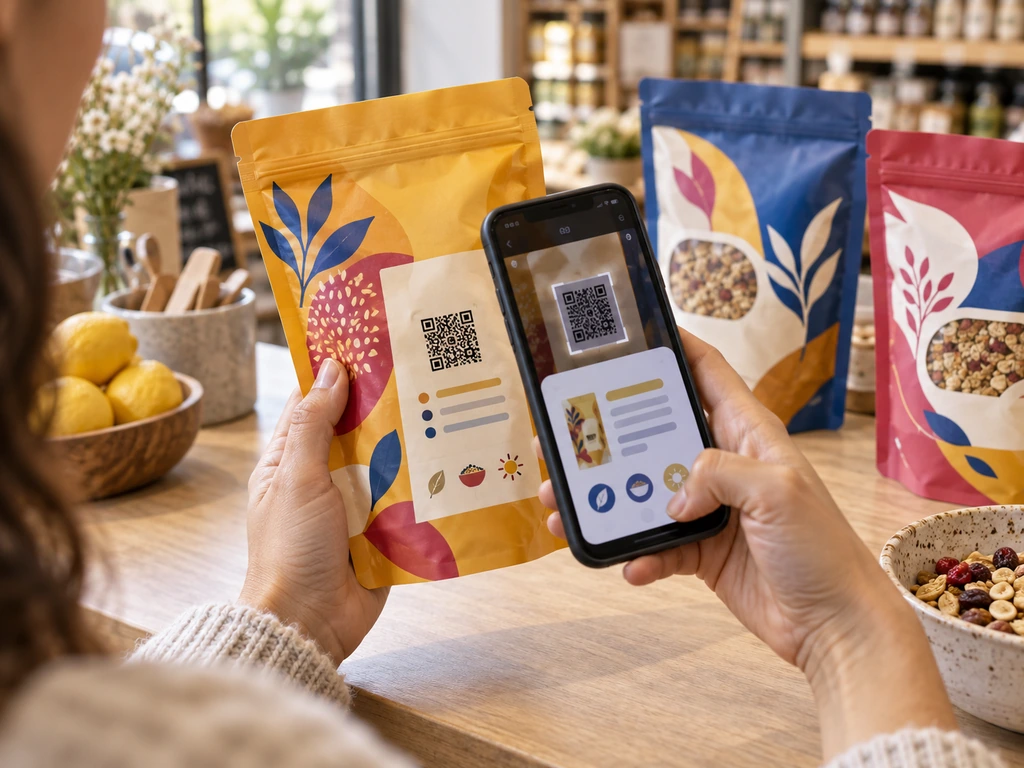
Trend 5: 2D Codes Connect the Printed Pouch to Live Product Data
QR Codes powered by GS1 and GS1 DataMatrix are moving packaging from static artwork toward a data carrier. The GS1 retail implementation programme aims for point-of-sale systems to process defined 2D barcodes by the end of 2027. Depending on the chosen standard and implementation, one code can support product identification while connecting customers or supply-chain partners to ingredients, allergen information, recycling instructions, batch data, expiry dates or brand content.
The design implication is more demanding than placing a decorative QR code on the back panel. The code needs a defined quiet zone, sufficient contrast, a size that survives printing and pouch distortion, and a location that remains flat enough to scan after filling. Matte varnish, metallic effects, transparent windows and curved gussets can all reduce readability. Test the printed production sample with the scanners and phones used in the target market rather than approving the code only on a monitor.
Digital printing adds another layer by allowing variable codes or serialized graphics without a new cylinder for every version. That can support controlled promotions, regional content and product-level traceability, but the data workflow must be planned before artwork approval. Decide who creates the codes, who verifies the encoded data, how duplicate codes are prevented and where the destination content will be maintained after the package ships.
Short Runs vs Big Runs: Which Stand Up Pouch Trends Fit Each Route
Material, closure and design choices ultimately meet the same commercial question: how many pouches must be produced per SKU? The answer depends on the printing route, and digital and gravure behave very differently.
| Factor | Digital printing path | Rotogravure path |
|---|---|---|
| Typical MOQ | Converter-specific; Baishen’s digital route starts from 500 pcs per SKU | Converter-specific; Baishen’s gravure route starts around 5,000–10,000 pcs |
| Setup cost | No plate or cylinder fees | One engraved cylinder per color and design |
| Turnaround | Baishen publishes 7–10 working days once artwork is approved | Baishen publishes approximately 15–20 working days |
| Unit cost | Higher per bag | Lowest per bag at volume |
| Best fit | New SKUs, seasonal runs, market tests | Stable, high-volume, single-design products |
The Short-Run Path: Digital Printing
Digital presses print straight from approved artwork, so there is no cylinder to cut and no plate fee to amortize. Baishen’s digital printing route starts at 500 pieces per SKU and lists a 7–10-working-day production time after artwork approval. Split-run printing lets one order carry several designs, which is how a brand can test two flavors or claims without treating each as a separate conventional print job.
Verify MOQ claims before planning around them because the advertised minimum may depend on pouch size, material, finish and the number of designs. Ask whether the MOQ applies per design or per order, whether proof or setup fees are separate, which structures qualify, and whether several SKUs can share the same material and size in one batch.
The Volume Path: Rotogravure
Gravure engraves each design onto cylinders, usually one per color. The setup commitment is higher, but the unit price falls as a stable design runs at volume. The economics work when demand is predictable and the artwork is settled. Baishen’s stand-up pouch production comparison places its gravure route around 5,000–10,000 pieces with approximately 15–20 working days of production.
Finding Your Breakpoint
The fork comes down to three numbers: how many SKUs you run, how often the artwork changes, and how much cash you can lock into one order. Many designs with frequent changes favor digital at almost any volume. One proven design at steady volume favors gravure once the cylinder cost is spread thin.
Baishen production entry points
digital printing, per SKU
gravure starting range
Use digital for breadth across small or changing SKUs; move proven, stable designs to gravure when volume earns the setup.
One warning on both paths: unit price is the wrong way to choose. A cheap gravure quote on an unproven design is expensive the moment the artwork changes, because the cylinders are already cut. A digital quote on a proven million-piece SKU leaves money on the table every month.
Translating Stand Up Pouch Trends into Specs for Your Category
A trend becomes useful only when it is written into a specification. Match the product category to its barrier, closure, production route and acceptance boundary before requesting prices.
Baishen Pack · Low-MOQ pouch line
Send your category row and target quantity, and we will price both print paths against it.
| Category | Material structure | Closures & features | Production path | Failure boundary & acceptance action |
|---|---|---|---|---|
| Coffee | High-barrier laminate (PET/AL/PE class); light protection is non-negotiable | One-way degassing valve (confirm supplier offer), zipper | Gravure once the blend is stable | Mono-material swap shortens shelf life; run a shelf-life test before switching |
| Pet food | Puncture-resistant heavy-duty laminate | Wide zipper or slider, tear notch | Gravure for volume | Thin mono-material films tear on sharp kibble; require burst test data |
| Supplements | Metallized barrier (MOPP/VMPET/PE class), light-blocking | Child-resistant zipper (28 mm vs 13 mm standard) | Digital for new SKUs, gravure at scale | Weak CR zippers fail retail compliance; require zipper pull-force data |
| Snacks & dry food | Mono-material PE viable; lightweight structures | Press-to-close zipper, transparent window optional | Digital for seasonal flavors | Window film reduces barrier; confirm seal strength at the window edge |
| Personal care | Laminate with premium finish (matte, metallic) | Spout, handle | Digital for launches | Spouts hurt recyclability claims; check the end-of-life story you are allowed to print |
Barrier-First Categories: Coffee, Pet Food, Supplements
For these categories the barrier layer is the product’s life support, so sustainability claims bend to it. Coffee needs oxygen and light blocked for months; a mono-material swap is possible only after a shelf-life test proves the pouch survives the intended distribution window. Pet food adds a mechanical problem: sharp kibble and heavy filling punish thin films, so puncture resistance matters alongside recyclability. Supplements add regulatory and closure requirements. If child-resistant packaging is required, specify the applicable market standard and request closure test documentation when reviewing custom barrier bag options.
Story-First Categories: Snacks and Personal Care
Here the trend story can lead. Dry snacks and treats sit in the sweet spot for recyclable mono-material structures, because their shelf life is shorter and their barrier needs are milder. Digital short runs fit seasonal flavors and limited editions without locking cash into cylinders. Personal care sells through finish and form: soft-touch and metallic surfaces, spouts for liquids, handles for larger formats. Just check that a spout pouch still matches whatever recyclability claim your market allows you to print.
The Spec Checklist to Send Your Supplier
Whatever the category, the same checklist protects the order. Send it with your inquiry and compare answers line by line:
- Material structure with layer order, total thickness and target barrier values
- Side and bottom seal widths, tolerances and the approved drawing
- Closure type, width, placement and required performance test
- Tear-notch position and clearance from the top seal and closure
- Certifications and compliance documents required for the product and sales market
- Acceptance reports: seal strength, burst, solvent retention and an agreed color tolerance against the approved proof
- Confirm-items for your market: degassing valve availability, mono-material barrier grade
The confirm-items exist because not every factory stocks every option. A coffee valve or a certified mono-material structure that exists in one plant may be a special order in the next. Asking before you order costs one email; discovering it after payment costs a season.
How Trend-Driven Pouches Fail in the Field, and What to Check Before Shipment
New structures fail in new ways, so a trend-chasing order deserves stricter acceptance than a repeat order. The failure modes are well documented, and none of them are mysterious.
The same failure modes recur across established and newer structures. Seals leak when the sealant, temperature, pressure or dwell time is wrong. Pouches fall over when gusset geometry and fill weight do not match. Layers separate when the adhesive, curing or lamination bond is inadequate. Zippers fail when the closure specification or attachment strength does not suit repeated use. E-commerce adds a system-level risk: the filled pouch and its shipping carton must survive handling together, so a pouch-only check is not enough.
| Failure mode | What it kills | Acceptance check before shipment |
|---|---|---|
| Weak seals / leakage | Shelf life, returns | Seal strength test report; random retention sample from your batch |
| Poor standing stability | Shelf presentation | Approved physical sample; gusset spec on the drawing |
| Delamination | Brand trust, food safety | Lamination strength data; solvent retention report |
| Zipper failure | Immediate refunds | Pull-force and cycle test data; incoming-batch sampling |
| Transit crush | E-commerce reviews | Drop test on the shipping configuration, not just the pouch |
Sampling passing once is not a quality system. Write the test frequency into the contract: which tests, on which AQL basis, per which production stage.
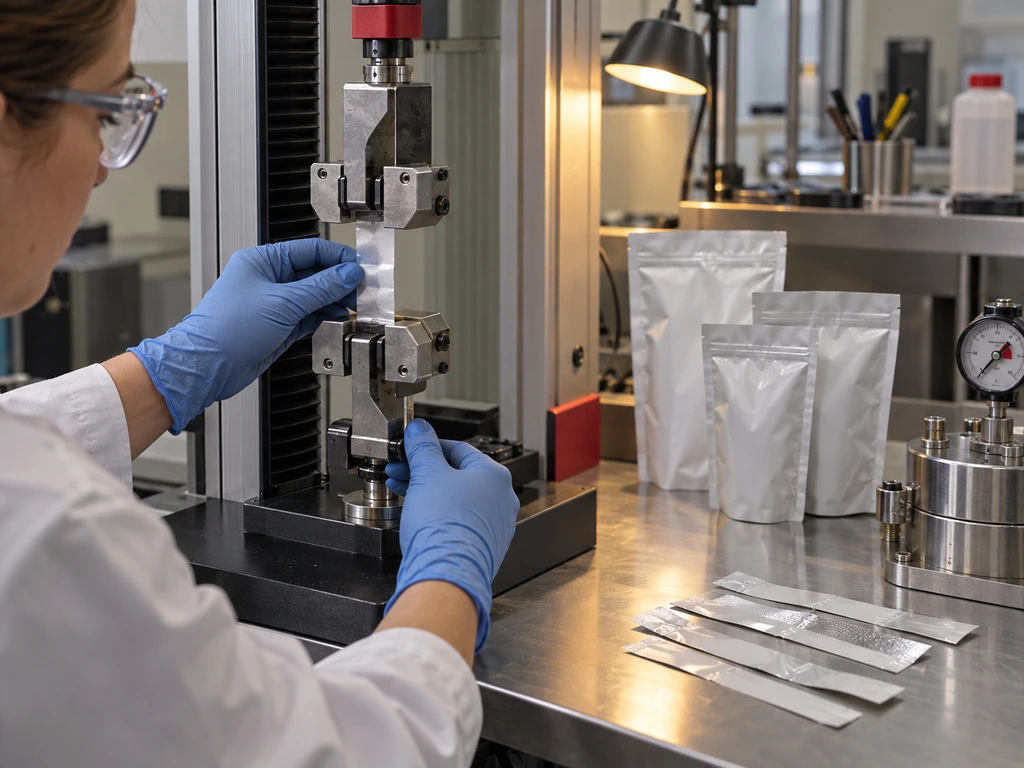
Treat the acceptance table as a purchase-order attachment rather than an informal expectation. Ask which tests the factory runs in-house, which are outsourced, how often samples are taken and what happens when a result falls outside the agreed limit. Baishen’s quality-assurance process, for example, includes interlayer adhesion, puncture, tensile, burst and drop testing.
What Stand Up Pouch Trends Mean for Your Inventory if You Sell Packaging
Distributors and packaging wholesalers face a different inventory question. Digital lines with no cylinder fees and low per-SKU minimums reduce the need to hold every printed design as finished stock. At the same time, established PE, PET and PP structures still dominate current demand, while bio-based films remain a smaller segment. The EU’s 2030 recyclability objective is also turning mono-material PE and PP from optional talking points into active development lines for brands selling in Europe.
The margin is moving from printing content to engineering and compliance content. Two inventory lines cover both directions of demand. High-barrier laminates serve the categories that cannot trade away shelf life. Recyclable mono-material structures serve the buyers who must answer the 2030 question this year. Within those lines, the premium sits in function: child-resistant and slider zippers, spouts, shaped pouches, and the test documentation that proves the bags survive retail handling. A distributor who can hand a retail buyer seal-strength and solvent-retention reports alongside the quote is selling certainty. Certainty is the one thing a commodity price list cannot undercut.
One boundary protects the other half of your business: digital short runs absorb test batches and small orders, not stable bulk programs. A national retail account reordering one proven design by the millions is not going digital, so do not dismantle the gravure supply chain in response to the short-run noise.
At Baishen Pack, we support both sides of that portfolio. We produce high-barrier laminates for products that cannot trade away shelf life and mono-material structures for projects with verified recycling requirements. Our digital lines handle market tests and mixed-SKU runs, while gravure serves stable bulk programs. Send us the product, sales market, quantity per SKU and target shelf life, and we will recommend the material, closure, print route and validation plan.
Turn the Right Pouch Trend Into a Working Specification
Share your product, market, pouch size and quantity per SKU. Our team will recommend a structure, print route and validation plan for your project.
Review My Pouch ProjectReferences
- Fortune Business Insights. “Stand-Up Pouches Market Size, Share and Growth Forecast.” 2026.
- Towards Packaging. “Stand-Up Pouch Market Size and Trends 2026–2035.” 2026.
- European Commission. “Packaging Waste and the Packaging and Packaging Waste Regulation.” Accessed 2026.
- CEFLEX. “Designing for a Circular Economy: Design Principles.” 2025.
- RecyClass. “Design for Recycling Guidelines.” Updated 2026.
- GS1. “2D Barcodes at Retail Point-of-Sale Implementation Guideline.” Accessed 2026.