

Mylar Bags for Food Storage vs Vacuum Sealing: The Honest Comparison
You bought a vacuum sealer because it felt like the serious way to store food. Then you discovered Mylar bags, and the first thing you asked yourself was probably: “If I already own a FoodSaver, why would I ever buy Mylar bags?” It is the single most common question in prepping forums, and the answer is not a contest with a winner. These two methods are built on different physics, protect food on different timelines, and punish mistakes in different ways. Here is the full comparison, including the food-by-food and cost details most guides skip.
What Are Mylar Bags and Vacuum Sealing?
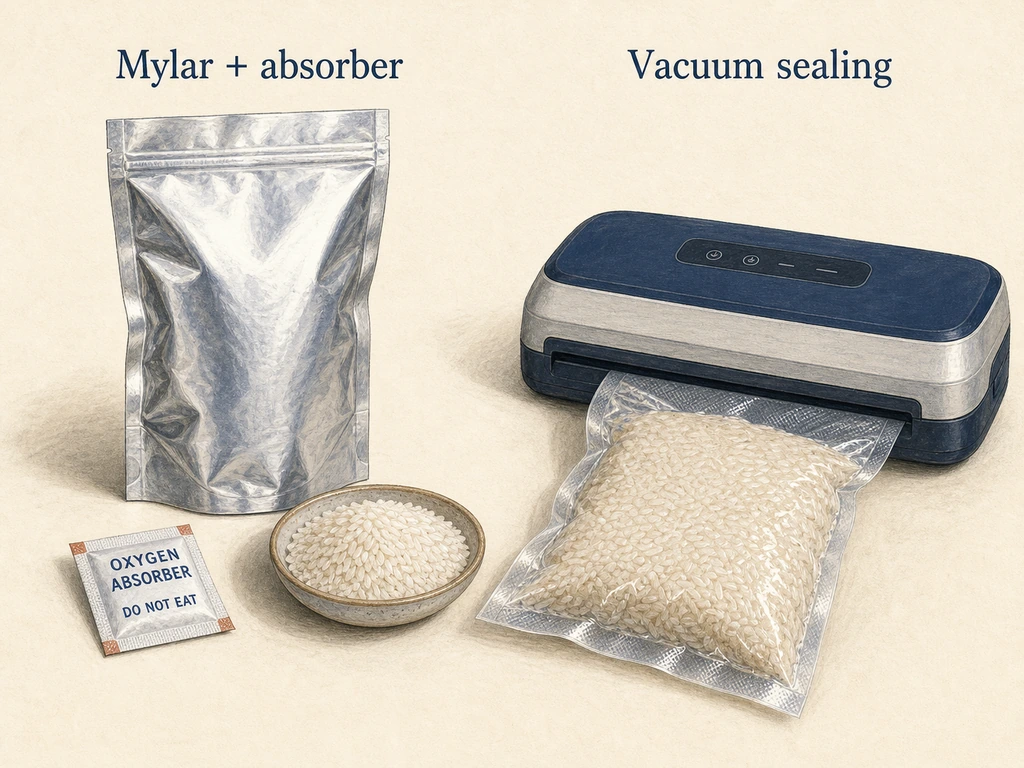
Mylar is a DuPont trade name that has turned into generic shorthand, the way Coke means soda, for foil-laminated pouches. A standard Mylar bag is a three-layer sandwich: a food-grade polyethylene (PET) inner layer that touches the food, a foil middle layer, and a tough polyester outer layer. That foil layer is the whole point. It dramatically reduces the transmission of oxygen, moisture, and light through the film (Utah State University Extension). The bags are heat-sealed shut and usually paired with oxygen absorbers, small packets of iron powder that chemically consume the oxygen left inside after sealing.
Vacuum sealing works differently. A machine, either an external clamp-style model like the popular FoodSaver or a commercial chamber sealer, sucks the air out of a plastic bag and heat-seals it shut. The bag itself is ordinary roll film, typically a nylon/PE coextrusion with no foil layer at all.
Both approaches remove oxygen, but on different schedules: vacuum sealing evacuates the air that was there at the moment of sealing; Mylar plus an absorber keeps removing oxygen after the seal. That single difference explains everything that follows.
Why the Two Methods Protect Food Differently
The core idea is simple: vacuum sealing solves the oxygen inside the bag on day one. Mylar solves the oxygen, moisture, and light on both sides of the bag for the entire storage period.
Plastic films, including the film used in vacuum bags, are not truly gas-tight. Research summarized in a widely cited scientific status review of active packaging shows that polymer films permit measurable oxygen transmission over time (Brody et al., Journal of Food Science, 2008). Utah State University Extension states the practical consequence plainly: plastics “are not that resistant to oxygen transfer and will allow significant oxygen levels into the container in 1 to 2 years.” The foil layer, by contrast, “dramatically reduces” transmission. Vacuum the air out perfectly today, and the film still lets a slow trickle of oxygen back in over the months that follow. The aluminum layer in a Mylar pouch has no such leak.
| Comparison factor | Mylar bags | Vacuum bags | Key difference |
|---|---|---|---|
| Oxygen barrier | Foil layer; near-zero oxygen transmission | Plastic film; significant oxygen ingress within 1-2 years | Mylar provides an ongoing barrier; vacuum bags only remove the air present at sealing |
| Moisture barrier | Very low moisture transmission | Low moisture transmission; decreases as film thickness increases | Mylar offers much better moisture protection for long-term dry-food storage |
| Light barrier | 100% light blocking | Transparent; no light barrier | Light causes fading and accelerates fat rancidity |
| Seal durability | Heat-sealed edges can last for years when left undisturbed | Temperature changes and compression stress heat seals; seal failure is a frequent complaint | Seal failure is the most common frustration reported by vacuum-bag users |
| Puncture resistance | Thicker, higher-mil films offer stronger puncture resistance | Thin film is vulnerable to sharp edges on frozen foods | A thickness of at least 4 mil is recommended for 5-gallon bucket liners |
| Ease of resealing | Difficult to reseal after cutting open | Zipper bags can be opened and closed repeatedly | Vacuum bags are more convenient for everyday access |
One form-factor note: a vacuum bag is essentially a flat pouch made from roll film, sealed on three sides; a Mylar pouch is a preformed high-barrier flat pouch. The shapes look similar. The material barrier is what separates them.
So the two are not in the same league as barriers. One is a container you can see through and reopen daily; the other behaves like a flexible tin can that trades convenience for permanence.
Shelf Life: What the Numbers Actually Mean
The numbers you see online are not properties of the bag. They are properties of a system: bag + oxygen absorber + food type + temperature. Change any one component and the number collapses.
What the Standard Numbers Claim
Vacuum-sealed dry goods are typically cited at 1 to 3 years of quality shelf life; frozen, they hold much longer. Mylar bags with oxygen absorbers are cited at 10 to 25 years for low-moisture staples, and Utah’s preparedness guidance notes that whole grains “hold their nutritional value for decades or longer” when sealed correctly (BeReady Utah). Four conditions attach to every one of those numbers: the food must be dry, stored cool (40-70°F), kept dark, and sealed intact. The temperature rule is brutal: for every 18°F above the ideal range, you lose about half the food’s shelf life (BeReady Utah).
Why Vacuum Bags Underperform Over Time
There are two independent failure paths, and they compound. First, the film itself: as noted above, plastic films let significant oxygen through within 1 to 2 years. That is a material property, not a manufacturing defect (Utah State University Extension). Second, the seal: heat-seal edges weaken under temperature cycling and pressure. Long-time users describe the pattern in plain language. One prepper, after years of freezer storage, wrote: “I can’t tell you how many times the bags lost their seal which allowed air in.” Neither failure is rare. Together they explain why vacuum bags are measured in months-to-years, while Mylar systems are measured in years-to-decades.
The Oxygen Absorber Factor
This is the piece most newcomers miss: the long shelf life of a Mylar bag does not come from the bag alone. It comes from the oxygen absorber. The packet’s iron powder oxidizes inside the sealed bag, chemically consuming the residual oxygen. The process takes 24 to 72 hours to finish. Sizing follows container volume: one 300cc packet handles roughly a one-gallon container (BeReady Utah); a five-gallon bucket liner needs a 2000cc-class absorber. Two safety notes: absorbers are not edible, and they start working the moment the packaging is opened. Seal leftovers immediately or they go inert.
Can You Vacuum Seal Mylar Bags?
Yes, but whether you should depends on three variables: the bag’s texture, your purpose, and your machine.
Textured vs Standard Mylar Bags
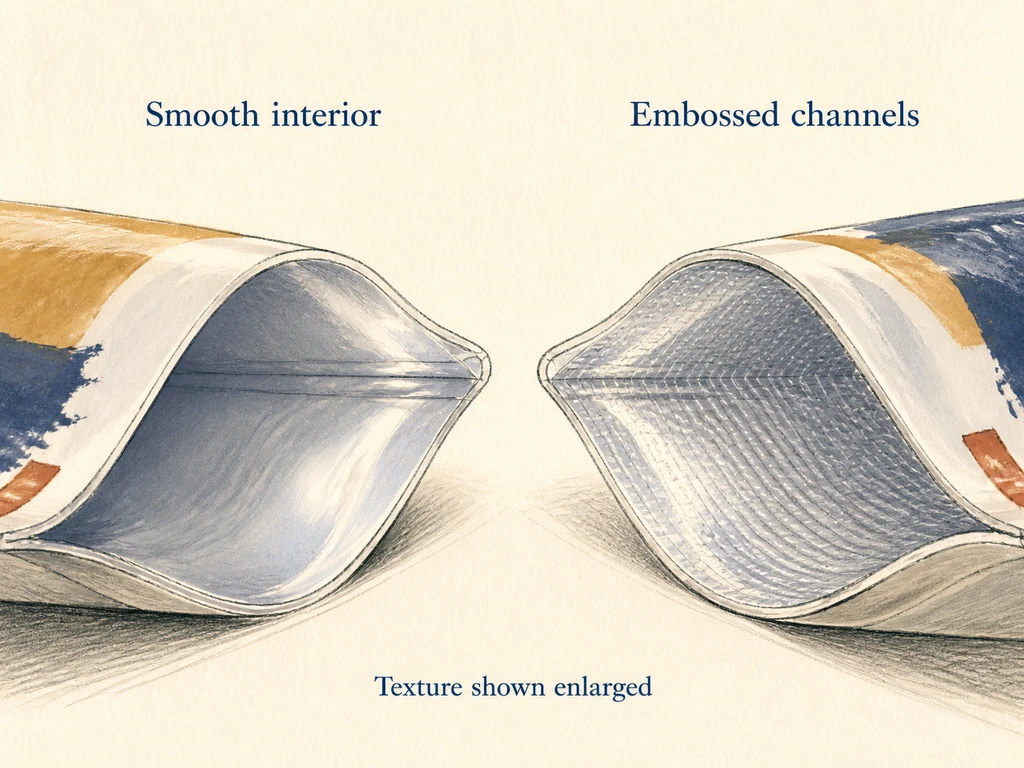
Smooth Mylar bags defeat most home vacuum sealers. The foil layers press together with no air channel, and an external machine like a FoodSaver simply cannot pull air out. Textured Mylar bags are embossed with micro-channels on the inside, giving the air a path to escape. They are the variant designed to work with external vacuum machines. Smooth bags work fine with chamber sealers (which evacuate the whole chamber), or with plain heat sealing.
Why You Usually Don’t Need Vacuum for Mylar
The mental block that costs people money: many assume Mylar requires a vacuum machine. One forum user admitted it directly: “for some reason [I] always thought that I needed to vacuum seal the bags.” You don’t. The oxygen absorber does the air-removal job within 24 to 72 hours, so a simple heat seal (a dedicated heat sealer, or even a hair straightener on the folded edge) is sufficient.
Both work; the second costs nothing in equipment.
When Combining Both Makes Sense
The hybrid, vacuum sealing first and then placing the inner bag into a Mylar pouch with an absorber, is a double-insurance play, not a default. It earns its cost for high-value dry goods aimed at 10-plus-year storage, or when you need to compress bulky items like pasta for space. Order of operations: vacuum seal the inner bag, place it in the Mylar pouch, add a reduced-size absorber, heat seal. You are paying for two layers of consumables, so reserve it for food that justifies the premium.
At production scale, chamber vacuum sealers typically run roll stock film, continuous rolls cut and sealed inside the chamber, rather than pre-cut bags. The same barrier logic applies: roll film is plastic, so it suits short-to-medium product runs, not decade-long storage.
Which Foods Go Where: A Food-by-Food Guide
Before the table, one rule: three food properties decide the packaging choice: moisture content, oil content, and water activity. High moisture means vacuum + refrigeration. High oil content means no method can save it long-term, because rancidity is irreversible. Extremely low water activity means Mylar + absorber is nearly a permanent solution.
| Food category | Recommended method | Expected storage time | Key reason |
|---|---|---|---|
| White rice | Mylar + oxygen absorbers | 25-30 years | Low moisture and fat content make it a classic long-term staple |
| Dried beans | Mylar + oxygen absorbers | 25-30 years | Removing oxygen helps prevent bean oils from going rancid and the beans from darkening |
| White sugar | Mylar or an airtight container (oxygen absorbers optional) | Decades | Very low water activity |
| Salt | Any airtight packaging | Indefinitely | No oxygen absorber needed |
| White flour | Mylar + oxygen absorbers | 5-10 years | Milled grains deteriorate much faster than whole grains |
| Brown rice & whole wheat flour | Freeze or use within a short period | 6-12 months | Natural oils turn rancid; no bag can prevent that indefinitely |
| Dehydrated fruits & vegetables | Mylar + oxygen absorbers | Several years (20-30 years for freeze-dried foods) | Sensitive to oxygen and moisture |
| Dry milk | Mylar + oxygen absorbers, or No. 10 cans | 3-5 years | Noticeable oxidized flavors after 4 years in plastic packaging (USU research) |
| Coffee beans & ground coffee | Mylar (beans require a one-way degassing valve) | Beans: 6-12 months of peak flavor | Beans release CO₂ after roasting; ground coffee is highly sensitive to oxygen |
| Nuts & oily dried fruit | Vacuum sealing + freezing | Several months | Fat oxidation is irreversible |
Two rules from the same table that answer the most-searched questions: do not store fresh or wet foods in Mylar, trapped moisture breeds spoilage; and do not expect vacuum sealing to rescue brown rice or nuts at room temperature, because oxygen control cannot undo oil chemistry.
The same logic scales directly to commercial packaging: a brand’s dry-food SKU has the same moisture, oil, and water-activity profile as your pantry staples. It just needs the decision made at batch volume.
What Each Setup Really Costs
The two routes have opposite cost structures. Vacuum sealing is equipment-heavy; Mylar is consumable-heavy.
| Cost item | Vacuum sealing | Mylar + oxygen absorbers |
|---|---|---|
| Initial equipment | External sealer: $50-150; chamber sealer: $300+ | Heat sealer: $0-30 (a hair straightener can be used instead) |
| Consumables per use | Roll film: $0.10-0.30 per foot | 1-gallon bags: $0.30-0.80 each; oxygen absorbers: $0.05-0.15 per packet |
| Reusability | The machine can be reused long term | Single-use consumables, but no vacuum machine required |
| Unit cost for long-term storage | Moderate (film costs + losses from seal failures) | Low (lower unit costs when storing in bulk) |
Prices are magnitude references; they shift with supplier and batch size. The structural conclusion holds: if you seal often and eat soon, the vacuum machine pays for itself; if you are filling buckets for years of storage, Mylar + absorbers wins on unit cost because there is no machine to buy and no resealing to repeat.
Mylar Bags vs Vacuum Sealing: How to Choose
Every argument above collapses into one decision table:
| Your situation | Which to choose | Why |
|---|---|---|
| Long-term dry-food storage (5+ years) | Mylar + oxygen absorbers | The only combination capable of decade-scale storage |
| Short-term freezer storage | Vacuum sealing | Low temperatures greatly slow oxygen transmission and help seals last longer |
| Everyday ingredients accessed frequently | Vacuum zipper bags | They can be opened and closed repeatedly; Mylar bags are discarded after cutting open |
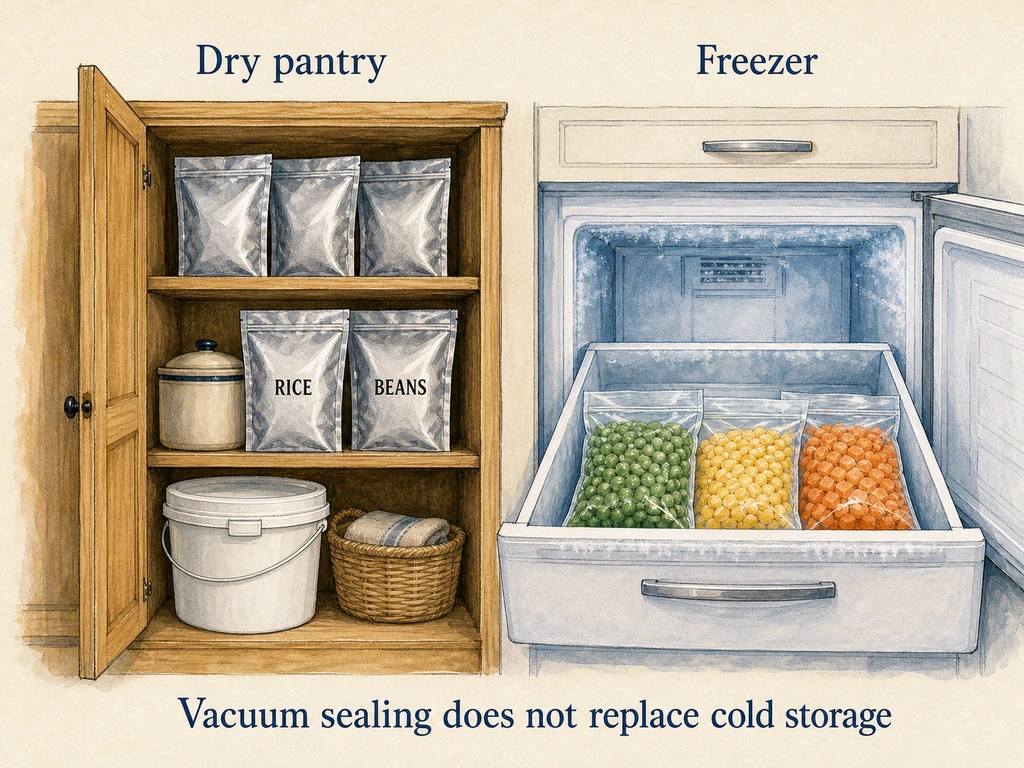
| Moist foods and marinated products | Vacuum sealing + refrigeration or freezing | Vacuum packaging is not a preservation method; room-temperature storage can increase the risk of botulism |
| Very limited storage space | Vacuum compression | Removing air minimizes package volume |
| Commercial product packaging | See the next section | Your brand’s shelf-life promise is at stake |
⚠️ An essential safety warning: Vacuum packaging alone is not a food preservation method. It removes oxygen, but foods that require refrigeration or freezing must still be refrigerated or frozen after vacuum sealing, because oxygen-free environments can favor the growth of botulism-causing bacteria (Utah State University Extension).
The two methods are complements, not competitors.
What This Debate Means for Anyone Selling Packaged Food
That final row in the decision table deserves more than one line, because when you are selling the food, a packaging mistake is not one wasted bag; it is a shelf-life promise you cannot keep.
Look first at how home users actually behave. Buyers select their method by what they already own (“recently I bought a FoodSaver vacuum sealer and was wondering if I could simply use it”), rather than by how long they need to store. They are confused about which foods belong where; the same forum threads keep asking about “sugar, salt, flour, rice.” And their dominant disappointment is seal failure: bags that “lost their seal which allowed air in,” reported by users who, after 30 years of vacuum storage, switched to Mylar entirely. These are not hobby anecdotes; they are market structure. The home-storage market is dual-track, vacuum for daily and short-term use, Mylar for long-term reserves. Demand splits along food category and storage duration, not equipment ownership. Seal reliability, more than price, decides brand loyalty, because a failed seal is the failure users can feel.
For anyone supplying this market, three moves follow. First, organize Mylar specifications by storage scenario (bucket liner thickness versus one-gallon pantry bags), not by price tier, because buyers come with a scenario, not a spec sheet. Second, qualify the product’s moisture content and target shelf life before proposing a bag structure; a pitch that starts with the food ends with the right film. Third, treat seal consistency as the repurchase gate: one batch of bags that loses seals in the field costs more trust than any pricing gap.
Now the business form. The technical boundary drawn in this article maps cleanly onto procurement: vacuum formats serve short-to-medium runs and frozen or high-moisture products; Mylar formats serve long-shelf-life dry goods paired with absorbers. That demand is stock-based: brands order by SKU in small-batch startup runs up to mid-volume. The buyers are food, coffee, and supplement brand founders, procurement staff, and packaging distributors. The decision gate is sampling: barrier and seal performance must be validated on the actual product before a batch order, and when packaging fails, the cost lands on the brand: a shortened shelf life at best, a recall at worst. That shapes the supplier requirements. Minimum-order flexibility at the sampling stage. Fast proofing to keep the deal cycle short. Print quality and finishes that carry shelf presence. Batch-to-batch barrier consistency as the qualification for repeat orders. Food-contact compliance (FDA 21 CFR 177, EU 10/2011) as the non-negotiable baseline.
At Baishen Pack, we help you select custom Mylar bags around your product, storage conditions, and target shelf life. We can tailor the film structure, thickness, size, resealable zipper, print, and finish, with low-MOQ digital printing for trial runs. Our sample support lets you check the pouch with your product and sealing equipment before committing to a larger order.
References
- Utah State University Extension. “Packaging Foods.”
- BeReady Utah (State of Utah). “Food Storage and Nutrition.”
- Brody, A. L., et al. “Scientific Status Summary: Innovative Food Packaging Solutions.” Journal of Food Science, 2008.
- Baishen Pack. “Custom Mylar Bags.”
- Baishen Pack. Homepage.