
Mylar Bag Thickness Explained: How to Choose the Right Mil for Food Storage
You’re staring at two listings: 5 mil and 7 mil mylar bags, nearly the same price. Which one do you buy? “Thicker is better” feels safe, until the bag arrives and your heat sealer won’t close it. Or it punctures the moment you pack rice. The honest answers to mylar bag thickness are rarely explained in one place: what the number actually measures, whether the bag will seal with your equipment, and whether it’s as thick as the label claims. This guide walks through every tier from 2 mil to 7+ mil, decodes the per-side vs. total labeling trap that has confused buyers for years, and ends with a four-step way to verify what you’re paying for.
What Does “Mil” Actually Measure on a Mylar Bag?
A mil is one thousandth of an inch: 1 mil = 0.001 inches = 25.4 microns. It’s the standard unit in North American packaging specs, while factories in Asia and Europe often quote microns or millimeters instead, which is the source of a lot of ordering mistakes (more on that below).
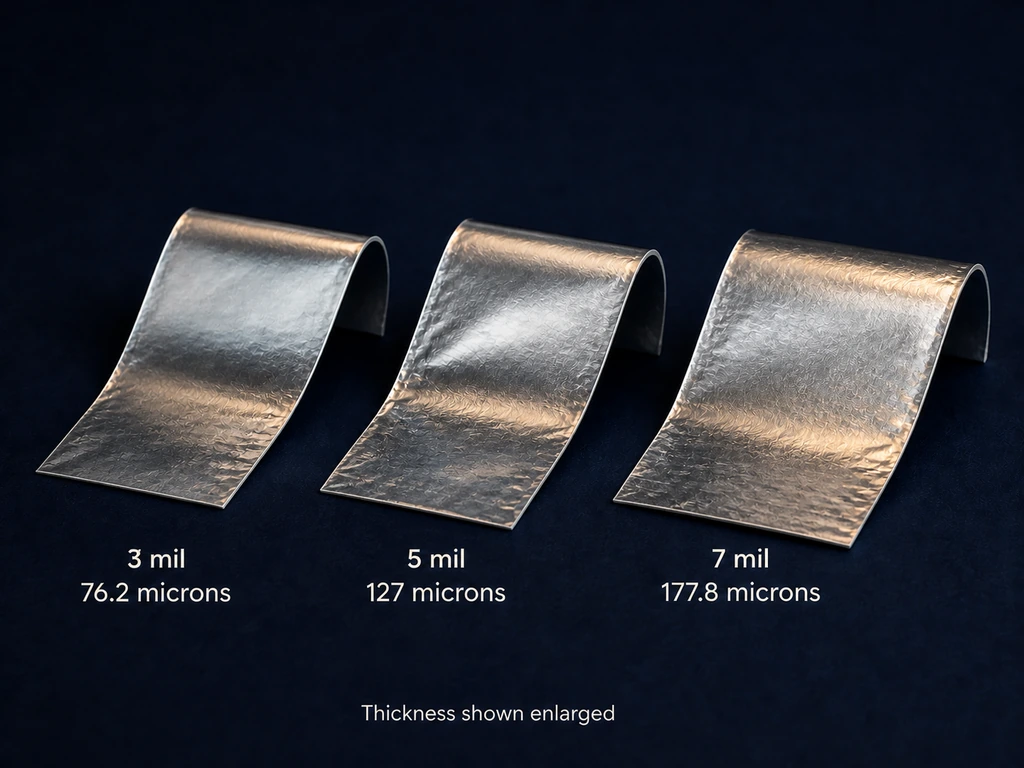
The bigger point most guides skip: a mylar bag is not a single film. It’s a laminated sandwich: a PET outer layer, an aluminum foil or metallized barrier layer, and a food-grade PE inner layer. The mil number measures the total thickness of that sandwich. And here’s the detail that matters for everything that follows: the foil layer that actually blocks oxygen and moisture may be only 7–12 microns (roughly 0.3–0.5 mil), a small fraction of the total. Most of the bag’s thickness is mechanical padding, not barrier. Thickness protects against punctures; the foil layer protects against oxygen. Keep those two jobs separate in your head and every “thickness” claim you meet from here becomes easier to judge.
“7 Mil” — Per Side or Total? The Labeling Trap Nobody Explains
Two conventions coexist in this market, and almost nobody tells you which one a listing uses. Here’s the rule that keeps you safe: the same “7 mil” can mean single-layer film thickness or total laminate thickness. The only way to know is what the number refers to. If the seller doesn’t say, assume the thinnest interpretation.
Per Side vs. Total Thickness: What the Number Actually Means
In the film industry, thickness is traditionally quoted per ply. A flat bag made from 3.5 mil film has two sides, so a seller quoting “per side” calls it 3.5 mil, while a seller quoting total thickness calls the same bag 7 mil. Both are technically describing the identical product.
This is not a niche quibble. A Reddit thread asking “when it says 7 mil, is that per side?” has sat near the top of Google for this exact search for years. Thousands of buyers have felt the same confusion. The answer that thread settled on: the stated thickness usually refers to each side of the film, not the sealed bag. That’s why two bags both labeled “7 mil” can feel completely different in your hands, and why “lots claiming to be 7 mil or more” on Amazon is a recurring complaint in food storage communities.
Three checks before you buy:
- Look for “per side” or “per ply” wording anywhere in the listing or spec sheet.
- Compare the same seller’s product family. If one SKU is exactly half another’s number, they’re mixing conventions.
- Ask the seller directly: “Is this number single-layer or total laminate thickness?” Get it in writing if you’re ordering more than a few bags.
Mil, Micron, and Millimeter: Converting Supplier Specs Without Mistakes
| Mil | Micron | Millimeter |
|---|---|---|
| 2 mil | 51 | 0.05 mm |
| 3.5 mil | 89 | 0.09 mm |
| 4 mil | 102 | 0.10 mm |
| 5 mil | 127 | 0.13 mm |
| 7 mil | 178 | 0.18 mm |
| 7.5 mil | 191 | 0.19 mm |
You only need one anchor: 1 mil = 25.4 microns. When a factory quotes “120 micron film,” divide by 25.4 and you get 4.7 mil. A 150 micron quote is 5.9 mil. If you requested 7 mil and the quote comes back in microns, do that math before you approve it. A skipped conversion here is how buyers end up with bags a full tier thinner than intended.
Same bag, two numbers. That’s the whole trap.
Mylar Bag Thickness Tiers: From 2 Mil to 7+ Mil
The market organizes into four practical tiers, and each one corresponds to a different storage job, not a different level of “quality.”
| Tier | Thickness | Typical Uses | Durability & Storage Horizon |
|---|---|---|---|
| Lightweight | 2–3.5 mil (51–89 micron) | short-term storage, light snacks, inner packs | low puncture resistance; weeks to months |
| Standard | 4–5 mil (102–127 micron) | general dry goods, retail food packaging (3.5 mil is the commercial default) | moderate; 1–2 years |
| Heavy-duty | 5–7 mil (127–178 micron) | long-term food storage with oxygen absorbers | high; 2–5+ years |
| Extreme | 7+ mil (178+ micron) | sharp contents, heavy stacking, industrial use | very high; 5–10+ years |
Two cautions go with that table. First, thickness does not buy barrier in a straight line: a thinner film with a quality foil layer can block oxygen as well as a thicker one with a weak barrier, so the tier tells you about puncture resistance first and shelf life second. Second, thickness is not free. Industry cost data puts the step from 3.5 mil to 5 mil at roughly a 30–40% higher per-bag price, in exchange for 200–300% better long-term barrier retention (Cubit Packaging, 2026). For multi-year storage, that trade is almost always worth it.
For home storage specifically, research-based guidance from the National Center for Home Food Preservation recommends keeping foods below 10% moisture when dry-packing with oxygen absorbers (NCHFP). The 5–7 mil tier is the community consensus for that kind of long-haul packing, with 5 mil as the floor.
Matching Thickness to What You Store
The deciding factor is not how expensive the food is; it’s how pointy it is. Rice grains and dry pasta are the most-cited puncture culprits in storage communities, while flour and beans almost never cause trouble.
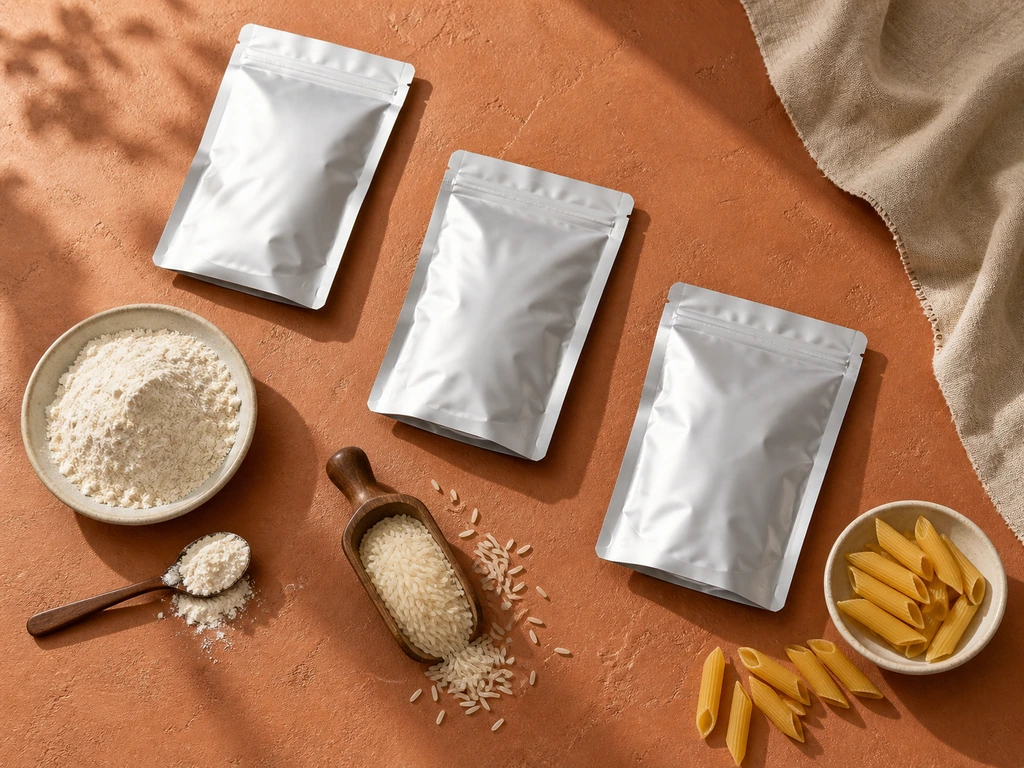
| What You’re Storing | Recommended Thickness | Why | Bag Note |
|---|---|---|---|
| White rice (long-grain) | 7 mil | sharp grain tips puncture thinner film under weight | 1-gallon flat bags, don’t overpack |
| Pasta & macaroni | 6+ mil | hard edges concentrate stress when stacked | leave headroom, avoid crushing |
| Flour, beans, sugar, salt | 5 mil | soft and low puncture risk | standard flat pouches, any size |
| Freeze-dried foods | 5–7 mil | brittle pieces + multi-year storage; thicker film is stiffer to handle | store whole pieces, don’t crush |
| Short-term snacks, nuts, spices | 3–4 mil | light use over weeks or months | small pint-size flat bags are fine |
One size-related rule the community has settled on over years of trial: small bags forgive thin film. A pint or half-gallon bag holding a few pounds never faces the stacking pressure of a full 5-gallon bucket liner, so 3–4 mil is perfectly serviceable there. The same 3–4 mil in a one-gallon bag of rice, though, is a puncture waiting to happen.
Thicker Bags, Harder Seals: What Changes at 7 Mil
Here’s the truth that saves people from a ruined storage run: 7 mil is not unsealable. The sealing conditions have to change with it. Heat must travel through a thicker laminate to reach the inner PE layer and melt it. Keep temperature and dwell time the same as a 4 mil bag and you get a “false seal”: it looks closed, feels closed, and peels open a week later.
Why Sealing Gets Harder as Thickness Increases
Heat sealing runs on three variables: temperature, pressure, and dwell time. As the laminate gets thicker, the heat from your sealing bar has to travel further before the inner layer reaches its melt point. Most household impulse sealers, typically 200–400 W, are engineered around films of 4 mil or less. At 7 mil, the inner layer may never fully melt, producing a “cold seal” with a cloudy, wrinkled seal line that separates under a light pull. One packaging blog claims thickness “does not affect the sealing process” at all; the experience of home users across r/preppers says exactly the opposite. “A bit harder to seal” is the polite version.
Sealing 7 Mil at Home: Heat, Time, and the Right Tools
Work up this three-step ladder:
- Use what you already have. A clothes iron or hair straightener can seal 7 mil. Extend the dwell time until the seal line turns transparent and smooth, then run a second pass a couple of millimeters behind the first. That double seal line is the standard low-cost fix for thick film.
- If you’re buying a sealer, buy the right feature. Choose one with adjustable dwell time and a wider sealing bar (5 mm or more). Fixed-time budget models are the most common cause of failed 7 mil seals.
- Verify every seal. Wait about 10 seconds after sealing, because the melted layer needs that time to set. Then press on the seal and give it a light pull test before you trust it with a decade of rice.
Cloudy line, peels open a week later
Transparent line, survives the pull test
Once oxygen absorbers go into the bag, you have roughly 10–15 minutes to finish sealing. Absorbers start working the moment they hit air, so run your seal tests before you open that packet.
How to Verify the Thickness You Actually Pay For
“Found lots claiming to be 7 mil or more” appears again and again in storage forums, and it points to the last real gap in this market: almost nobody teaches buyers how to verify a claim. Four steps cover it:
- Pin down the convention. Ask whether the quoted number is per-side or total laminate thickness, and get the answer in writing.
- Ask for documentation, not adjectives. A serious supplier can produce food-contact compliance and barrier test data (oxygen transmission rate and moisture vapor transmission rate). In the U.S., food-contact films fall under 21 CFR Part 177, “Indirect Food Additives: Polymers” (eCFR). A seller who can’t name their compliance basis fails this step immediately.
- Physically verify samples. Measure the film with a micrometer or caliper and compare it against a known-good bag. Small tolerances (typically ±5–10%) are normal in extrusion; a “7 mil” bag that reads 4 mil is not.
- Test small before you buy large. Order a sample batch, seal it with your own equipment, and store it for a month before committing to volume.
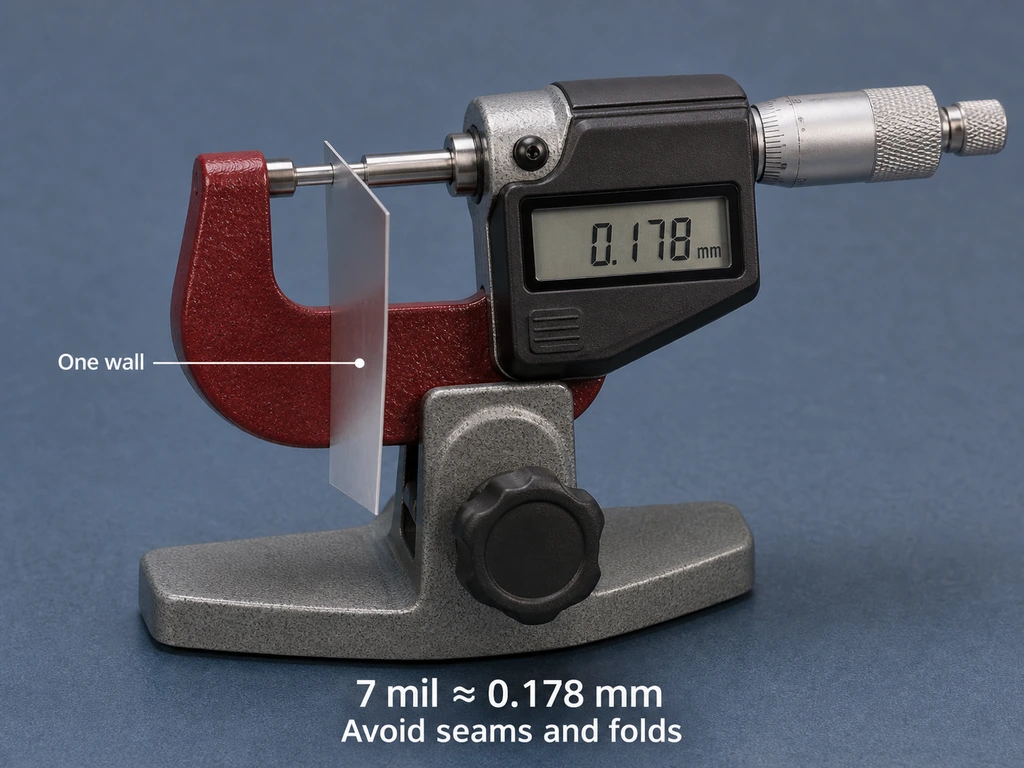
Per-side or total, confirmed in writing
21 CFR Part 177 in the U.S.
OTR and MVTR reports
What the Thickness Debate Means for the Mylar Bag Business
Those four verification steps read like a buyer’s checklist. Turn them around and they describe the business of selling mylar bags.
Start with what buyers keep tripping over. They can’t tell whether “7 mil” means per side or total. They’ve been burned by listings that overstate thickness. They discover at home that thick film needs different sealing conditions. And they lose bags to rice grains and pasta edges. These are the same facts from earlier in this article. Now look at them from the supply side. The market rules they reveal are threefold: first, the label number is the only parameter a buyer can see, so when it’s not trustworthy, buying decisions stall; second, most returns and bad reviews trace back to seal failures and punctures; third, most buyers are paying for a number, not for data. Few have ever seen an oxygen transmission report, and almost none know how to ask for one.
For anyone stocking or selling these bags, those rules convert into concrete moves. State the thickness convention right in the product title. “3.5 mil per side / 7 mil total” costs nothing to write and immediately separates an honest listing from an ambiguous one. Teach the mil-to-micron conversion before pitching a product; the seller who explains the spec wins the educated buyer. And pair puncture-prone categories (rice, pasta, freeze-dried) with heavy-duty SKUs by default instead of leaving buyers to discover the problem themselves.
Now step back to how this trade actually operates. The 5–7 mil consensus has made storage bags a highly standardized, reorder-driven product: mostly standard flat bag formats, trial orders first, mid-volume reorders after. The buyers are distributors, brands, and e-commerce sellers. Their gate is not price; it’s samples and documentation. And when a seal fails in a customer’s pantry, the cost lands on the seller’s repeat business, not the film mill’s. That business shape dictates what a supplier has to be good at: documentation that survives verification (certifications plus OTR/MVTR data), affordable trial orders (low-MOQ digital printing with no plate fees), and speed through the sampling loop (digital proofs within a day, production measured in days, not months).
At Baishen Pack, we help you choose custom Mylar bags around your product, target shelf life, and sealing setup. Our packaging team can recommend a film structure and thickness, then tailor the bag size, zipper, tear notch, print, and finish. We offer stock samples and custom sample support so you can check fit and sealing before a bulk order, plus low-MOQ digital printing for trial runs.
Custom thickness, structure, and print with documented barrier data, free samples, and a 7–10 day digital turnaround.
References
- eCFR (Electronic Code of Federal Regulations). “21 CFR Part 177 — Indirect Food Additives: Polymers.”
- National Center for Home Food Preservation. “Research-based recommendations for home food preservation.”
- Cubit Packaging. “Mylar Bag Thickness Guide: How to Choose the Right Mil.” 2026.
- Reddit r/preppers. “Mylar bag thickness — when it says 7 mil, is that per side?”
- Reddit r/preppers. “Mylar Bag Recommendations for food storage.”
- Baishen Pack. “Mylar Bags.”
- Baishen Pack. “About.”
- Baishen Pack. “Contact.”
- Baishen Pack. “Home.”