
Types of Mylar Bags Explained: Structures, Features, Thickness, and What They Really Cost
Walk down any grocery aisle and most of the flexible packaging you see — coffee bags, snack pouches, pet-treat bags, supplement packets — falls under one loose label: mylar bags. But “mylar bag” is about as precise as “box.” Flat pouches, stand-up pouches, gusseted bags, zip-top bags, child-resistant bags, bucket liners: they share a film family and behave nothing alike once filled, sealed, and shipped.
This guide sorts the types of mylar bags by structure, feature, and thickness, then turns to the part that matters most: choosing the right one, whether you’re storing rice for the long haul or launching a product that needs packaging that sells.
What Makes a “Mylar” Bag Different: Foil, Metallized Film, and the Barrier Hierarchy
Strictly speaking, Mylar® is a trademark for biaxially oriented polyester (BoPET) film, but the packaging industry uses “mylar bag” as shorthand for foil-laminate pouches. The functional difference between a cheap “silver” bag and an expensive one is the metal layer, and it’s worth understanding before you compare any two quotes.
Three structures dominate the market:
| Structure | What’s inside | Barrier level | Cost tier |
|---|---|---|---|
| Full foil laminate | Aluminum foil layer 6–9 μm thick | Highest | High |
| Metallized film | Vapor-deposited aluminum coating, tens of nanometers thick | Mid | Mid |
| Clear coated PET | Transparent film with barrier coating | Lower | Low |
The scale here is the point: a foil layer is measured in microns, a metallized coating in nanometers. Three orders of magnitude apart. Two bags can look identical on a shelf and differ 3× in cost because one hides a real foil layer and the other a vapor coating. This film family is also a serious market: stand-up pouches alone were a $30.7 billion market in 2023 (Grand View Research, 2023), and global pouch consumption reached 620.5 billion units in 2024 (Smithers, 2024).
The Four Core Bag Structures
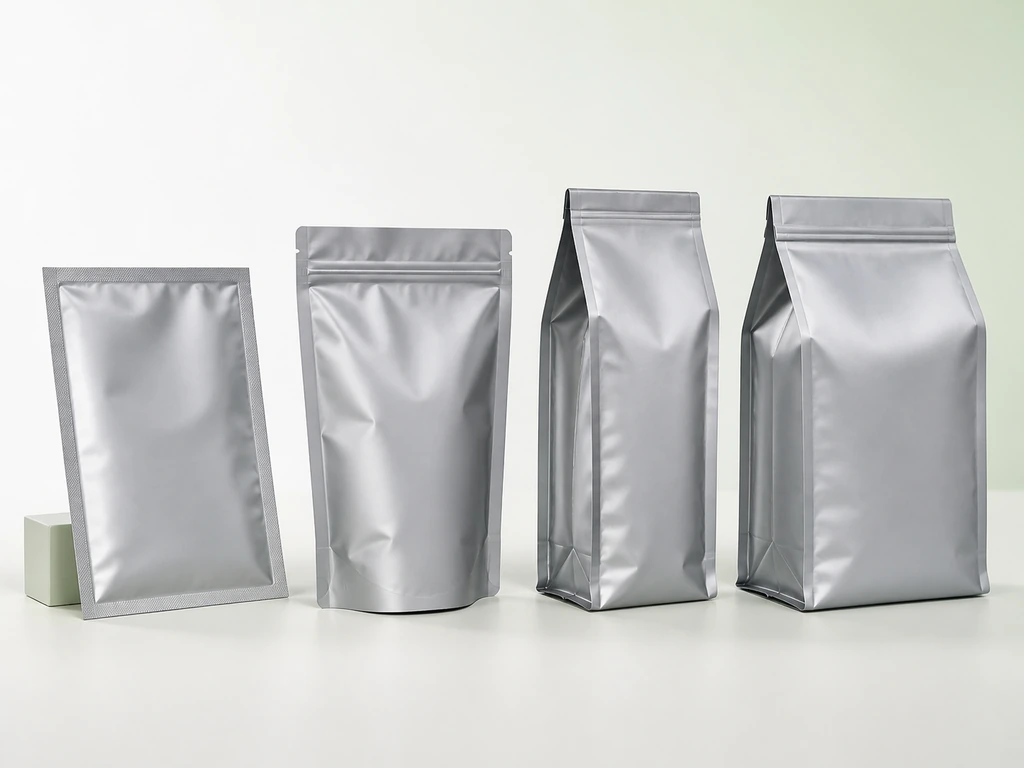
Structure decides three things: whether the bag stands up, how much it holds, and what it costs. Four families cover nearly everything you’ll encounter.
| Bag structure | Construction | Self-standing | Typical sizes | Reference cost | Best for | Poor fit for |
|---|---|---|---|---|---|---|
| Flat pouch (pillow) | Two sheets sealed on 3 sides | No | 2″×3″ to 12″×18″ | $0.03–0.15 | Samples, spices, sachets, long-term storage | Retail shelf display, heavy products |
| Stand-up pouch (SUP) | Front + back panels, bottom gusset | Yes | 4 oz to 5 lb | $0.08–0.40 | Coffee, snacks, pet treats, supplements | Bulk storage, liquids without a spout |
| Side-gusseted bag | Side gussets expand when filled | Partially | 8 oz to 5 lb | $0.10–0.35 | Coffee beans, flour, granola, pet food | Small portions |
| Flat-bottom pouch | Box-style base, side gussets | Yes (most stable) | 4 oz to 2 lb | $0.15–0.55 | Premium coffee, luxury snacks, gifts | Budget-sensitive products |
The pattern is simple: the more structure a bag has, the more it costs and the better it presents. Flat pouches win on pure economics — they’re the cheapest format and run at high speed on vertical form-fill-seal lines. Stand-up pouches win the shelf: a bottom gusset gives them the presence of a rigid container at a fraction of the weight. Flat-bottom pouches go further still, with up to five printable panels for premium brands.
Closure and Feature Types: Zip Tops, Child Resistance, and More
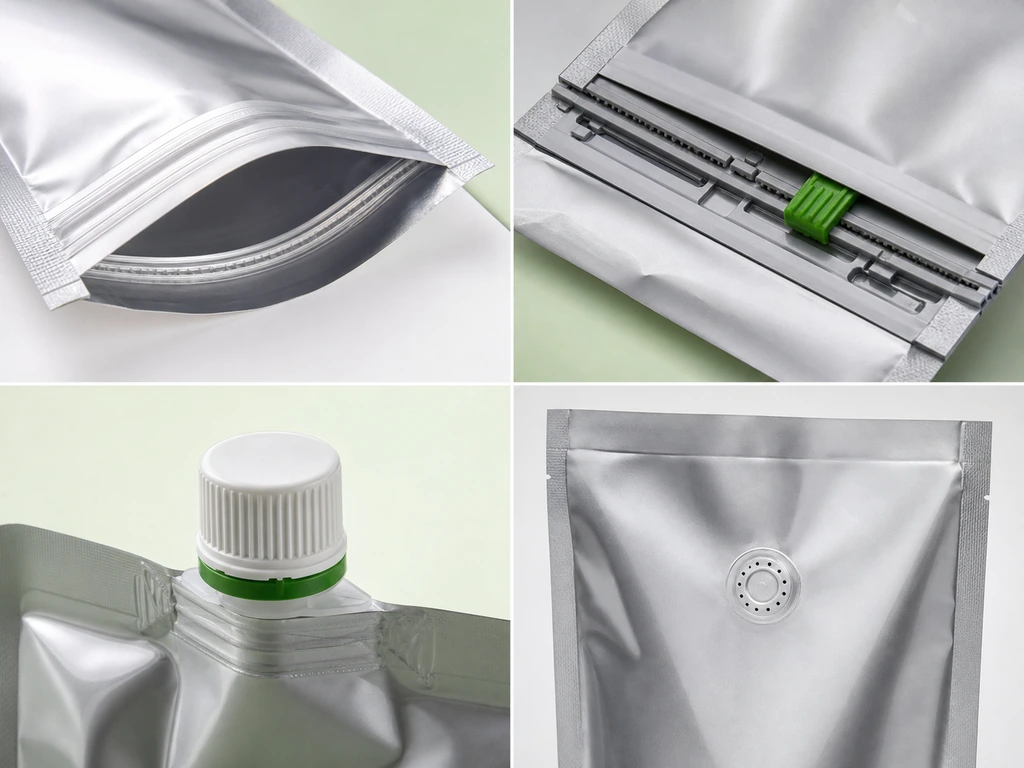
The second classification axis is how a bag opens, and who opens it. One question picks your feature set: how often will this pack be opened, and by whom?
| Feature | What it does | Typical add-on cost | Watch-outs |
|---|---|---|---|
| Resealable zipper | Press-to-close for repeat access | +$0.01–0.03 | For storage use, confirm the bag heat-seals above the zipper |
| Child-resistant (CR) closure | Press-and-slide or dual-action mechanism | Bags run $0.25–0.80 | Mandatory for cannabis/CBD and many pharma SKUs |
| Spout + cap | Controlled pouring for liquids | Bags run $0.30–0.80 | The only real option for sauces, baby food, liquid supplements |
| Degassing valve | One-way CO₂ release | +$0.02–0.05 | Standard on roasted coffee |
| Clear window | Product visibility | +$0.01–0.03 | Sell the “what’s inside” factor |
| Kraft paper exterior | Natural look over foil barrier | Varies | Organic coffee, bath salts, baking mixes |
Child-resistant bags deserve special attention because the requirement is a legal one, not a preference. In the U.S., CR packaging must pass 16 CFR §1700.20: panels of 50 children aged 42–51 months are tested, and no more than 20% may open the package within the full 10-minute test window.
Thickness: Matching Mil to Content and Shelf Life
A mil is 1/1000 of an inch (≈25.4 μm), and it’s the single most common source of buyer regret in the storage world — “I bought way too thin.” Thickness should follow three variables: the content, the storage duration, and how roughly the bag will be handled.
| Scenario | Typical content | Recommended mil | Why |
|---|---|---|---|
| Light retail snacks | Chips, candy, small dry goods | 3–3.5 | Light, non-sharp contents on indoor shelves |
| Standard retail food | Coffee, protein, pet treats | 3.5–5 | The workhorse range for retail and DTC |
| Heavy or sharp contents | Bulk pet food, mixes with sharp inclusions | 5–6 | Puncture resistance under weight |
| Long-term food storage | Rice, beans, oats, wheat | 5–7.5 | Storage communities swear by 5+ mil; 7 is the safety standard |
| Bucket liners (5-gallon) | 25–35 lb dry food, 10–30 year goals | 5–7.5 | Sized 18″×28″–20″×30″; pair with a 300cc oxygen absorber per quart |
One more storage-specific tip from the community: foil pinholes almost always come from folding and creasing in transit. For long-term storage, buy bags that ship flat or rolled and were never folded — and always check that zippered bags can still be heat-sealed above the zipper track.
How to Choose: Matching Bag Type to Your Product and Storage Setup
Type lists only get you so far. The shortcut that works is four questions, in order:
Answer those four, and the bag type almost chooses itself. The rest of this section turns each question into specifics.
Matching the Bag to Your Product Category
| Product category | Recommended bag type | Thickness | Must-have features |
|---|---|---|---|
| Snacks & nuts | Stand-up pouch | 3.5–5 mil | Resealable zipper, tear notch |
| Coffee (whole bean) | Side-gusseted or SUP | 4–5 mil | One-way degassing valve |
| Pet food & treats | Side-gusseted or SUP | 5–6 mil | Heavy-duty bottom gusset |
| Powders & supplements | Stand-up pouch, sachets for samples | 3.5–5 mil | Zipper + tamper-evident seal |
| Liquids & sauces | Spout pouch | 4–7 mil by viscosity | Spout fitment, tight seal around spout |
| Tea, dried fruit, colorful blends | Window or clear-front pouch | 3.5–4.5 mil | Clear panel sells the product |
| Samples & single-serve | Flat pouch or sachet | 3–3.5 mil | Lowest possible unit cost |
Long-Term Food Storage: The Spec Sheet You Can Copy
You don’t need to become a packaging engineer to store food for a decade. You need three things, and the community consensus on each is settled:
| Storage goal | Bag configuration | Oxygen absorber | Sealing |
|---|---|---|---|
| 1–5 years | 5 mil flat pouch, pantry or bin | 300cc per quart-size bag | Heat seal, or zip + heat seal above the track |
| 10–30 years | 5–7 mil flat pouch or bucket liner in a 5-gallon bucket | 300cc per quart, sized up with volume | Heat seal only; bucket adds structural and pest protection |
Three pitfalls that produce most of the “lost a year of rice” stories: bags bought too thin (under 5 mil), pinholes from folded or creased bags, and zipper bags that can’t be heat-sealed above the zipper. Check all three before you commit a season’s harvest.
Custom Orders: The 8 Specs to Put in Your Quote Request
If you’re pricing custom bags for a product launch, the fastest way to get an honest, comparable quote is to send the same eight specifications to every supplier:
Two verification moves separate serious suppliers from the rest: request a physical sample before approving production, and ask for the material structure report — the document that states the actual foil or coating spec. The more complete your spec sheet, the harder it is for a quote to be padded.
What a Mylar Bag Really Costs (and Why Identical Bags Differ in Price)
Now that you know the types, the prices should make sense. Every dollar maps to a spec you’ve just seen.
| Bag type | Typical price range |
|---|---|
| Flat pouch | $0.03–0.15 |
| Stand-up pouch | $0.08–0.40 |
| Side-gusseted bag | $0.10–0.35 |
| Flat-bottom pouch | $0.15–0.55 |
| Child-resistant bag | $0.25–0.80 |
| Spout pouch | $0.30–0.80 |
What the Bag Choice Means for a Product Business
So far this has been a consumer story. But every pattern above is also a business signal. The same facts, read from the other end of the supply chain.
Start with what end users actually say. Storage buyers don’t ask for “high-barrier solutions”; they ask whether the bag is 7 mil, whether it seals above the zipper, and whether it was ever folded — because thin film and pinholes are exactly where their food goes bad. What looks like pickiness is a market structure: these buyers are paying for spec certainty, not brand promises. They make decisions on community consensus and hard numbers, and their disappointments concentrate in a single place — spec failures that only show up months later, after the food is already stored. Their biggest blind spot is the one we opened with: most of them can’t tell foil from metallized film, which is precisely where the price spreads hide.
For anyone selling into this market, that structure translates into concrete moves. Publish your specs the way customers talk about them — “7 mil, heat-seals above the zipper, ships uncreased” is stronger marketing than “premium barrier packaging.” Educate on the structure gap before competitors do; the brand that teaches foil-versus-metallized owns the trust. And treat thickness and structure claims as the first thing a serious buyer will verify, because the cost of being wrong is a customer’s entire stockpile.
The B2B side of the same story is a different business shape. Custom bag orders are mostly reorder-style purchasing (brands restocking proven packaging), mixed with project-style new product launches. Typical orders start small, in the 1,000–10,000 bag range for a first run, and the buyer is usually a founder or product manager, not a packaging engineer. Every order passes the same gates. Sampling comes first, then compliance checks, and a small validation run. And when the bag is wrong — leaks, failed seals, a CR closure that doesn’t pass testing — the brand absorbs the failure cost, not the supplier.
That’s why the winning supplier behaviors in this market are predictable: digital printing with genuinely low minimums and fast proofs, because that’s what lets a first launch happen at all; certifications (BRC, ISO 9001, SGS) as the entry ticket rather than a differentiator; and the ability to quote against a complete spec sheet, because parameterized quoting is how professionals tell each other apart from order-takers.
At Baishen Pack, we manufacture custom Mylar bags around your product and filling process. We can tailor the pouch style, size, film structure, thickness, barrier level, zipper or tear notch, printing, and matte, gloss, or metallic finish. Our in-house printing, lamination, slitting, and bag-making workflow supports low-MOQ digital runs, multi-SKU launches, digital proof feedback typically within 24 hours, and custom samples before production. Tell us what you are packing, and we will recommend the right structure and quote it.
References
- U.S. eCFR. “16 CFR §1700.20 — Testing procedure for special packaging.”
- Smithers. “The Future of Pouch Packaging to 2029.” 2024.
- Grand View Research. “Stand-up Pouches Market Size, Share & Trends Analysis Report.” 2023.
- Cubit Packaging. “Types of Mylar Bags: Every Style Compared.” 2026. (Reference price ranges.)
- Baishen Pack. “Contact.”
- Baishen Pack. “Custom Flexible Packaging Manufacturer.”