
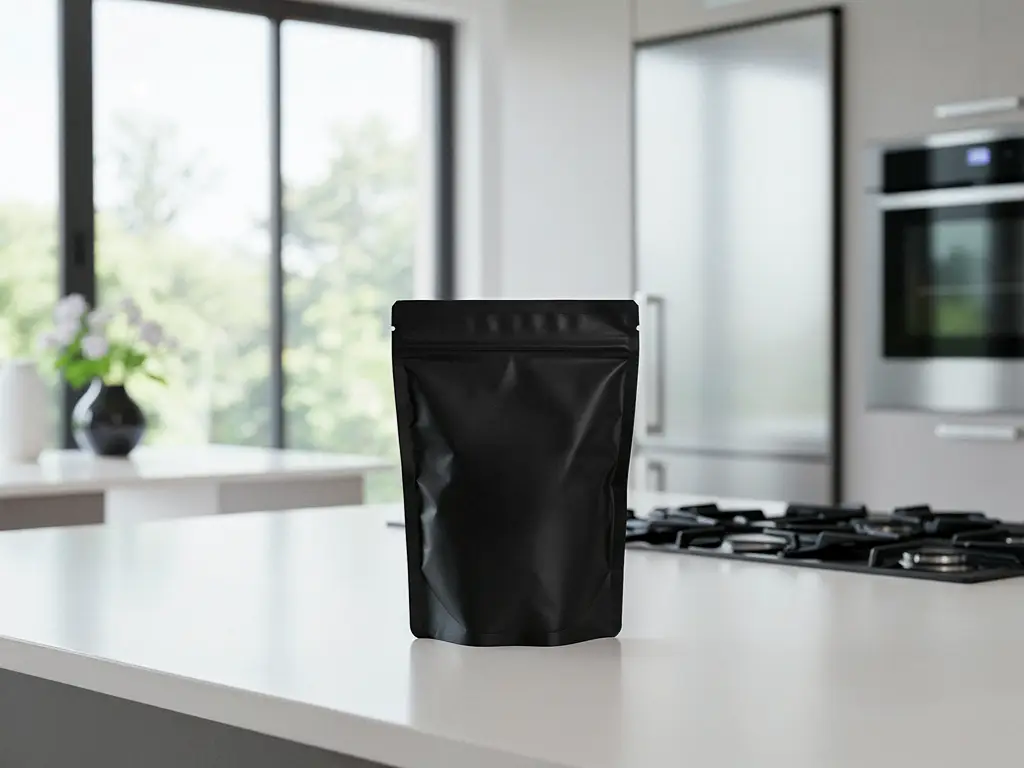
What Are Mylar Bags Made Of? A Layer-by-Layer Breakdown
Hold a shiny silver pouch in your hand and you will likely wonder whether you are holding plastic, metal, or some odd hybrid of the two. You are asking one of the most common packaging questions on the internet.
The short answer: a Mylar bag is a sandwich of both, layers of plastic film and a layer of aluminum working together. The long answer matters more than most people expect, though. Two very different constructions are sold under the same name, and which one you buy decides how well your food keeps.
What “Mylar” Actually Is: A Name, Not a Material
Mylar is not a material. It is a brand name that became a category. The name belongs to a polyester film made from stretched polyethylene terephthalate (PET), technically called biaxially-oriented PET, or BoPET. Developed in the 1950s, it is still produced by the trademark’s current owner, Mylar Specialty Films (formerly DuPont Teijin Films). In its original form, the film is transparent, strong, and flexible. Helium balloons, emergency blankets, and solar filters come from the same material family.
The bags you buy for food storage are not just BoPET. A plain polyester film lets light through and has only a modest barrier to oxygen. Fine for a balloon, useless for a 25-year rice supply. So converters laminate that film with other layers until it becomes something else entirely: a multi-layer barrier bag. That is what “Mylar bag” means in everyday use.
The Three Layers Inside a Mylar Bag
Strip a quality Mylar bag apart and you will find three functional layers, each with a specific job:
| Layer | Material | Job in the Bag | Why It Matters |
|---|---|---|---|
| Outer | BoPET (polyester film) | Strength and print surface | Resists punctures and tears; holds high-resolution print |
| Core | Aluminum foil (or metalized coating) | Blocks oxygen, light, and moisture | Decides how long the contents stay fresh |
| Inner | Polyethylene (PE) | Food-contact surface and heat-seal layer | The only layer that touches food; makes the bag sealable |
Each layer earns its place. The outer BoPET film carries the tensile strength. Polyester is stretched in two directions during manufacturing, which gives it tear resistance that a snack bag made of thin kitchen wrap can only dream about. The aluminum core is the reason Mylar bags are used for long-term food storage at all. Metal is opaque to light and effectively impermeable to gas, so the core layer turns the pouch into a flexible can. And the inner PE layer does two quiet jobs. Because it is food-safe and inert, nothing from the outer structure touches your food. It also melts at a relatively low temperature, which is what allows the bag to be heat-sealed shut in the first place.
Notice the word “or” in the core layer row. Not every shiny silver bag carries a real foil core. Some carry a coating of aluminum so thin it is measured in nanometers rather than microns. That single difference changes everything, and it is the subject of the next section.
Foil Laminate vs. Metalized Film: Two Bags, Same Name
One question sorts every Mylar-style bag on the market: is the core layer a solid sheet of aluminum foil, or a vapor-deposited aluminum coating? A solid foil sheet is a true barrier. A vapor-deposited coating is mostly for looks. Everything else follows from that answer.
How Each Construction Is Made
The two constructions come from two completely different manufacturing processes.
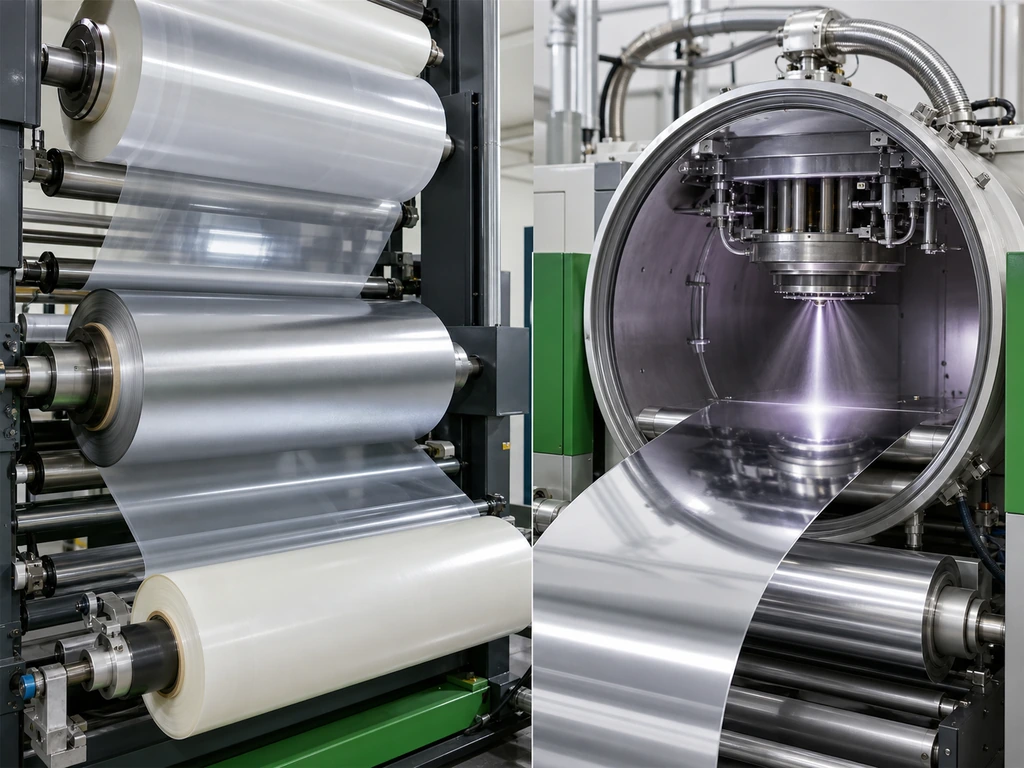
In a foil laminate, a real sheet of aluminum is bonded with adhesive between the outer polyester film and the inner polyethylene layer. It is typically 6 to 9 microns thick, roughly a tenth the thickness of kitchen foil. Because the aluminum is a continuous, unbroken metal sheet, gas molecules simply have no path through the core. The barrier is physical, not chemical.
A metalized film starts differently. In a vacuum chamber, aluminum is heated until it evaporates. As it cools, the vapor condenses onto the surface of a PET film as a coating just tens of nanometers thick. That is hundreds of times thinner than the foil used in a laminate. The result is a brilliant silver finish at a fraction of the material cost. But a nano-thin coating is not a solid wall: it carries microscopic pinholes and flex cracks, and its gas barrier is far weaker.
Barrier Performance, Price, and Where Each Belongs
That difference in manufacturing shows up in the numbers, and in the shelf-life claims a bag can honestly make.
| Dimension | Foil Laminate | Metalized Film |
|---|---|---|
| Oxygen barrier (OTR) | < 0.01 cc/m²/day, near zero (PackagingBest, 2025) | roughly 1–10 cc/m²/day (ScienceDirect) |
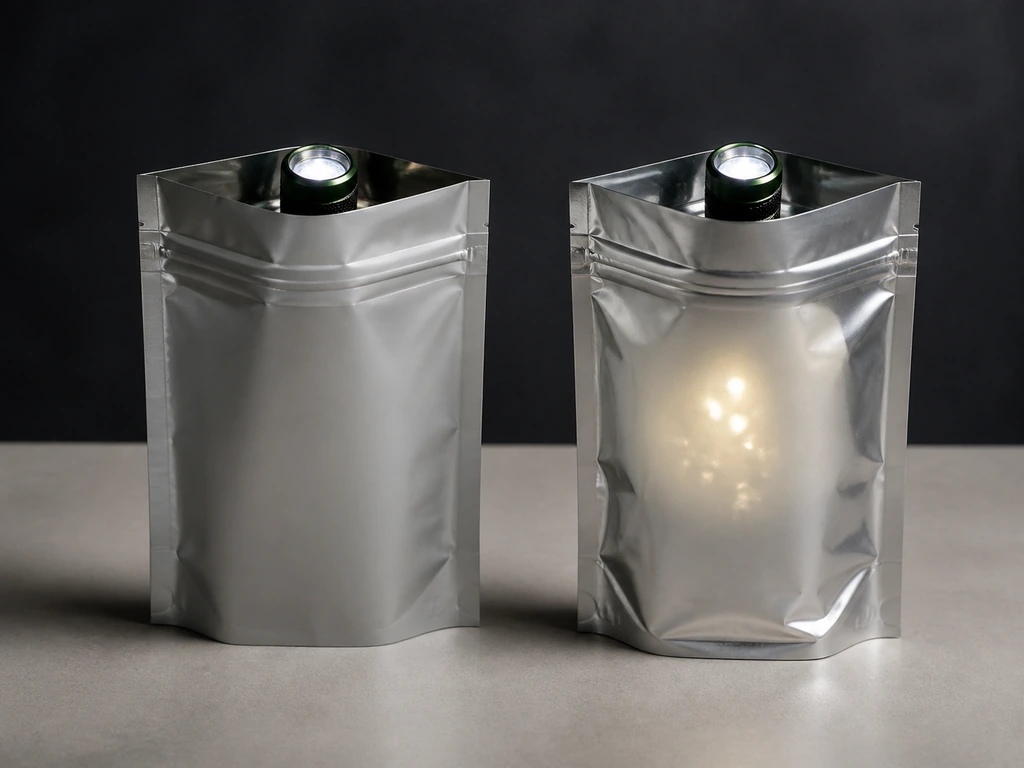
| Light block | Total opacity | Strong, but a flashlight shows faint glow |
| Durability | High puncture resistance; fold lines turn white but do not break | More flexible, no fold cracking, but punctures easily |
| Typical use | Long-term food storage (5–25+ years), rations, high-value products | Short-to-mid shelf-life snacks, display packaging, balloons |
A metalized bag is not a counterfeit. Metalized film simply does a different job. On a retail shelf, it shines. It costs less per unit, which makes it a smart choice for snack packs that sell within months. The mismatch happens when a metalized bag is bought to do a foil laminate’s job. No amount of oxygen absorbers can compensate for a barrier that leaks 100 to 1,000 times more oxygen. This is also why demanding applications upgrade the whole structure. U.S. military MRE pouches, for instance, use a nylon outer layer instead of polyester for extra puncture resistance on top of the foil core (SorbentSystems).
How to Tell Which One You’re Holding
You rarely need a lab. Three checks sort almost every bag in the market:
- The flashlight test. In a dark room, put a bright flashlight inside the empty bag. Light glowing through means a metalized or thin-foil structure; total darkness means a genuine foil laminate.
- Read the spec sheet. The words “VMPET,” “METPET,” or “metallized” describe a metalized film core. The letters “AL” or “ALU” with a thickness (for example, “AL 7µ”) describe real aluminum foil.
- Match the claims to the price. A “25-year shelf life” bag priced like a snack bag is almost always a metalized film dressed up as a storage bag.
Does the Metal Touch Your Food? The Layer That Decides Safety
No. In a properly constructed bag, the aluminum never touches the contents. Inside the bag, the foil core sits sandwiched between the outer polyester film and the inner polyethylene layer. The only material in contact with food is that inner PE sealant layer. It is the same family of plastic used in milk jugs and food storage bags. The metal’s job is structural, not culinary.
What “food grade” actually verifies is the better question. In the United States, the FDA does not certify finished bags. It approves the raw plastic resins for food contact, such as the PET and polyethylene covered under 21 CFR Part 177 (FDA). A trustworthy supplier should be able to document that the materials in your bag come from approved resins. Two safety notes follow from the materials themselves. Polyester’s melting point near 260°C (500°F) (Pilcher Hamilton, 2025) does not make the bag boilable, and the metal core makes it absolutely non-microwaveable. For a deeper look at safety myths, from BPA to microplastics, see our guide to Mylar bag safety.
Choosing the Right Construction for What You Store
The right material is a function of three questions: how long the product must last, what it is, and whether it sells at retail or sits in your pantry. Answer those three, and the construction choice follows.
| Use Case | Recommended Structure | Typical Thickness | Notes |
|---|---|---|---|
| Home long-term storage (5–25 years) | Foil laminate + oxygen absorbers | 5–7 mil | Low-moisture dry goods only (<10% moisture); seal, then store cool and dark |
| Short-to-mid-term home use (1–2 years) | Foil laminate or heavier metalized film | 3.5–5 mil | Budget-sensitive buyers can use metalized film with a faster rotation schedule |
| Retail brand packaging (snacks, coffee, pet food) | Metalized or foil, matched to shelf life | 120–150 microns (about 4.7–5.9 mil) | Custom printing plus zippers, tear notches, and other closures |
| E-commerce small batches (low MOQ) | Digitally printed custom pouches | 120-micron class | No plate fees; runs from 500 pieces are practical |
One more axis matters for brands: form. The same three-layer material system can be converted into stand-up pouches that hold a retail shelf, flat pouches for bulk and pantry use, or roll stock film. Companies with their own filling lines buy the film instead of finished bags. Families storing rice at home will buy flat pouches and a heat sealer; a coffee brand launching on Amazon will buy printed stand-up pouches with a zipper. Same core materials, different formats. The material question and the format question are two separate decisions.
What the Material Question Means for Your Business
The same facts we have been working through look different from the other side of the transaction.
For the people buying bags one at a time, the picture is simple: they cannot see structure, so they improvise tests for it. The flashlight test and the fold-line check exist because buyers learned the hard way: two silver bags can look identical while differing by orders of magnitude in oxygen barrier. And “quality varies from manufacturer to manufacturer” is not a warning label but a market condition. Most buyers also never learn that food-contact approval applies to the resin, not the finished bag. So they accept the phrase “FDA approved” as a complete answer when it is only half of one. In practice, that means a large share of retail bag purchases are being made on price against a spec nobody printed. That is the definition of buying blind.
For the people selling or sourcing bags, that same blindness is the opportunity. When buyers cannot read a spec sheet, the seller who prints the structure becomes the seller who gets the order. And for buyers, the cheapest insurance is a three-line addition to any RFQ. Those three lines cost nothing to request and everything to skip.
Structurally, this is a mixed-format business. Standard-size barrier bags move as stocked goods through distributors to home-storage buyers. Custom-printed pouches move as project orders: artwork approval first, then a pre-production sample, then production. Order sizes run from 500-piece digital runs for a startup’s first SKU up to distributor volumes. For most buyers in that range, sample speed and honest specifications matter more than a supplier’s name recognition. Certifications get you into the conversation; a transparent spec sheet and a believable lead time close it.
Baishen Pack provides custom Mylar bags for product launches, multi-SKU programs, and volume production. We can tailor the bag format, size, high-barrier material structure, zipper or tear notch, print, and matte, gloss, or metallic finish to your product. Digital printing starts at 500 pieces, with 24-hour digital proofing and custom sample support; production typically takes 7–10 business days after artwork approval.
References
- Mylar Specialty Films. “Mylar® Polyester Films.”
- U.S. FDA. “21 CFR 177.1630 — Polyethylene phthalate polymers.” eCFR.
- ScienceDirect. “Oxygen Transmission Rate — an overview.”
- PackagingBest. “Mylar vs Sustainable Pouches: Long-Term Food Storage Compared.” 2025.
- Pilcher Hamilton Corporation. “Ultimate Guide to BOPET Films.” 2025.
- SorbentSystems (IMPAK). “Mylar® Base Barrier Bags and Pouches.”
- Baishen Pack. “Mylar Bags with Good Barrier Property.”
- Baishen Pack. “Are Mylar Bags Toxic: Myths, Facts, and Safety Guidelines.” 2025.
- Baishen Pack. Homepage.