
What Are the Colored Dots on Chip Bags? The Printing Quality Secret Behind Your Snacks
What Are the Colored Dots on Chip Bags? (The Short Answer)
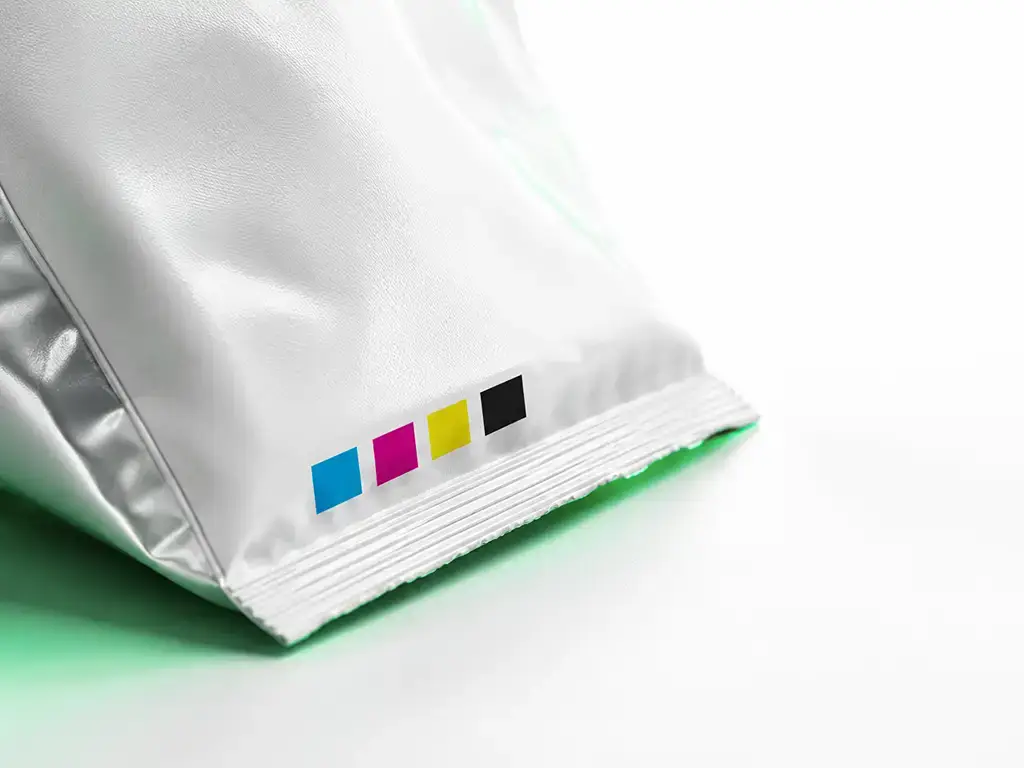
You’ve seen them — a row of small, colorful circles or squares printed along the bottom edge or side seam of your favorite bag of chips. Maybe you’ve wondered if they’re a secret code about ingredients, a freshness indicator, or something the manufacturer doesn’t want you to know. The answer is simpler and more interesting than any of those theories.
Those colored shapes are called printer’s color blocks, process control patches, or color control targets. They are a quality control tool used during the printing process to verify that the ink colors on the packaging are accurate and consistent. In short: they’re not for you — they’re for the printing technicians who produce millions of identical packages every day.
The colors you’ll typically see are black, magenta (a bright pink-red), cyan (a vivid blue), and yellow — the four base inks of the CMYK printing system used in most packaging production. Some bags show more than four dots. That’s because certain packages use additional “spot” colors for brand-specific shades: the iconic orange on a Cheetos bag, the deep blue on a Cool Ranch Doritos package, or the bright yellow of a Lay’s Classic. Each of those colors gets its own control patch so the printer can monitor it independently.
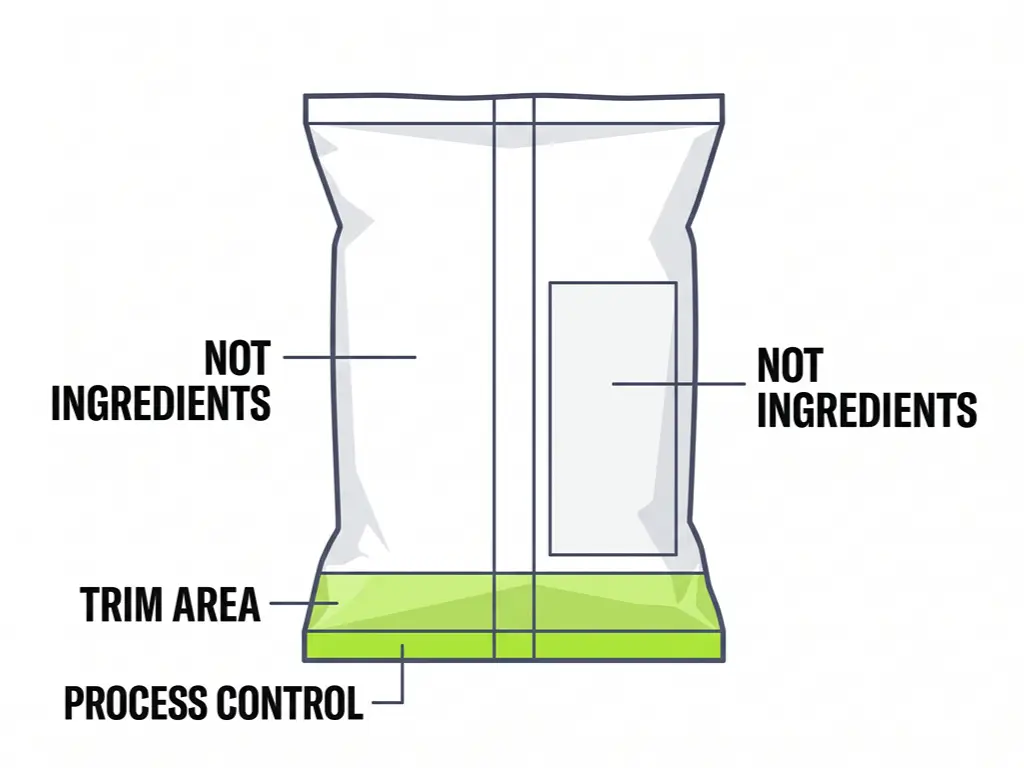
Why can consumers see them at all? The patches are printed in what’s called the trim area — the margins of the packaging material that are supposed to be cut off during finishing. Some manufacturers leave them visible because trimming every millimeter adds cost. Others remove them entirely. Whether a bag has visible dots tells you nothing about the food inside — only about that factory’s finishing process.
Think of it this way: these color patches are the printing equivalent of a sound check at a concert. The audience isn’t meant to hear the sound check, but it ensures the actual performance is flawless. The color patches do the same job — making sure every bag looks exactly how the brand intended, whether it’s the 100th bag or the 10 millionth.
What Those Color Patches Definitely Do NOT Mean
Whenever something looks like a code, people understandably assume it is a code. The colored dots on chip bags have spawned a remarkable number of urban legends — most of which circulate on social media and YouTube, where a short video asking “what do these dots mean?” can rack up millions of views without ever providing a correct answer.
Let’s clear the air. The colored patches on your chip bag are not:
- A secret ingredient code. This is the most persistent myth. No government agency — not the FDA, not the European Food Safety Authority, not any national food regulator — requires or defines color-coded dots as an ingredient labeling system. The ingredients are listed in the ingredients panel, in plain text, as required by law.
- A freshness or expiration indicator. The dots don’t change color over time or react to temperature. Your bag’s expiration date is printed separately, usually in black ink on the back or bottom.
- A flavor identifier. The number and color of the patches have nothing to do with what the food tastes like. A bag with four dots isn’t necessarily plain and a bag with six isn’t spicy.
- A hidden message for consumers. There is nothing to decode. The dots serve the printing supply chain, not the retail customer.
Next time you’re holding a bag of chips, try this: count how many colored dots or squares you see, and note which colors appear. Then look at the main design on the front of the bag. You’ll notice that every color on the package — from the logo to the product photo to the background gradient — is represented among those patches. They’re not a code. They’re a mirror of the printing process itself.
Inside the Printing Process — How Color Control Patches Actually Work
Understanding what the dots are is one thing. Understanding how they work — and why an entire industry relies on them — reveals a fascinating intersection of manufacturing precision and brand economics.
The critical thing to know is this: printing millions of identical chip bags is extraordinarily difficult. A single bag might pass through multiple printing stations, each applying a different color at high speed. If any one station drifts even slightly — too much magenta, not enough yellow — the entire production run can come out looking wrong. And “looking wrong” for a consumer brand isn’t a minor inconvenience. It’s a business problem.
CMYK on the Factory Floor — The Four-Color Quality Check
Most snack packaging is printed using flexographic printing (often shortened to “flexo”), a high-speed rotary process. Flexible plates transfer ink onto the packaging material — usually a multi-layer plastic film or laminate. Each color in the design gets its own printing station with its own plate, its own ink reservoir, and its own set of variables that can drift during a production run.
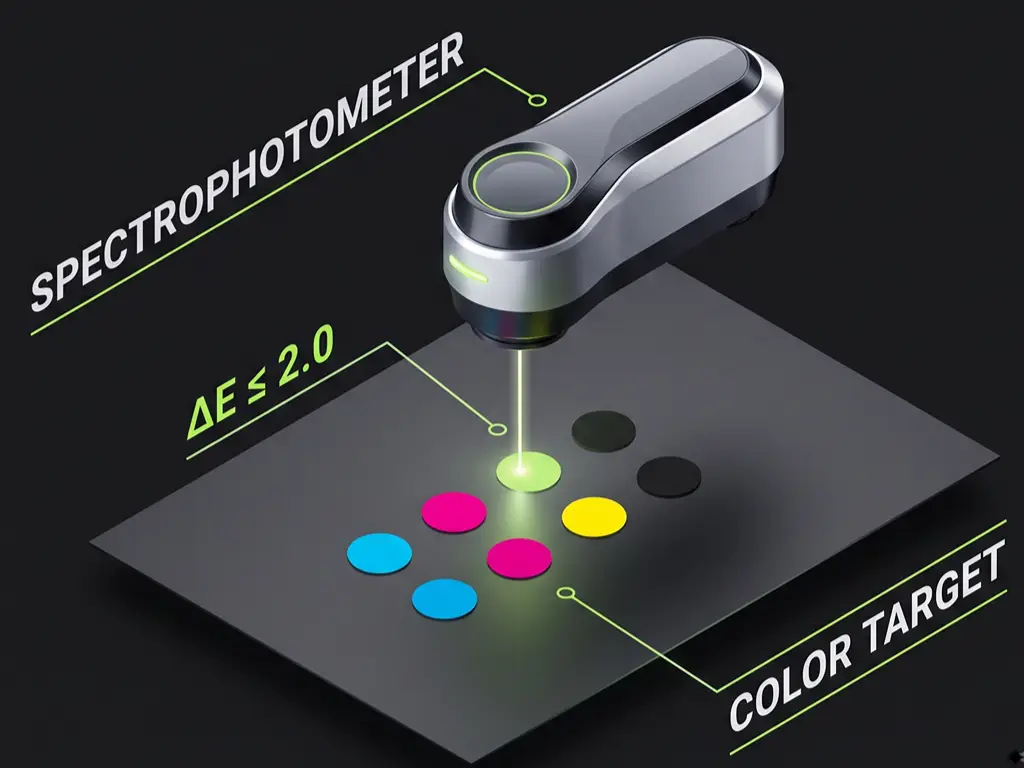
The color control patches give technicians a real-time window into what’s happening at each station. During production, a technician pulls sample bags at regular intervals — typically every 20 to 30 minutes — and checks the color patches against a master reference. They may do this visually, but in professional operations they use a device called a spectrophotometer, which measures color numerically using L*a*b* values (lightness, green-red axis, blue-yellow axis).
Here’s where it gets precise. Brand owners typically require color accuracy within a Delta E (ΔE) of 2.0 or lower. Delta E is the standard unit of color difference — a ΔE of 1.0 is roughly the threshold at which a trained eye can detect a difference. If a measurement comes back at ΔE 3.5, that color is visibly wrong, and the press needs adjustment. The international standard governing this process is ISO 12647-6:2020, which defines the requirements for process control in flexographic printing of packaging materials (ISO/TC 130, 2020).
These color patches are so essential to quality control that industry guidelines — such as those published by the Flexographic Technical Association (FTA) — specify that control strips should include at least seven measurement points: the minimum printable dot, tonal values at 10%, 30%, 50%, and 70%, a solid 100% fill, and the bare substrate itself (FTA FIRST Methodology). Each patch answers a different question about the press’s performance, from “can it hold the finest detail?” to “is the solid color fully saturated?”
Beyond CMYK — Spot Colors and Brand Identity
Walk down any supermarket snack aisle and notice how you navigate. You don’t read every label — you scan for colors. The orange bag. The blue bag. The red canister. Research has consistently shown that color increases brand recognition by up to 80% (University of Loyola, Maryland study), and consumers form an initial judgment about a product within 90 seconds — with up to 90% of that assessment based on color alone.
This is why major food brands treat their signature colors as intellectual property worth protecting with industrial-grade precision. That specific shade of orange on a Cheetos bag isn’t just “orange” — it’s a Pantone-specified spot color, mixed from a proprietary formula. Every production run must match it within a tolerance of ΔE ≤ 2.0. If a print run drifts outside that tolerance, the brand can — and sometimes does — reject the entire shipment.
Spot colors get their own dedicated control patches because they can’t be reliably reproduced by mixing CMYK alone. A signature orange might require a precise blend of pigments that the four-color process can only approximate. When you see more than four colored dots on a package, the extras are almost certainly spot-color patches — each one monitoring a brand-critical shade.
Some modern flexo printers use a technique called Extended Color Gamut (ECG) printing, which adds Orange, Green, and Violet (OGV) to the standard CMYK set. This seven-color process can reproduce up to 85% of Pantone spot colors within a ΔE of 2.5, reducing the need for custom spot-color mixing. But whether four-color, seven-color, or spot-color, the principle stays the same: every ink needs a control patch, and every control patch needs a technician watching it.
The India Exception — When Dots Do Tell You About the Food
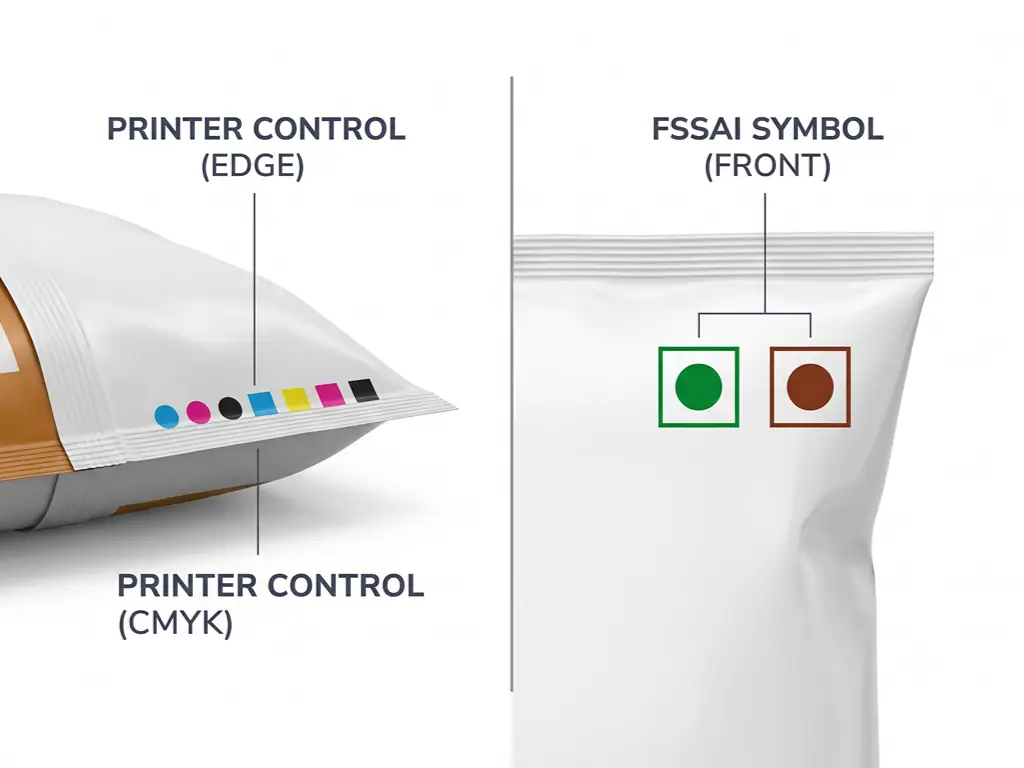
At this point, readers from India may be thinking: “Wait — in India, the green dot DOES tell you something about the food.” And they’re right. The Indian food regulatory system uses a completely separate dot-based labeling scheme. It’s important to distinguish it from the printing color blocks we’ve been discussing.
Under the Food Safety and Standards (Packaging and Labelling) Regulations, 2011, issued by the Food Safety and Standards Authority of India (FSSAI), all pre-packaged food sold in India must display a symbol indicating whether the product is vegetarian or non-vegetarian. But here’s a detail that surprises many people: the non-vegetarian symbol is brown, not red. The widespread belief in a “red dot” for non-veg is a misconception — the official FSSAI standard specifies a brown-filled circle inside a brown-outlined square.
The two systems are easy to tell apart once you know what to look for:
| Feature | Printer’s Color Blocks | Indian FSSAI Symbols |
|---|---|---|
| Purpose | Print quality control for manufacturers | Consumer information about food content |
| Colors | CMYK + spot colors (varies by design) | Green (vegetarian) + Brown (non-vegetarian) |
| Shape | Circles or squares, randomly arranged | Filled circle inside a square outline |
| Position | Bottom edge, side seam, or trim area | Front of package, near the product name |
| Required by law? | No — entirely voluntary | Yes — mandatory for all pre-packaged food in India |
| Who is it for? | Printing technicians | Consumers |
The short version: if you’re in India and see a green or brown dot inside a square on the front of the package, that’s the FSSAI vegetarian/non-vegetarian declaration. If you see a row of multicolored circles along the bottom edge or seam, those are printer’s color blocks — regardless of what country you’re in.
Why Color Quality Matters for Your Food Brand
So far, we’ve answered the consumer’s question. But if you’re someone who actually orders custom packaging — a food brand founder, a product manager, a startup entrepreneur — the story of those colored dots has a different ending. It’s not just trivia. It’s a window into one of the most important quality decisions you’ll make about your product’s shelf presence.
Think about it: you’ve invested in your recipe, your branding, your logo design, your social media presence. A customer walks into a store, scans the shelf, and in less than two seconds their eyes land on a package. If the colors on that package don’t match what they’ve seen online — too dark, too washed out, slightly the wrong shade — they might not even recognize it as your product. That’s not a hypothetical. It happens every day in retail.
The Real Cost of Color Inconsistency — What’s at Stake
For a small or mid-sized food brand, a single batch of poorly printed packaging carries costs that go far beyond the printing invoice:
- Rework and reprinting: If a print run fails color inspection, the entire batch of packaging material is scrap. For a flexo print run — where each color requires a separate printing plate costing $200 to $500 — the setup investment alone can reach $1,600 to $4,000 for an eight-color design, plus the cost of wasted material. A rejected batch can easily cost a small brand $5,000 to $20,000 in plates, material, and production downtime.
- Delayed product launch: If your packaging isn’t ready, your product can’t ship. In the food industry, missing a scheduled retail slot or a seasonal launch window — holiday snacks, summer beverages, limited-edition flavors — can mean losing an entire sales cycle.
- Brand perception damage: Consumers don’t think “oh, the printer made a mistake.” They think “this product looks cheap” or “is this a counterfeit?” Brand trust, once eroded by inconsistent packaging, is expensive to rebuild.
This is why large food brands invest heavily in color management. They employ dedicated print quality managers, specify ΔE tolerances in supplier contracts, and audit production facilities. They know the cost of preventing color drift is a fraction of the cost of fixing it after thousands of bags are already printed.
Traditional vs. Digital — How Modern Printing Changes the QC Game
Not all printing technologies handle color quality the same way. Understanding the difference matters — especially if you’re a smaller brand that can’t afford the setup costs and minimum order quantities of traditional flexo printing.
| Aspect | Traditional Flexo Printing | Digital Printing |
|---|---|---|
| Color QC method | Manual visual checks of color patches + periodic spectrophotometer readings | Inline spectrophotometer with closed-loop, per-print auto-calibration |
| Setup cost | $200–$500 per color plate | $0 (no plates required) |
| Typical minimum order | 5,000+ units (to amortize plate costs) | 500 units |
| Color accuracy (typical) | ΔE ≤ 2.0–2.5 (operator-dependent) | ΔE ≤ 1.5 (software-controlled, per-print) |
| Turnaround time | 3–6 weeks (includes plate manufacturing) | 7–10 business days |
Digital printing represents a fundamental shift in how packaging color quality is managed. Instead of relying on a press operator to visually inspect color patches and make manual adjustments, digital presses use built-in spectrophotometers that measure every single print and automatically calibrate the color output in real time. The machine corrects itself before a deviation becomes visible — no colored dots needed on the trim line, no technician squinting at a reference card.
For small and emerging food brands, this technology changes the economics of packaging quality. Digital printing eliminates plate fees entirely, accepts orders as low as 500 units, and delivers consistent color whether you’re printing 500 bags or 50,000. Companies like Baishen, a digital flexible packaging manufacturer based in Guangdong, have built their production around this model — combining HP Indigo digital presses with automated inline color calibration to offer the same ΔE ≤ 1.5 color fidelity that large brands demand, but at order volumes and turnaround times (7–10 business days) that work for startups and SMEs.
This doesn’t mean digital printing has made traditional flexo obsolete — for ultra-high-volume runs in the millions of units, flexo remains more cost-effective per bag. But for the growing segment of specialty food brands, craft producers, and direct-to-consumer companies, digital printing has made professional-grade packaging color consistency accessible without the industrial-scale commitment.
The colored dots on your chip bag started as a curiosity. But behind them is a whole system of color science, manufacturing precision, and brand economics — one that affects every packaged product on every store shelf. Whether you’re a consumer who now has a great piece of trivia, or a brand builder thinking about your next packaging order, those little dots have something to teach.
If you’re sourcing custom flexible packaging and want to explore digital printing options — with plate-free setup, low minimum orders, and automated color quality control — Baishen’s catalog and contact details are available at bsflexpack.com.
References
- ISO/TC 130. “ISO 12647-6:2020 — Graphic technology — Process control for the production of half-tone colour separations, proofs and production prints — Part 6: Flexographic printing.” International Organization for Standardization, 2020. https://www.iso.org/standard/75219.html
- Flexographic Technical Association. “FIRST Methodology — Flexographic Image Reproduction Specifications & Tolerances.” https://www.flexography.org
- Food Safety and Standards Authority of India. “Food Safety and Standards (Packaging and Labelling) Regulations, 2011.” https://fssai.gov.in
- University of Loyola, Maryland. Study on color and brand recognition. Widely cited in marketing literature: color increases brand recognition by up to 80%.
- Baishen Pack. “Custom Flexible Packaging Manufacturer.” https://www.bsflexpack.com/
- Baishen Pack. “Contact.” https://www.bsflexpack.com/contact/