Cotton Candy Packaging Ideas — The Complete Guide to Formats, Materials, and Sourcing
You've perfected your cotton candy recipe. The colors are vibrant, the texture is cloud-light, and people love it. But between your spinning machine and the customer's hands sits a make-or-break moment: the package. Get it right, and your product stays fluffy for months while catching eyes on the shelf. Get it wrong, and that beautiful spun sugar turns into a sticky, collapsed lump in under three days.
Most packaging advice for cotton candy stops at "use clear bags and make them pretty." This guide goes deeper — covering the six format options, the moisture-barrier science that determines your shelf life, how to choose materials, design strategies that actually sell, where to find a manufacturer, and what you should expect to pay. Whether you're selling at a weekend farmers' market or aiming for regional retail shelves, you'll leave with a clear plan.
Packaging Formats That Work for Cotton Candy — Know Your Options Before You Buy
Before you choose a packaging format, answer three questions: (1) Where will your cotton candy be sold — online shipping, retail shelf, or in-person at events? (2) How long does it need to stay fresh — same-day consumption or weeks on a shelf? (3) What price point are you targeting — budget concession or premium gift? These three answers will point you toward the right format. Below is an overview of all six options, followed by a framework for matching format to sales channel.
The Six Packaging Formats for Cotton Candy — A Side-by-Side Overview
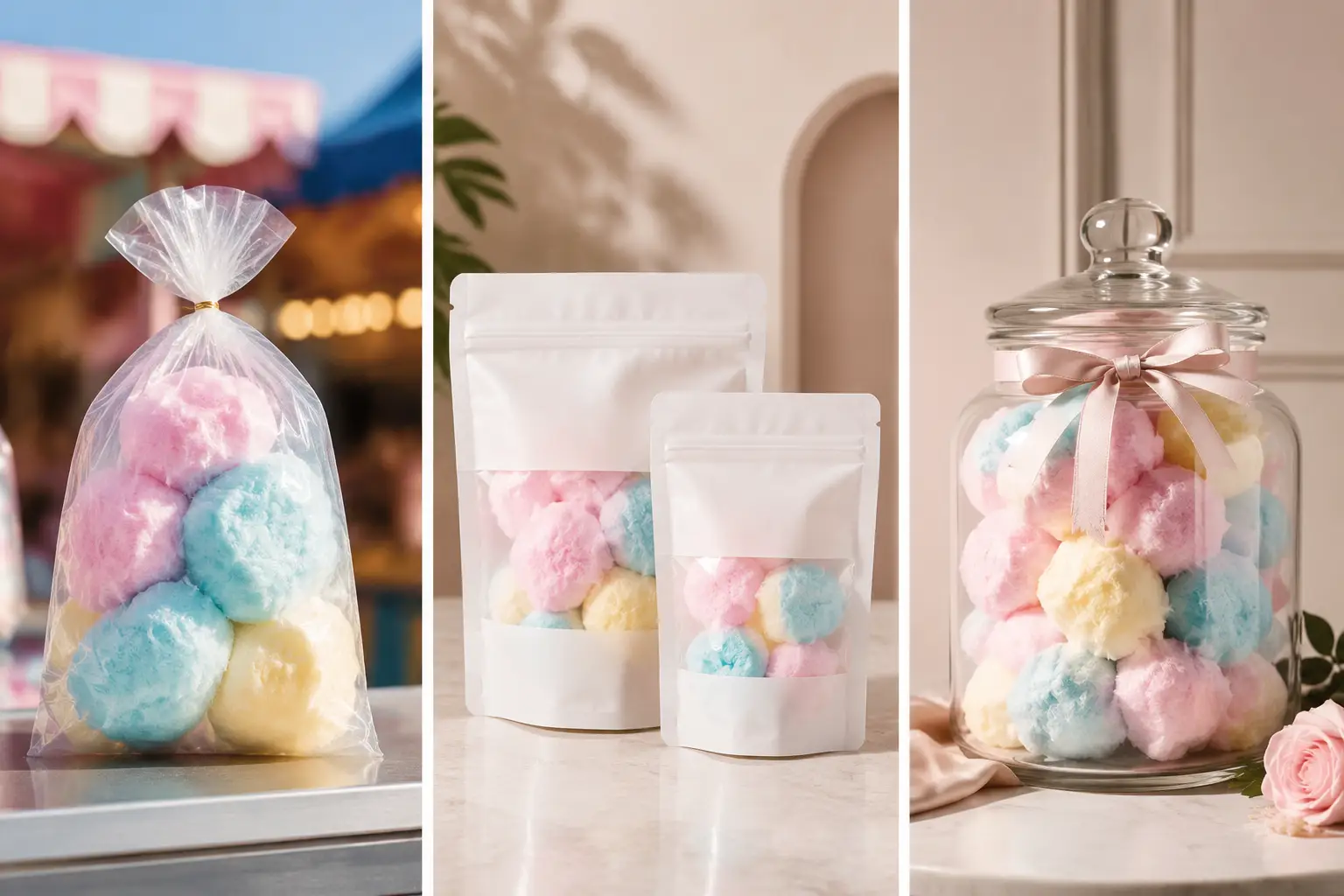
Clear polypropylene or cellophane bags are the most common and least expensive option. They offer full product visibility — a genuine advantage for cotton candy, where the colors drive impulse purchases. The downside: standalone poly bags have almost zero moisture barrier. Water vapor transmission rates (WVTR) for LDPE films typically sit around 18 g/m2/day at standard test conditions, which translates to a functional shelf life of roughly one to three days in ambient humidity. These are best suited for same-day or next-day consumption scenarios: carnival booths, fair concessions, and event sales.
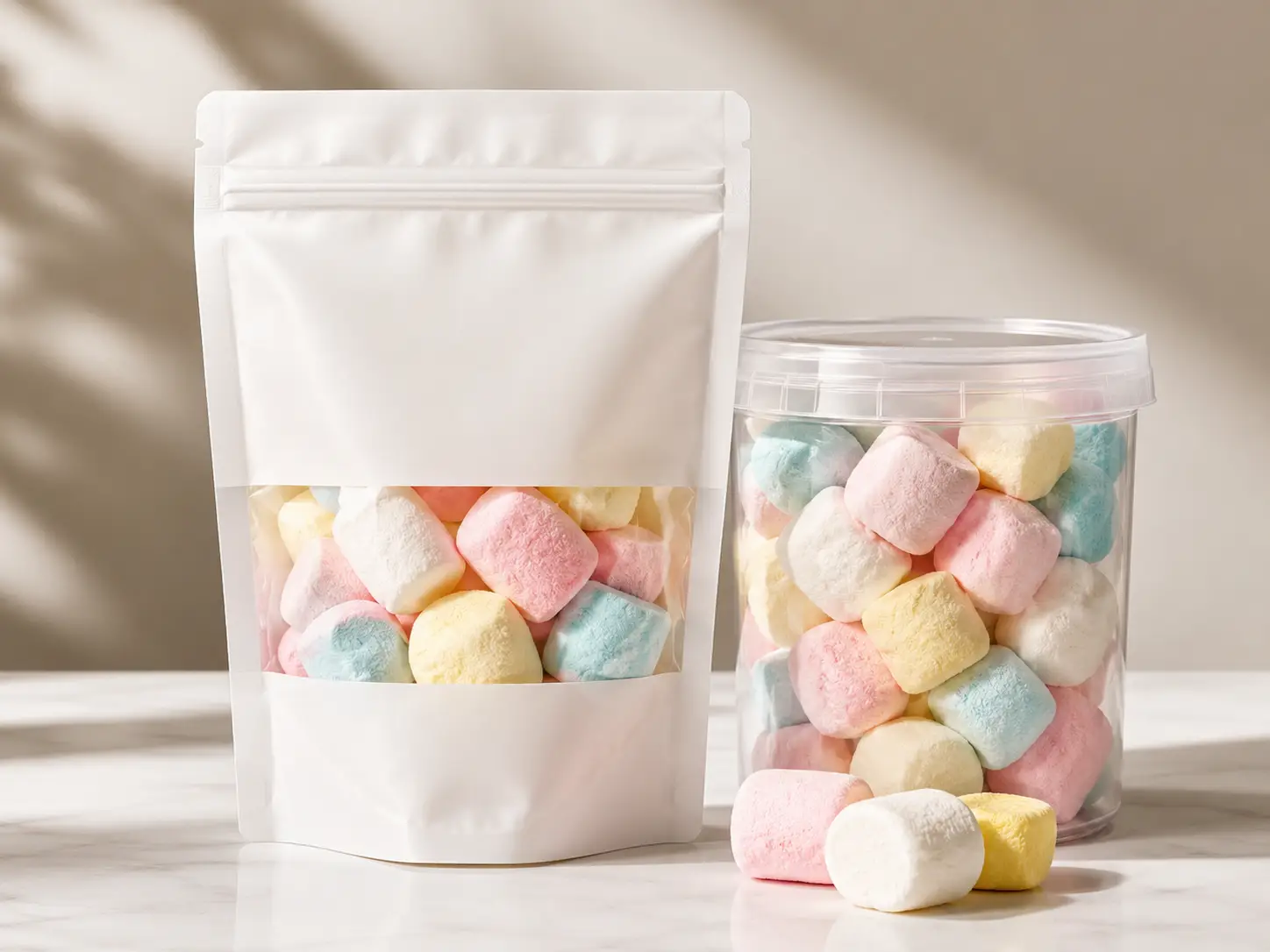
Resealable stand-up pouches (doypack style) are the retail workhorse of the flexible packaging world. They stand upright on shelves, can include a press-to-close zipper for consumer convenience, and — when built with a multi-layer structure — provide meaningful moisture protection. A metallized PET outer layer brings WVTR below 1 g/m2/day, extending shelf life into the months rather than days. This format signals "real product" to retail buyers and works equally well for e-commerce shipping.
Rigid polypropylene tubs or cups with snap-seal lids represent the premium end of the protection spectrum. A polypropylene container with 0.007–0.015-inch wall thickness and an airtight snap-seal lid creates a near-hermetic environment. Shelf life can extend from three days to two months or more compared to a basic bag. The rigid structure also prevents crushing during shipping and stacking — a critical consideration if your product will sit on retail shelves or travel through distribution channels. The trade-off is higher unit cost and bulkier shipping.
Kraft paper pouches serve the eco-conscious and artisan brand segment. The natural brown kraft exterior communicates handmade, organic, and sustainable values before the customer reads a single word. However, kraft paper by itself provides zero moisture barrier. Any kraft pouch intended for cotton candy must include an inner barrier liner — typically a thin PE or metallized film layer. With that liner in place, kraft pouches can achieve reasonable shelf life while maintaining their earthy aesthetic.
Glass jars occupy the gift and premium positioning. They offer total product visibility, a reusable container the customer keeps, and a perceived value that supports price points two to three times higher than bagged equivalents. The glass itself is an absolute moisture barrier; the seal quality of the lid determines actual performance. Jars are heavy and expensive to ship, which limits their viability for e-commerce-first brands.
Custom-printed boxes are the format for gift sets, multi-packs, and seasonal collections. Corrugated or paperboard boxes support full-surface printing for maximum brand presence and often include die-cut windows to reveal the product inside. Like glass, boxes work best when the contents are individually sealed in barrier packaging first — the box provides structure, branding, and giftability, while the inner pouch handles moisture protection.
How to Match Your Packaging Format to Your Sales Channel
Your sales channel dictates your packaging priorities more than any other factor. If you sell at farmers' markets and weekend events where the product is consumed within hours of purchase, a clear poly bag with a custom sticker gives you maximum visual appeal at minimum cost. If you ship through e-commerce — Etsy, Shopify, Amazon — you need three things: moisture protection (the package may sit in a warehouse or delivery truck for days), crush resistance (your package will be stacked and tossed), and professional presentation (the unboxing experience is your only in-person brand moment). A resealable stand-up pouch or a rigid tub handles all three. If you're on retail shelves, you're competing for attention in a split-second scanning decision — and you need weeks-to-months of shelf stability. This is where stand-up pouches with high-barrier metallized film or rigid tubs become non-negotiable. And if you're in the gift and corporate space, the perceived value of the container matters as much as the product: glass jars, custom boxes, and kraft pouches with ribbon closures create the premium unboxing moment that justifies a higher price.
The Moisture Problem — Why Your Cotton Candy Packaging Fails (And How to Fix It)
Cotton candy isn't like other candy. It's essentially spun sugar glass — a network of microscopically thin amorphous sucrose strands with an enormous collective surface area. Every square inch of that fluffy cloud is actively pulling moisture from the surrounding air. Your packaging is either a shield or a sponge, and the difference determines whether your product lasts three days or six months.
Why Standard Packaging Destroys Cotton Candy in Days
The science is straightforward and unforgiving. Cotton candy is amorphous sucrose in a glassy state — a form that is thermodynamically unstable and aggressively hygroscopic. When relative humidity around the product exceeds roughly 33%, the sugar strands absorb enough water to drop their glass transition temperature (Tg) below room temperature. The strands go from brittle glass to rubbery, then collapse and recrystallize into hard, gritty sucrose crystals. What was a cloud becomes a rock.
A landmark study by Labuza and Labuza (2004), published in the Journal of Food Processing and Preservation, quantified exactly how fast this happens. At 33% relative humidity and room temperature, cotton candy collapsed and crystallized in approximately three days. At 45% RH, the same product failed in under one day — roughly six hours. At 75% RH, the collapse happened in under an hour. Conversely, at 11% RH or below, the product remained stable for over 12 months. The message is clear: cotton candy's shelf life is almost entirely a function of how well your packaging keeps moisture out.
Now overlay packaging material performance onto these numbers. A basic LDPE bag — the kind you buy in bulk for concession sales — has a WVTR around 18 g/m2/day at standard test conditions (38°C, 90% RH, per ASTM F1249). That means ambient humidity penetrates the bag rapidly. Your three-day shelf life isn't a product problem — it's a packaging problem. A standard oriented polypropylene (OPP) laminate improves things to roughly 30 days. But for meaningful commercial shelf life, you need to cross the barrier threshold.
How Barrier Packaging Turns a 3-Day Product Into a 6-Month Product
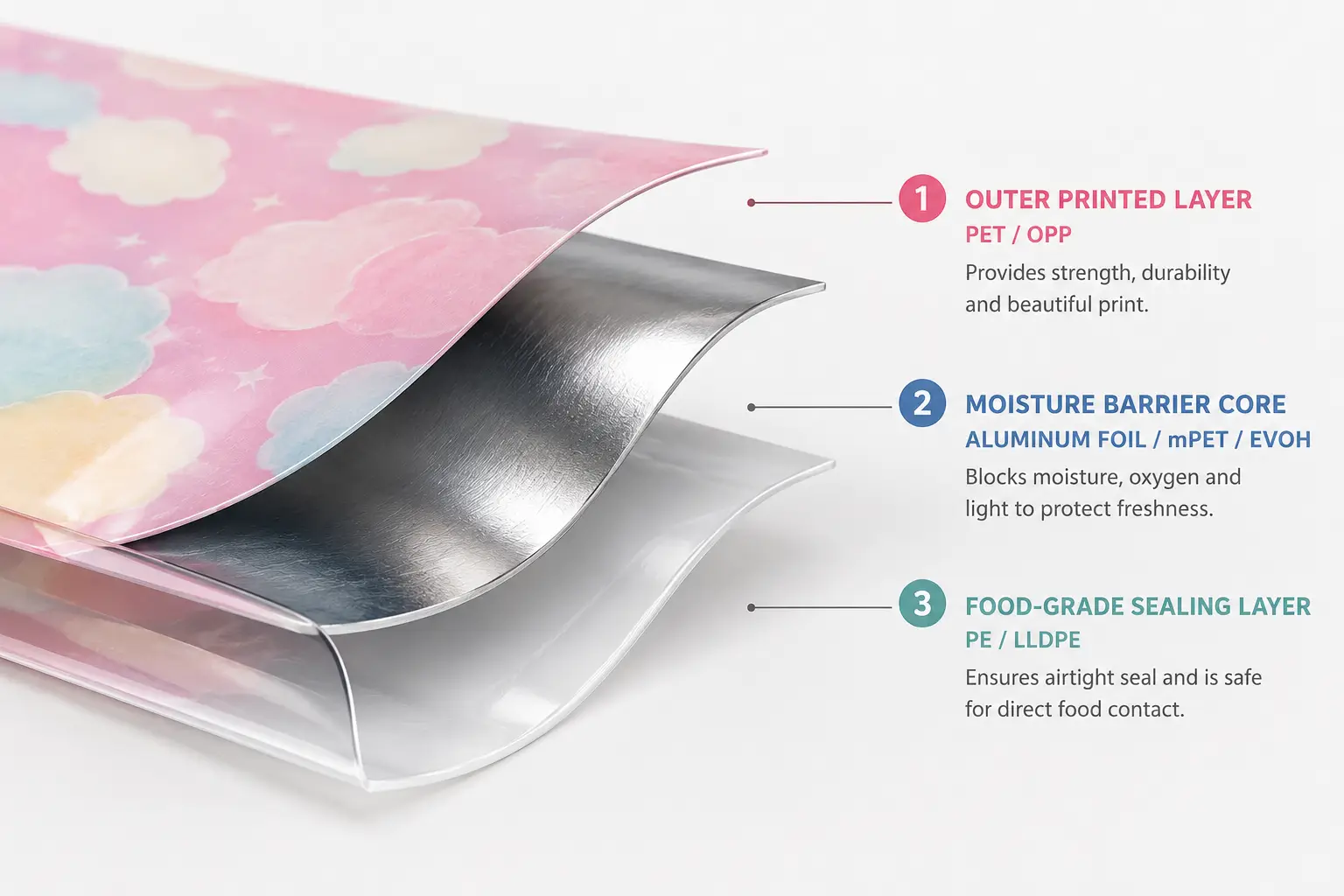
The solution lies in multi-layer composite film structures — what the packaging industry calls "high-barrier laminates." Think of them as an onion with three layers, each serving a distinct purpose.
The outer layer is the print layer, typically PET (polyester) or OPP. It provides rigidity, carries the printed graphics, and protects the layers beneath. The middle layer is the barrier layer — the critical one. In order of increasing protection: metallized PET (a PET film with a vacuum-deposited aluminum coating nanometers thick, WVTR < 1 g/m2/day), aluminum foil (essentially zero WVTR at < 0.01 g/m2/day), or EVOH (ethylene vinyl alcohol, a transparent high-barrier polymer with WVTR around 0.5–1.0 g/m2/day). The inner layer is the sealant layer — typically PE or LLDPE — which provides the heat-seal surface and the food-contact safety compliance.
A typical high-barrier structure for a product as moisture-sensitive as cotton candy would be PET 12μm / aluminum foil 7–9μm / PE 50–80μm. This structure keeps internal humidity below the critical 11% threshold for months, effectively turning a three-day product into a six-to-twelve-month product. The heat seal must achieve a strength above 45 N/15mm (per ASTM F88) to survive shipping without leaking.
At this point you may be thinking: this sounds like specialty manufacturing. It is. Professional flexible packaging manufacturers who work with multi-layer barrier films have the material science expertise, the lamination equipment, and the in-house testing capability to deliver packaging that genuinely protects your product — this is not commodity bag-making, it's engineered material selection matched to your specific product's sensitivity profile and target shelf life. For example, a manufacturer like Baishen Pack runs six on-site lab tests per batch — interlayer adhesion, puncture resistance, tensile strength, burst integrity, drop performance, and visual appearance inspection — and can provide WVTR test data for the specific film structure they recommend for your product. When you're sourcing packaging for cotton candy, the manufacturer's ability to recommend and execute the right barrier structure with verifiable test data matters more than any other single factor.
Choosing the Right Material — A Quick Comparison for Cotton Candy Packaging
Choosing a packaging material for cotton candy means balancing three competing demands: transparency (your customer wants to see the product), moisture protection (the product needs a barrier), and cost (your business needs margin). No material maximizes all three. The table below lays out the trade-offs so you can choose based on your specific priorities.
| Material Solution | Transparency | Moisture Barrier | Typical Shelf Life | Best Positioning | Cost |
|---|---|---|---|---|---|
| Clear PP/PE bag (monolayer) | High — full visibility | Low (WVTR ~18 g/m2/day) | 1–7 days | Immediate consumption / markets | $ |
| Metallized stand-up pouch (mOPP/PE) | Medium — metallic sheen | Medium-High (WVTR <1 g/m2/day) | 3–6 months | E-commerce / regional retail | $$ |
| Aluminum foil stand-up pouch (PET/AL/PE) | None — fully opaque | Highest (WVTR <0.01 g/m2/day) | 6–18 months | Premium retail / long shelf life | $$$ |
| Rigid PP tub with snap-seal lid | High — full clarity | Medium-High | 2–6 months | Premium / gift / specialty retail | $$$ |
| Kraft paper composite pouch (with inner barrier liner) | None — window optional | Medium (depends on liner) | 1–6 months | Organic / artisan / eco-brand | $$ |
A couple of things to keep in mind. First, "transparent" doesn't have to mean "low barrier." PET/EVOH/PE three-layer structures can deliver both full transparency and sub-1.0 WVTR — but they cost five to ten times more than a basic clear bag because EVOH is a specialized material requiring precise lamination. Second, aluminum foil's total opacity is a genuine trade-off for cotton candy. If your product's color is the primary purchase driver, losing all visibility behind a foil pouch may cost you more in lost impulse sales than you gain in shelf life. Many brands split the difference: a metallized pouch with a clear window panel.
Cotton Candy Packaging Design — Visual Strategies That Sell
Your packaging design is a silent salesperson. It communicates price point, brand personality, and product quality in the half-second a customer scans a shelf or scrolls past a product photo. Four strategies consistently drive results for cotton candy brands.
Transparency is your strongest selling tool. Cotton candy is one of the few food products where color IS the product appeal — those swirls of pink, blue, and lavender are what trigger the purchase impulse. At minimum, your package needs one fully transparent face or a generously sized die-cut window. If your barrier requirements force you into metallized or foil materials, insist on a clear window panel. The incremental manufacturing cost is negligible compared to the sales you lose when customers can't see what they're buying.
Color psychology should match your positioning, not just "look fun." Bright, saturated primaries — hot pink, electric blue, sunshine yellow — signal carnival, kids, and impulse. They work for concession sales and value-priced retail. Muted pastels and soft gradients signal artisan quality and sophistication — they work for the $12-a-bag Whole Foods customer. Metallic accents (gold foil stamping on a matte background) signal luxury and giftability. The rule: your package color palette should make the price tag feel predictable before the customer sees a number.
Seasonal SKU rotation is a revenue multiplier. Cotton candy is unusually well-suited to seasonal packaging because the product itself is color-flexible. A red-and-green Christmas edition, a pastel Easter tub, a spooky purple-and-orange Halloween pouch — same product, same production line, completely different shelf appeal at different times of year. If you're using digital printing (more on this below), seasonal SKU changes cost nothing extra because there are no printing plates to remake. Plan your design files to keep brand elements locked while swapping seasonal color accents and imagery.
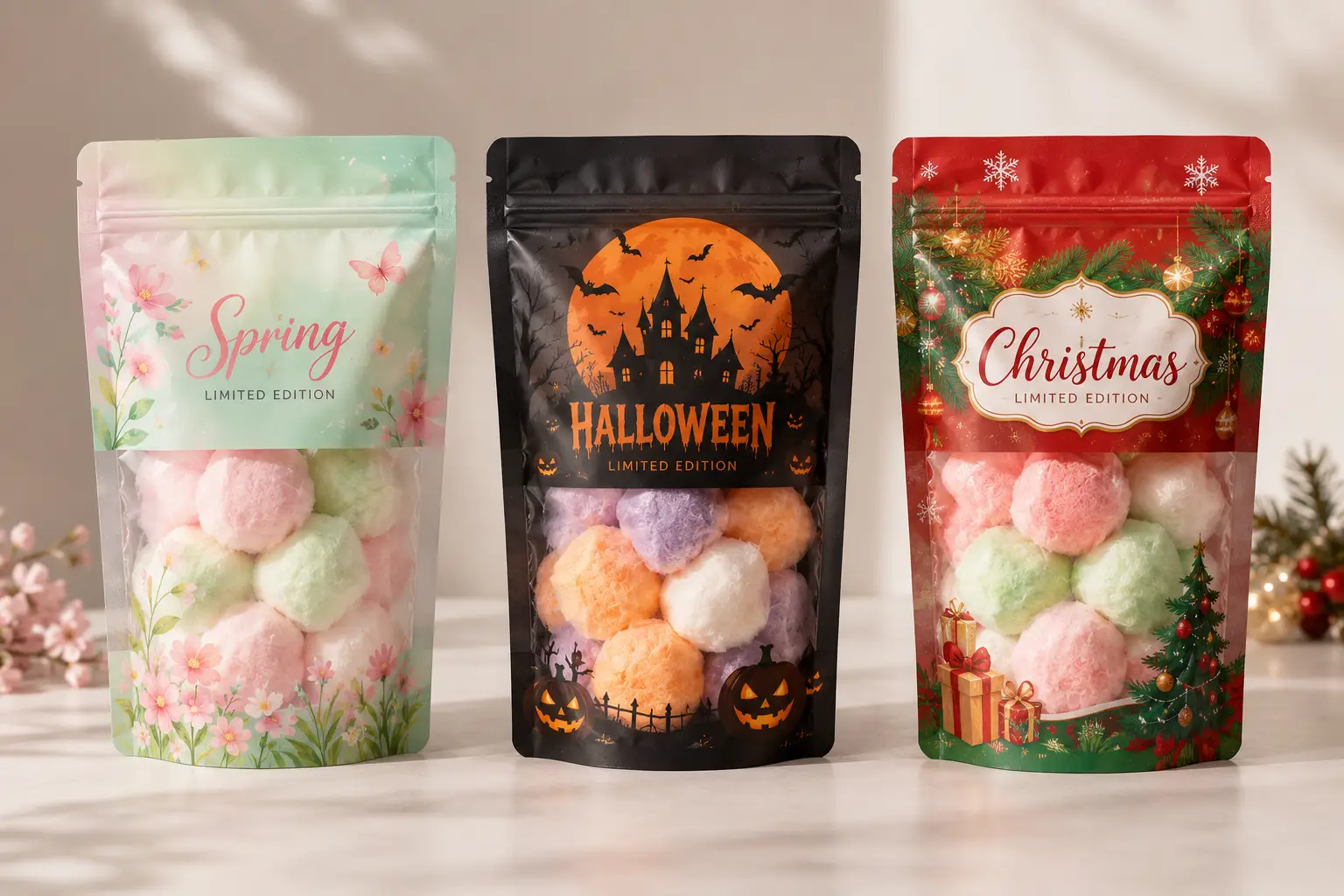
Information hierarchy matters more than clever copy. On the front face of your package, the customer's eye has time for exactly three things: brand name, product identity (what flavor/color/variant is this?), and a visual of the product. Everything else — ingredients, nutrition facts, net weight, barcode, social media handles — belongs on the back or side panels. Front-face clutter is the most common design mistake small candy brands make. If the customer has to search for "what flavor is this?", you've already lost them.
One technical note: if you're designing a package with ten colors and detailed gradients, know that your printing method determines whether that complexity is free or expensive. Rotogravure printing charges per color — each additional color means another engraved cylinder at $200–$500 per cylinder. A ten-color design adds $2,000–$5,000 in one-time plate fees before you print a single bag. Digital printing (HP Indigo or equivalent) has no color limit and no plate fees — you can run photographic-quality, unlimited-color designs at no per-color premium. For small to medium production runs, digital printing's design freedom is genuinely transformative.
Where to Source Custom Cotton Candy Packaging — A Real-World Buyer's Guide
You know what format you want, what material you need, and what design you're aiming for. Now you need to find someone to make it. Before you contact a single supplier, understand one thing that will determine your entire buying experience: the difference between digital and rotogravure printing.
Digital Printing vs. Rotogravure — The MOQ-Cost Tradeoff Every Buyer Must Understand
These two printing technologies split the flexible packaging world into two completely different experiences. Here is the comparison that determines which path you're on:
| Dimension | Digital Printing (HP Indigo) | Rotogravure Printing |
|---|---|---|
| Minimum order quantity | 200–500 pieces | 5,000–20,000 pieces |
| Plate / cylinder fees | None | $200–$500 per color |
| Unit cost (per piece) | $0.25–$0.65 | $0.08–$0.15 |
| Production lead time | 7–10 business days | 20–25 business days |
| Color limit | Unlimited (97% Pantone gamut) | One cylinder per color |
| Best for | Market testing, multi-SKU startups, seasonal runs | Mature single-SKU products at scale |
If your order is under 5,000 pieces, digital printing is your only realistic path. The plate fees alone on a rotogravure run would exceed your total digital printing cost. If you have a single SKU selling consistently above 10,000 units, rotogravure will cut your per-unit packaging cost by 50–70% — the plate fees amortize to near-zero across the volume. Most cotton candy brands start with digital, prove the market with one or two SKUs, then transition their winning products to rotogravure while keeping seasonal and test SKUs on digital.
A less obvious advantage of digital: split-run printing. Because digital presses don't use physical plates, a manufacturer can print multiple SKU designs in the same production batch as long as the bag dimensions and material are identical. If you have four cotton candy flavors each selling 300 units, digital split-run means you can order 1,200 total bags without paying four separate setup fees. Rotogravure would require four sets of cylinders and likely four separate production runs.
How to Evaluate a Flexible Packaging Supplier — 5 Questions to Ask Before You Commit
The difference between a smooth sourcing experience and a costly mistake often comes down to what you ask before placing an order. These five questions separate professional manufacturers from order-takers.
1. "What certifications do you hold — and can you show me the certificates?" ISO 9001 means the manufacturer has a documented quality management system. BRC Packaging certification (Issue 6) is the gold standard for food-contact packaging — it means the facility has been audited for hygiene, contamination control, and traceability. SGS or equivalent third-party material testing reports confirm that the raw materials meet food-safety standards (FDA 21 CFR 177.1520 for olefin polymers in the US, or EU 10/2011 for food-contact plastics in Europe). A manufacturer who can't name their certifications or provide certificate numbers is one you should cross off your list.
2. "Can you provide WVTR test data for the specific film structure you're recommending for my product?" "Our bags are moisture-proof" is marketing language. "WVTR tested at 0.5 g/m2/day per ASTM F1249 at 38°C / 90% RH" is engineering data. For cotton candy specifically, you need the latter. If the manufacturer can't produce a test report with actual numbers, they're guessing about your product's shelf life — and that guess will cost you.
3. "What is your actual MOQ for my specific bag dimensions and material?" MOQ is never a single number. It varies by bag size, material complexity, and printing method. A manufacturer who says "500 minimum, everything" without asking your specs is giving you a marketing answer, not a production answer. Get a written MOQ quote specific to your bag dimensions, material structure, and print design.
4. "Can I get a pre-production sample before the bulk order runs?" The answer must be yes. Distinguish between stock samples — free samples of the manufacturer's existing work to evaluate print quality and material feel — and custom samples — a small production run of your actual design, typically 10–50 pieces, which may cost $50–$200 depending on complexity. Custom samples are your last chance to catch a design error, material mismatch, or seal failure before it multiplies across thousands of units.
5. "What is your typical production lead time, and what shipping options do you offer?" For digital printing, expect 7–10 business days for production. For ocean freight from Asia to the US West Coast, add 15–20 days; to the East Coast or Europe, add 25–35 days. Air freight cuts transit to 3–7 days globally but costs roughly three to five times as much as sea freight. Factor both production and transit time into your inventory planning — running out of packaging is just as bad as running out of product.
What Cotton Candy Packaging Actually Costs — A Realistic Budget Framework
Packaging pricing is frustratingly opaque — few manufacturers publish their rates, and the range between "basic bag" and "custom premium pouch" spans an order of magnitude. What follows are realistic ballpark ranges based on current flexible packaging market rates for orders sourced from Asian manufacturers (China, Vietnam, India), which is where most small-to-medium US and European confectionery brands ultimately source.
Small-batch startup phase (digital printing, 500–1,000 pieces):
- Simple clear stand-up pouch with zipper: $0.25–$0.45 per piece
- Full-color digital print stand-up pouch with zipper and clear window: $0.40–$0.65 per piece
- Custom rigid PP container with snap-seal lid: $0.80–$2.00 per piece
Scale-up phase (rotogravure printing, 10,000+ pieces):
- Rotogravure-printed stand-up pouch with zipper: $0.08–$0.15 per piece
- One-time cylinder/plate fees: $200–$500 per color (reusable for repeat orders)
- Unit cost drops dramatically, but upfront cash flow needed for MOQ and plate investment
Hidden costs first-time buyers miss:
- Freight: ocean $200–$500 per pallet; air freight 3–5x more
- Customs duties: 5–25% depending on HTS classification
- Design fees: $50–$200 if manufacturer creates print-ready artwork
- Accessories: resealable zippers add $0.03–$0.08/piece; degassing valves $0.05–$0.10/piece
If your brand is still in the validation phase — testing flavors, building initial accounts, proving demand — start with digital printing at 500–1,000 pieces per SKU. Accept the higher per-unit cost as the price of flexibility. Once a SKU proves itself with consistent reorders above 5,000 units, run the math on a rotogravure transition. The breakeven on plate fees typically happens around 3,000–5,000 units depending on your color count.
If you're ready to explore custom packaging for your cotton candy brand — with specific barrier-film recommendations matched to your product's moisture sensitivity, digital print samples to review, and a clear quote with no hidden costs — Baishen Pack offers free stock samples, 7–10 business day digital print turnaround, and one-on-one sales support to walk you through material selection and pricing for your specific product.