Sustainable Packaging for Food: A Practical Buyer’s Guide for Brands
What “Sustainable Packaging” Actually Means for Food Brands
“Sustainable packaging” is not one thing. It’s three distinct paths, each with different implications for your product’s shelf life, your brand’s credibility, and your unit economics. Yet most food brand owners we talk to use the term as if it were a single choice. That confusion is exactly what leads to expensive mistakes.
Here are the three paths, defined clearly:
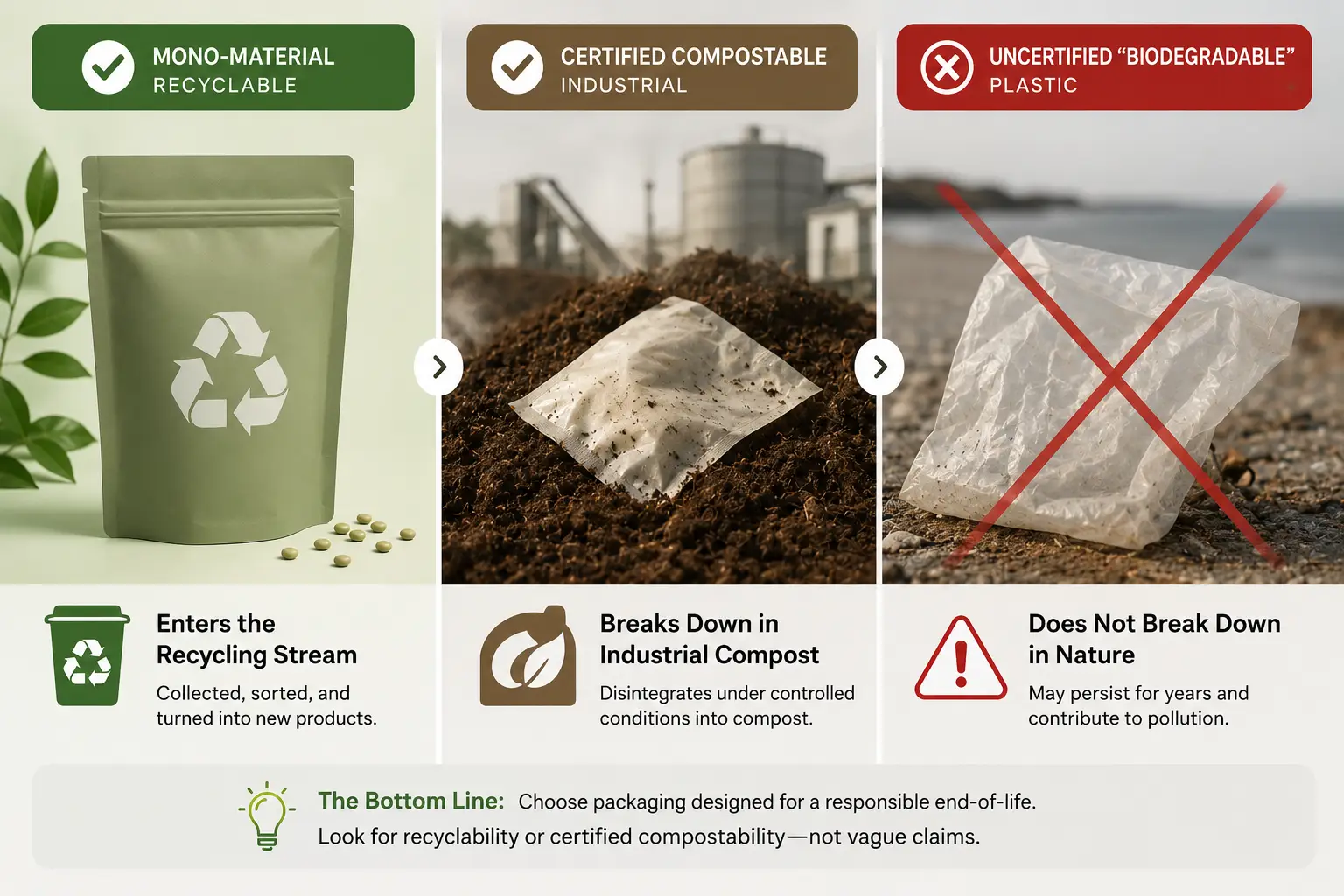
Recyclable packaging is designed to enter existing material recovery streams after use. The key enabler is mono-material construction: a pouch made from a single resin type (typically all-PE or all-PP, with that single resin accounting for more than 90% of the structure by weight). When a package is mono-material, it can be sorted, ground, and remanufactured. When it’s a multi-material laminate — paper bonded to aluminum bonded to polyethylene — it cannot be separated, and it cannot be recycled, regardless of what the marketing copy says.
Compostable packaging is designed to break down into organic matter under specific temperature, humidity, and microbial conditions. This happens almost always in an industrial composting facility, not your backyard bin. The distinction matters enormously: a package certified to EN 13432 (the European industrial composting standard) has been tested to disintegrate within 12 weeks inside a managed facility operating at 58°C. That same package dropped in a home compost pile may sit intact for years.
Biodegradable packaging is, in 2026, the term smart brands are walking away from. The word has no legal definition, no timeframe requirement, and no environmental condition specification. A plastic bag labeled “biodegradable” might take a century to degrade in soil. Until it does, it functions as conventional plastic. The EU’s Packaging and Packaging Waste Regulation (PPWR) has tightened restrictions on unqualified biodegradability claims, and brands using the term without third-party certification face growing regulatory and reputational risk. Think of it this way: “biodegradable” without a standard is like saying a car is “fast” without a speed number. Certified compostable is like saying “0 to 60 in 4.2 seconds.” Only one is actionable.
Recyclable vs. Compostable vs. Biodegradable: Which Path Fits Your Food Product?
Before you choose a material, answer three questions. They will function as your decision filter for everything that follows:
- Does your target market have recycling or composting infrastructure?
- How long does your product need to stay fresh on the shelf?
- Are your consumers willing to pay a green premium — and how much?
Keep these questions in mind. Each path below gets measured against them.
Recyclable Mono-Material: The Pragmatic Choice for Most Food Brands
If your product needs more than six months of shelf life and you sell into markets with functional recycling collection, recyclable mono-material flexible packaging is the most defensible choice you can make in 2026. The regulatory winds agree.
The technology has matured rapidly. A mono-PE pouch with an EVOH (ethylene vinyl alcohol) barrier layer delivers oxygen transmission rates below 2 cc/m²/day and moisture vapor transmission rates under 1 g/m²/day. That is performance approaching traditional aluminum foil laminates, while staying fully compatible with polyethylene recycling streams. The Association of Plastic Recyclers (APR) classifies structures with more than 90% PE by weight as “Preferred” for store drop-off recycling programs across North America (APR PE Flexible Design Guide).
Shelf life? Nine to twelve months for dry and low-moisture foods — comparable to what you’re getting from your current multi-material laminate. Cost? A 0 to 15% premium over conventional structures, and that gap is narrowing as production scales. The EU PPWR mandates that all packaging on the European market be designed for recyclability by 2030, with non-recyclable formats (grades D and E) banned outright. The cost equation for multi-material laminates will only worsen as compliance deadlines approach (European Commission PPWR Guidance, 2025).
The honesty the industry owes you: a technically recyclable pouch is not the same as an actually recycled pouch. Flexible film collection infrastructure, particularly curbside, remains uneven across markets. In North America, PE flexible packaging is primarily recovered through store drop-off programs, not curbside bins. Your pouch may carry a How2Recycle label and still end up in landfill if the consumer doesn’t know to take it to a participating retailer. This is not a reason to avoid recyclable packaging. It’s a reason to be accurate in your own sustainability claims and to educate your customers on proper disposal.
Compostable Packaging: The Premium Niche That Needs Infrastructure
Compostable flexible packaging makes sense in exactly one scenario: your packaging will be heavily food-soiled in normal use, making it unsuitable for recycling streams, and your target market has access to industrial composting facilities.
The classic use case is a coffee brand selling into Germany or the Netherlands, where industrial composting infrastructure is genuinely available. The packaging carries food residue — coffee oils, fine grounds — that would contaminate a paper or plastic recycling stream. A certified compostable pouch (EN 13432 in Europe, ASTM D6400 in North America) can carry that organic residue into a managed composting facility, where both packaging and food waste break down together.
The trade-offs are significant. Compostable films, typically PLA/PBAT blends, cost 30 to 60% more than conventional multi-material laminates. Pure bio-based films can run two to seven times higher. Shelf life is shorter: six to nine months, versus nine to twelve for mono-PE. And critically, a PLA-coated paper pouch looks like paper but acts like a contaminant. Drop it in the paper recycling bin and it degrades the quality of the entire recovered fiber batch (Lebeipackaging.com Recyclable vs. Compostable Guide, 2025).
Bottom line: compostable packaging is a premium, market-specific solution. It’s not the “more sustainable” version of recyclable. It serves a different job entirely.
Biodegradable: Why Smart Brands Are Walking Away
We’ll keep this section short because the conclusion is simple. “Biodegradable” without a certification number, a timeframe, and specified environmental conditions is a liability. The EU PPWR has tightened the regulatory framework around biodegradability claims. Canada’s single-use plastics prohibition explicitly excludes unverifiable degradation claims. In the United States, the FTC Green Guides are under revision to further restrict the term.
The brands gaining market share in 2026 aren’t the ones with the boldest sustainability claims. They’re the ones with the most verifiable ones. Recyclable mono-material with a How2Recycle label. Compostable with an EN 13432 or BPI certification number printed on the package. If your supplier can’t give you a certification code, walk away.
Unverifiable biodegradability claims are a growing regulatory liability across the EU, Canada, and the United States. The brands winning in 2026 are the ones with the most verifiable claims — certified recyclable or certified compostable, backed by a certification code.
If your supplier can’t give you a certification code, walk away.
The Real Cost of Sustainable Food Packaging (It’s Not What You Think)
Most food brands evaluate packaging costs the wrong way. They compare the per-unit price of a sustainable pouch against their current conventional pouch, see a 10% or 15% gap, and conclude it’s too expensive. That calculation misses half the equation. Sometimes it flips the answer entirely.
Think of it like buying a car. The sticker price of a hybrid is higher than a gas car. But total cost of ownership — fuel, maintenance, resale — often reverses the decision. Sustainable packaging works the same way. You need to measure three things: direct unit cost, hidden costs that don’t appear on the supplier’s quote, and operational savings that offset the premium.
Unit Cost Comparison: Recyclable vs. Compostable vs. Conventional
Here is the cost landscape as it stands in mid-2026, based on published manufacturer pricing and industry surveys:
| Packaging Type | Cost Premium vs. Conventional | Typical Shelf Life | Best For |
|---|---|---|---|
| Conventional multi-material (PET/AL/PE) | Baseline | 9–18 months | Legacy products, cost-sensitive markets |
| Recyclable mono-PE + EVOH | +0% to +15% | 9–12 months | Most dry/low-moisture food — the practical default |
| Compostable PLA/PBAT blend | +30% to +60% | 6–9 months | Premium organic brands in markets with composting infrastructure |
| Pure bio-based films (PHA, etc.) | +100% to +700% | 2–6 months | Niche, experimental, or marketing-driven applications |
| Packaging Type | Cost Premium | Shelf Life | Infrastructure Readiness | Best For |
|---|---|---|---|---|
| Conventional Multi-Material | Baseline | 9-18 months | Established | Legacy products |
| Recyclable Mono-PE | +0% to +15% | 9-12 months | Growing (store drop-off) | Most food brands |
| Compostable PLA/PBAT | +30% to +60% | 6-9 months | Limited (industrial only) | Premium organic in EU |
| Pure Bio-Based | +100% to +700% | 2-6 months | Minimal | Experimental/Niche |
The mono-PE premium has been shrinking for three years. Film producers are scaling output, and converters are gaining experience running these materials on standard form-fill-seal equipment. Several major film manufacturers now produce mono-PE structures at volumes where the cost delta against conventional laminates is in the single digits. The compostable premium, by contrast, is structural. Agricultural feedstock supply chains cannot scale at the same rate as petrochemical or bio-based PE production. It is unlikely to close materially in this decade (XLD Flex Sustainable Materials List, 2025).
Hidden Costs That Skew Your ROI Calculation
Beyond unit price, three hidden costs routinely flip the sustainability ROI calculation. Most brands discover them too late.
First, shelf-life compression. If switching to a compostable pouch reduces your product’s shelf life from twelve months to eight, your retail partners may refuse to stock it entirely. Most grocery chains require a minimum of nine months remaining shelf life at the point of receipt. A three-month reduction can mean delisting, not just higher packaging cost. The financial impact of lost distribution dwarfs any material premium.
Second, equipment modification. Some bio-based films require narrower heat-sealing temperature windows than conventional PE. If your co-packer’s form-fill-seal line is tuned for a 120–160°C seal range and your new compostable film needs a tighter 140–160°C band, you’re looking at slower line speeds, higher reject rates, or both. Budget for a trial run before committing to a volume order.
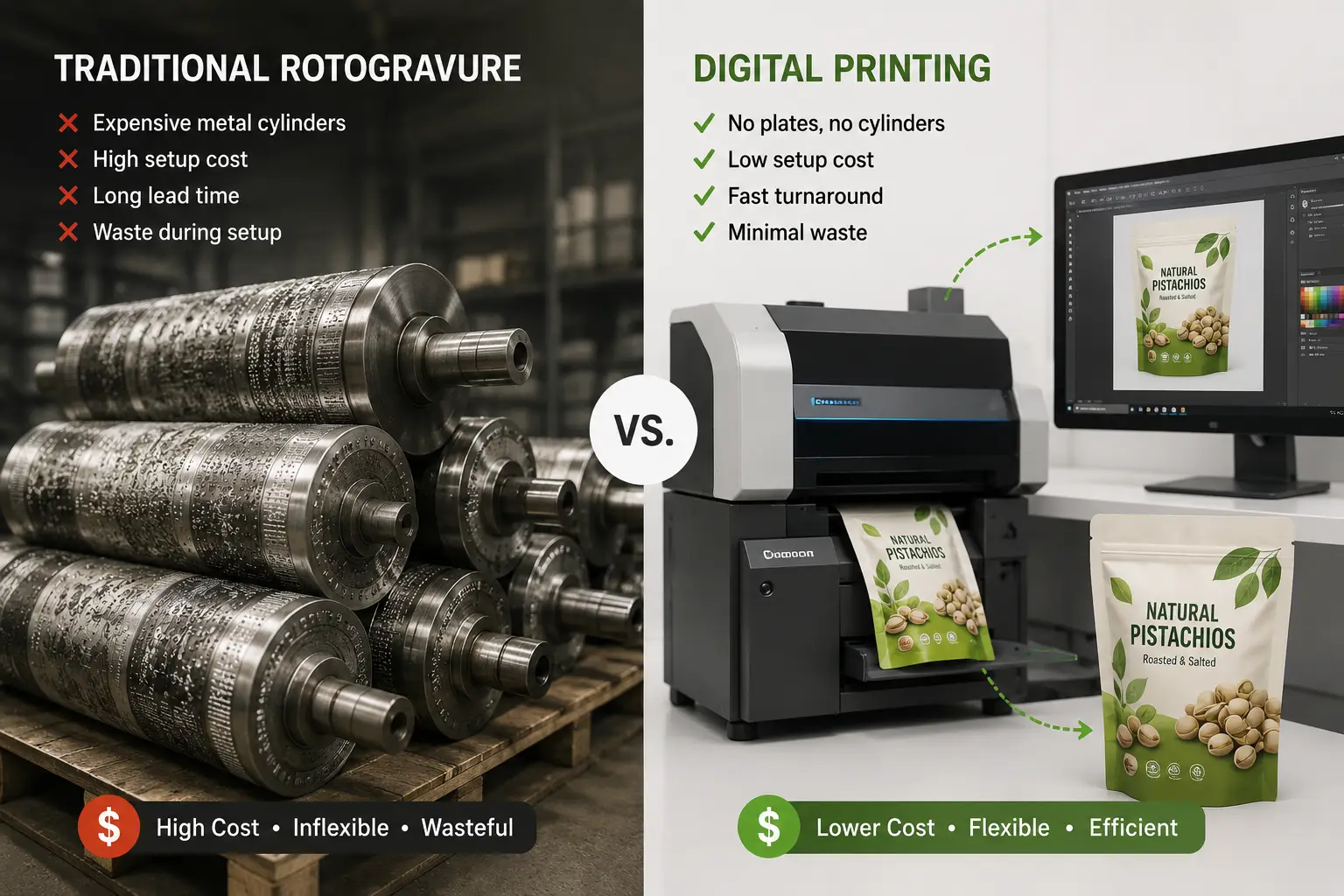
Third, inventory obsolescence. This is where smaller brands get hit hardest. Traditional rotogravure printing requires metal printing plates for each color. At $200 to $500 per color, a ten-color design costs $2,000 to $5,000 in plates before a single bag is printed. That fixed cost forces brands to order large volumes to amortize the plate investment. But large volumes mean exposure: if your recipe changes, your rebrand launches, or your demand forecast is wrong, those 50,000 pre-printed pouches become write-offs.
This is where the intersection of sustainability and smart sourcing becomes a genuine competitive advantage. Some flexible packaging manufacturers now run fully digital production lines. That means zero printing plates, setup waste measured in single-digit meters rather than hundreds, and minimum order quantities as low as 500 units. One digital-print flexible packaging supplier, Baishen, operates multiple digital presses alongside fifteen bag-making lines in Guangdong, China. The configuration eliminates plate costs entirely, cuts setup waste to under five meters of film per job, and delivers finished pouches in seven to ten business days. For a food brand managing multiple SKUs, that combination of low waste and fast turnaround directly reduces the inventory risk that makes sustainable packaging appear more expensive than it actually is.
Where the Savings Actually Come From: Digital Printing and Smart Sourcing
If you take one insight from this article, make it this: your printing method is a sustainability decision, not just a production decision.
A food brand launching thirty SKUs faces a brutal math problem under traditional rotogravure printing. Take a coffee roaster with a dozen single-origin offerings and multiple bag sizes. Thirty designs, averaging eight colors each, at $300 per plate: that’s $72,000 in plates alone. Digital printing requires none of that. The same thirty designs go from PDF to press directly, at the same per-unit cost whether you print 500 or 5,000 of each SKU.
Beyond plates, digital printing eliminates most setup waste. A rotogravure press burns through 50 to 200 meters of film during color registration and adjustment every time a new design is mounted. Digital presses register electronically and stabilize within five meters. Over a year of frequent SKU changes, the cumulative film saved is measured in tons. That’s material that never gets manufactured, shipped, or landfilled.
Combine digital production with factory-direct sourcing, and the math shifts. Cut out the two to three layers of distributor and regional converter markup that typically add 20 to 40% to your landed cost. The 10% premium for recyclable mono-PE film gets absorbed by the savings from eliminated plates, reduced waste, and a shorter supply chain. Sustainable packaging stops being a cost center and starts looking like an operational upgrade that pays for itself (Zkprintpack Eco-Friendly Packaging Wholesale Guide, 2025).
Digital Printing: The Sustainability Lever Nobody Talks About
When most people discuss sustainable packaging, they talk exclusively about materials. Paper or plastic? Recyclable or compostable? Bio-based or petroleum-based? Those conversations matter. But they miss an equally powerful sustainability lever hiding in plain sight: how the packaging is printed.
Digital printing reduces environmental impact across three dimensions that material-focused discussions ignore entirely. None of them require exotic materials or unproven technology. All of them are available today.
Zero Plates, Zero Setup Waste
Traditional rotogravure printing is, at its core, a metal-stamping process. Each color in a design requires a separately engraved metal cylinder. Typically copper-plated steel, weighing ten to thirty kilograms, these cylinders must be manufactured, shipped to the printing facility, mounted on the press, and then stored or scrapped when the production run ends. For a brand with thirty SKUs averaging eight colors each, that is 240 metal cylinders manufactured for a single production cycle.
Digital printing replaces every one of those cylinders with an inkjet head and a PDF file. The environmental math is difficult to ignore: zero metal consumed, zero plating chemicals discharged, and essentially zero setup film waste. Digital presses register in under five meters of material, versus fifty to two hundred meters for rotogravure color matching during job changeover. Over hundreds of SKU changeovers per year, the cumulative material savings alone justify the switch.
Print What You Need, When You Need It
The larger sustainability win is the elimination of overproduction. It also carries the most immediate business impact.
Traditional printing economics reward volume. The more you print, the lower your per-unit cost, because that $3,000 plate investment gets amortized across more units. The rational business decision under that model is to print six to twelve months of inventory at once. But that decision carries a hidden waste coefficient: if your formula changes, if a new regulation requires updated labeling, or if a seasonal promotion underperforms, those pre-printed pouches become landfill. Industry estimates put packaging obsolescence waste at five to fifteen percent of total inventory for food brands with active product development pipelines.
Digital printing inverts that incentive. With minimum order quantities as low as 500 units and no setup cost penalty for small runs, brands can order quarterly instead of annually. Inventory turns faster. Write-offs approach zero. And the cash that was tied up in a year’s worth of packaging sitting in a warehouse gets freed for ingredients, marketing, or investing in better materials — like upgrading from conventional film to recyclable mono-PE.
Multi-SKU Agility: A Sustainability Advantage in Disguise
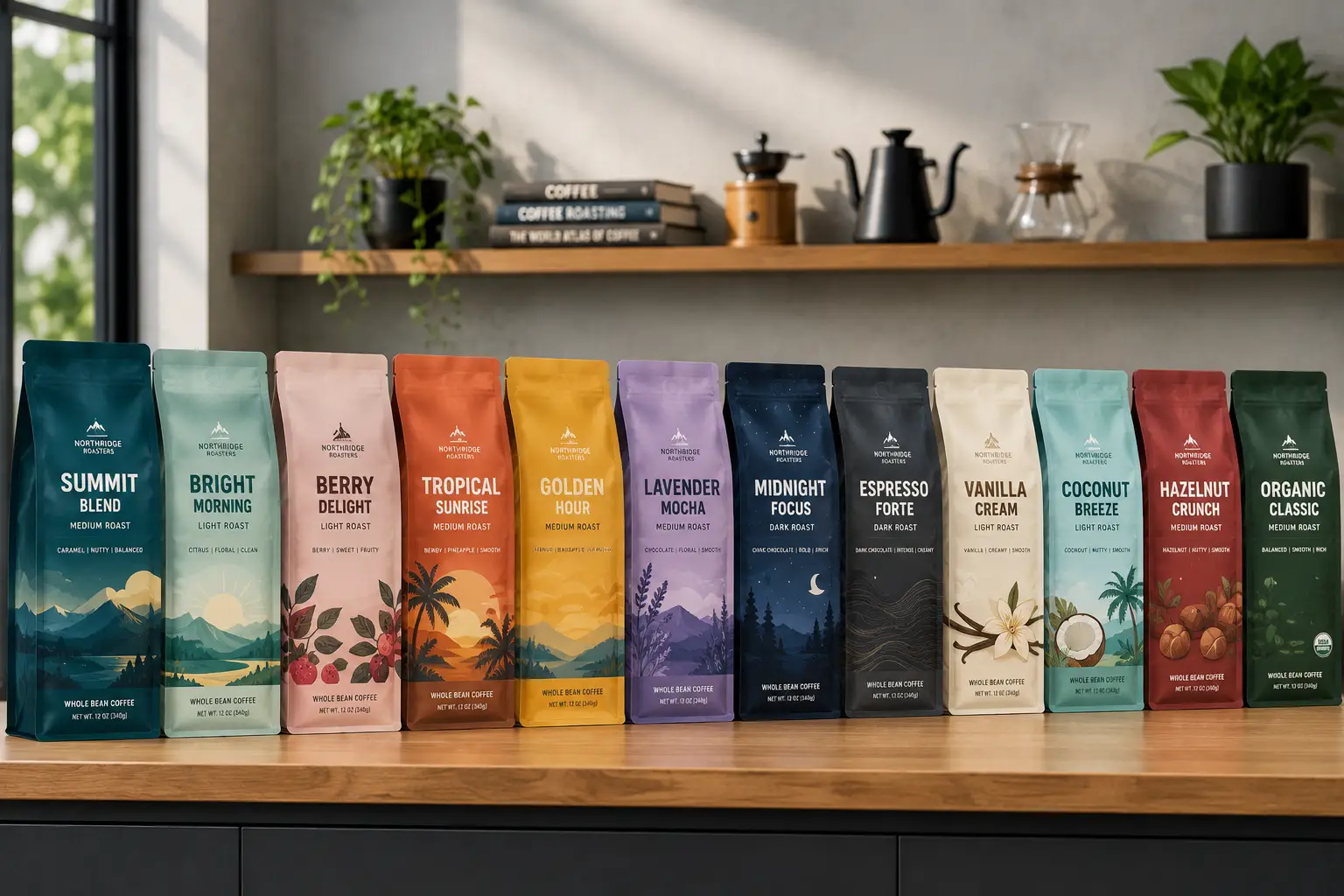
There is a quiet connection between operational flexibility and environmental responsibility that few brands recognize: the ability to manage many SKUs efficiently is itself a form of waste reduction.
Consider a pet food brand with four protein variants, each available in three bag sizes. That is twelve distinct packaging SKUs. Under conventional printing, the brand faces an agonizing choice: order large volumes of all twelve (wasteful, capital-intensive, high obsolescence risk) or consolidate to a single generic bag design with stickers (cheaper, but undermines the brand’s shelf presence).
Digital printing dissolves that trade-off. All twelve designs can be printed in a single production batch, each at its exact required quantity, with zero changeover cost between designs. The brand gets exactly the packaging it needs for each variant — no more, no less. Excess production, the root cause of most packaging waste, is engineered out of the process.
A coffee roaster with twelve single-origin offerings putting each origin’s name and tasting notes directly on the bag is not just a better brand experience. It’s a lower-waste packaging strategy. No stickers that peel off in the freezer aisle. No generic bags that fail to tell the product’s story on shelf.
How to Verify a Supplier’s Sustainability Claims (Before You Sign the PO)
You have chosen your material path. You have modeled the costs. Now you need to make sure your supplier’s claims are real. Here is a five-point verification framework to use before signing any purchase order.
| Verification Dimension | What to Ask Your Supplier | What a Credible Answer Looks Like |
|---|---|---|
| Recyclability | “What percentage of the pouch structure by weight is a single resin? Which recycling design guide did you follow?” | >90% PE or PP by weight. References APR PE Film Design Guidance or How2Recycle store drop-off protocol. Provides composition breakdown by layer. |
| Food Contact Safety | “Can you provide batch-specific migration test reports for this film structure against my product category?” | Full test report to FDA 21 CFR or EU 1935/2004, dated within 12 months, covering your product’s fat content, pH, and shelf-life conditions. |
| Certification Authenticity | “Send me your ISO, BRC, and any other certificate numbers. I’ll verify them directly.” | Certificate number, issuing body, scope statement, and expiration date — all independently verifiable on the certifier’s public database. ISO 9001 for quality management. BRC for food safety. |
| Production Transparency | “Can I get a certificate of analysis for the last three production batches of this film?” | Three sequential COAs showing consistent barrier values (OTR, MVTR), seal strength, and material composition within specification. Inconsistency across batches is a red flag. |
| Sample Verification | “Send empty pouch samples AND filled samples with my actual product, sealed on your recommended equipment settings.” | Sealed, filled samples that you can drop-test, shelf-test, and inspect for seal integrity. Empty samples alone do not predict real-world performance. |
One principle underlies this entire checklist: if a supplier cannot produce documentation on demand, assume the claim does not exist. The most expensive mistake in sustainable packaging procurement is not paying too much per unit. It’s building your brand’s sustainability story around a supplier’s verbal assurances. When the retailer audit comes, and the certification turns out to be expired or the recyclability claim unverifiable, your limited-edition “eco-friendly” launch becomes a liability — not a differentiator.
The most expensive mistake in sustainable packaging procurement is not paying too much per unit. It’s building your brand’s sustainability story around a supplier’s verbal assurances. If a supplier cannot produce documentation on demand, assume the claim does not exist.
Your Sustainable Packaging Roadmap: Where to Start
You do not need to switch all thirty SKUs to sustainable packaging tomorrow. The brands that win on this are not the ones with the boldest claims. They are the ones with the most consistent, verifiable execution. Here is a three-step path to begin.
Step 1 — Define your requirements. Write down your product’s shelf-life target, your target market’s recycling infrastructure reality, and your maximum acceptable cost premium. These three numbers will tell you which material path — recyclable mono-material, certified compostable, or a hybrid approach — fits your actual constraints. Do not let a packaging supplier define your requirements for you.
Step 2 — Get real quotes and real samples. Approach at least three manufacturers. Use the five-point verification checklist above. Request empty pouch samples, then filled samples with your actual product. Any supplier unwilling to provide filled samples at the quoting stage will not be more responsive after you have placed an order.
Step 3 — Start small, test, then scale. Pick one or two SKUs for a pilot run. Use digital printing to keep the minimum order low and the financial risk contained. Run those SKUs through your full distribution chain. Measure fill-line efficiency, seal integrity after transport, consumer feedback, and whether your sustainability claims resonate with buyers in practice, not just in theory. Take what you learn and apply it to the next batch of SKUs.
Sustainable packaging is not a one-time material choice. It is a procurement strategy that gets sharper with every production cycle. The brands executing this well in 2026 are not the ones with the largest sustainability budgets. They are the ones who treated supplier selection as a core competence, not an afterthought.
- Define your requirements. Write down your product’s shelf-life target, your market’s recycling infrastructure reality, and your maximum acceptable cost premium — these three numbers determine your material path.
- Get real quotes and real samples. Approach at least three manufacturers, use the five-point verification checklist, and demand filled pouch samples before committing.
- Start small, test, then scale. Pilot one or two SKUs using digital printing to contain financial risk, measure real-world performance, then apply learnings to the next batch.
If you are evaluating flexible packaging suppliers and want to compare recyclable mono-material options against your current packaging specifications, you can request samples and a consultation directly through the Baishen website.
References
- Association of Plastic Recyclers (APR). “APR PE Flexible Design Guide.” https://staging.plasticsrecycling.org/apr-design-hub/apr-design-guide/pe-flexible/
- European Commission. “PPWR Guidance and FAQs.” 2025. https://simontbraun.eu/new-eu-packaging-and-packaging-waste-regulation-ppwr-less-than-a-year-before-entry-into-application/2025/09/15/print/
- Lebeipackaging. “Recyclable vs. Compostable Flexible Packaging: What B2B Brands Need to Know in 2026.” https://www.lebeipackaging.com/recyclable-vs-compostable-flexible-package/
- XLD Flex. “Sustainable Flexible Packaging Materials List for 2025.” https://xldflex.com/blog/sustainable-flexible-packaging-materials-list-2025/
- Zkprintpack. “Sustainable Food Packaging Bags Wholesale: Why Eco-Friendly Packaging Matters for Brands.” 2025. https://www.zkprintpack.com/eco-friendly-packaging-wholesale-guide/
- Nanwang Paper Packaging. “The Ultimate 2025 Guide: 7 Key Factors for How to Choose Sustainable Food Packaging.” https://www.nanwangpaperbag.com/the-ultimate-2025-guide-7-key-factors-for-how-to-choose-sustainable-food-packaging/
- Baishen Pack. Capabilities. https://www.bsflexpack.com/capabilities/
- Baishen Pack. Flexible Packaging Products. https://www.bsflexpack.com/flexible-packaging/
- Baishen Pack. Case Studies. https://www.bsflexpack.com/case-study/
- Baishen Pack. Contact. https://www.bsflexpack.com/contact/
- Baishen Pack. Homepage. https://www.bsflexpack.com/