

The packaging design in the competitive environment of pet nutrition is commonly perceived from a purely aesthetic perspective. Brand managers and creative directors pay a lot of attention to color palette, typography, and shelf appeal. This is not surprising; the package is the main channel of communication in a busy retail setting. But a design that is beautiful to the eye, and does not work on the production line–or still worse, does not keep the product inside safe–is a liability, not an asset.
The production process of transforming a digital art file into a tangible pouch on a shelf is dictated by the laws of physics, chemistry, and engineering. In the case of pet food in particular, these restrictions are much stricter than those of human snacks or dry goods. The fat content, the strong odors, and the heavy weight of the product require a structural integrity that transcends to the graphic design.
This paper describes the key factors of Design for Manufacturing (DFM). Knowing these technical realities at the beginning of the creative process will save you time and money in costly delays, regulatory compliance, and a product that will not lose its quality between the factory and the home of the consumer.
Bridging the Gap Between Creative Design and Manufacturing
The situation that occurs in the packaging industry is a common one. An upscale pet food brand takes months to collaborate with a leading branding firm. They come up with a design that has complex gradients, edge-to-edge transparency, and a distinctive, slim pouch shape. The marketing department is excited. They submit the files to a manufacturer and anticipate that production should start immediately.
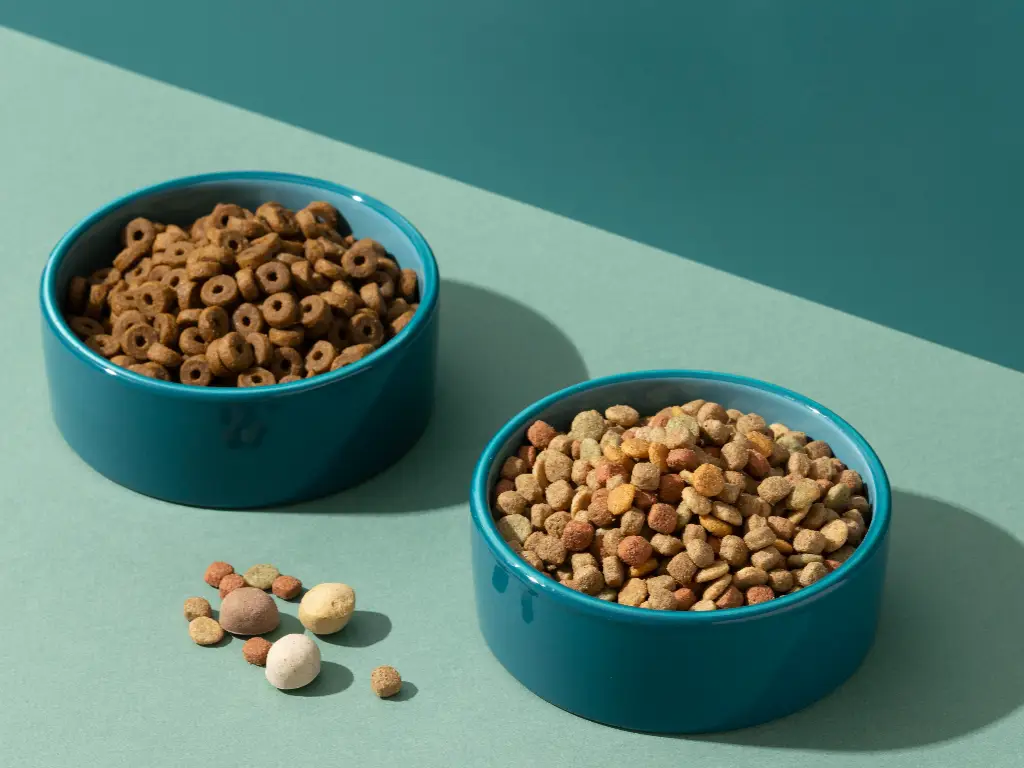
Then, the problems begin. The manufacturer complains that the thin form is not able to hold the weight of the kibble and falls over on the conveyor belt. The gradients demand additional color stations than a conventional flexographic press can support, and the cost of the setup doubles. Worse still, the substance used to get that particular appearance does not have the barrier properties to prevent the high-fat salmon oil in the food from oxidizing. The project halts. The design will have to be redesigned, lacking important launch windows.
This disconnection is due to the fact that the design was seen as a canvas and not as a working engineering element. This is what Design for Manufacturing (DFM) is all about.
Pet food products are a unique product category. Unlike potato chips or cookies, premium products—especially high-protein kibble and freeze-dried raw diets—are rich in animal fats and oils. It is dense, heavy, and biologically active. It decomposes in the presence of light and oxidizes in the presence of air. Moreover, the consumerism of pet food is different. One or two sittings are taken of a bag of potato chips. A pet food bag might require opening and closing every day for a month.
Thus, protection and functionality should be the priorities of the pet food packaging design process. A gorgeous package that spills grease, stinks of rusted oil, or cracks open when dropped will destroy brand equity more quickly than a mediocre logo could ever do. The manufacturing viewpoint poses the question: How does this design pass through a filling machine? What is its response to heat sealing? How can a drop three feet in length survive? The answers to these questions at the concept stage are not to restrict creativity, but to make sure that creativity is feasible.
Material Selection: Balancing Sustainability with Barrier Performance
The packaging industry is on the verge of a major change. By 2026, the laws of Extended Producer Responsibility (EPR) and more stringent environmental regulations will compel most brands to leave the traditional multi-layer laminate constructions and use recyclable materials.
In the past, the pet food packaging depended on such structures as PET/AL/PE (Polyester/Aluminum/Polyethylene). These materials are very good at blocking oxygen and moisture and are hard to recycle since they combine various families of plastics and metals. The trend in the industry is towards mono-material structures, mainly PE/PE (Polyethylene on Polyethylene), which can be recycled in existing streams.
But the transition to sustainable materials creates a conflict. High barrier performance is needed in pet food to stop spoilage, and recyclable packaging options do not always have the strength of conventional laminates. This poses a certain challenge to the designer.
Navigating Mono-Material Recyclability Challenges
The mono-material PE structures do not act in the same way as the traditional laminates on the production line. Polyethylene is a naturally elastic material. It is not as stiff and heat-resistant as polyester (PET). When a designer is designing a layout of a Mono-PE bag, he or she has to consider this physical difference to achieve sustainable pet food packaging.
The first issue is heat resistance. The outer part of the bag is in direct contact with the hot sealing bars during the sealing process. Unless the material used is heat-resistant, the design may distort, or the ink may smear. Designers must not put heavy ink coverage or important fine text in the seal areas (top 20mm and bottom 20mm of the pouch).
The second issue is registration. Due to the fact that PE is strained a little when it is under tension, it is harder to keep the various colors in the printing process perfectly aligned. A design based on hairline registration, in which two distinct colors are required to be in contact without overlapping or leaving a gap, is dangerous. A single millimeter stretch in the material will cause the image to appear blurry or out of focus.
In the case of recyclable pet food packaging, the best designs involve trapping. It is a method in which colors overlap a bit to take into consideration movement. Designers are also advised to prefer playful designs with bold and separate graphics as opposed to multi-layered graphics that need absolute accuracy. Knowing the elasticity of the substrate, you can create a visual system that will be sharp and professional even on biodegradable materials or compostable packaging.
The “Rancid” Trap: Why Transparency Can Be Dangerous
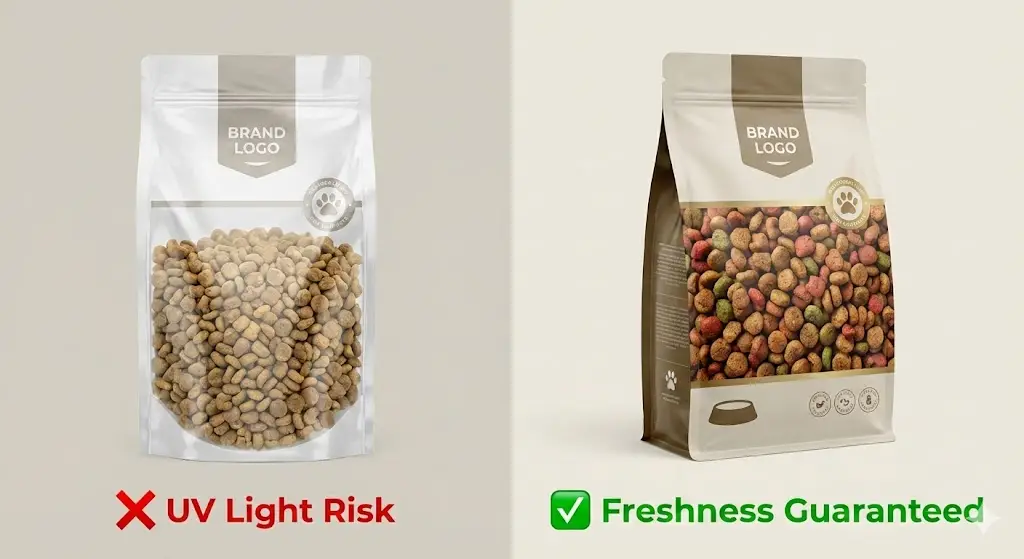
Marketing has a great desire to demonstrate the product. The trends of clean label make brands use transparent windows to allow consumers to see the actual meat and vegetables, hoping to build an emotional connection. Although this is effective in pasta or rice, it is a risky move with high-end pet food.
Fats, vitamins, and amino acids are found in pet food. These elements are very sensitive to light. Fats start to oxidize when they are exposed to UV light (the sun) or even LED lighting (supermarkets). This process produces free radicals, which destroy the nutritional value of the food and give it a rancid smell.
When a designer puts a big, clear window on the front of a bag of high-fat kibble, he is making a greenhouse to spoil. The pet parents may view the food, but when he/she opens the bag, the smell will be repulsive. The pet may refuse to eat it.
We suggest that instead of using a physical window, high-fidelity simulated window printing should be used. In the era of modern gravure or high-definition digital printing, we are able to print a photograph of the food so realistic that it looks like a window. If you cannot do without a physical window in your marketing strategy, it should be designed properly. It must be small, on the bottom gusset (where it is less likely to be hit by direct light), and, most importantly, the clear film applied should be covered with a UV-barrier coating. This preserves the product quality and it also satisfies the curiosity of the consumer.
Printing Technologies: Choosing Between Flexo, Gravure, and Digital
The choice of printing technology is as significant as the design of the packaging itself. The cost structure, the lead time, and the level of detail that can be achieved is determined by the production method. Designers usually design without having any idea of what machine will print their work, resulting in budget overruns or poor quality.
The following table will compare the three main technologies that can be used to package pet food:
| Feature | Digital Printing | Flexography (Flexo) | Rotogravure (Gravure) |
| Best Used For | Market tests, Multiple SKUs, Limited Editions, Samples | Medium to High Volume Production | High Volume Mass Production |
| Setup Costs | Low (No plates/cylinders required) | Medium (Requires flexible relief plates) | High (Requires engraved metal cylinders) |
| Unit Cost | Higher (but economical for small runs) | Low | Lowest (at very high volumes) |
| Image Quality | Excellent (Photo-realistic, high detail) | Good (Best for bold colors & solids) | Premium (Unmatched depth, detail, & consistency) |
| Lead Time | Fast | Standard | Long (due to cylinder engraving time) |
| Color Control | High consistency; easy to tweak colors on the fly | Good; requires careful plate setup | Excellent; highly stable over long runs |
One of the traps that designers fall into is excessive use of Spot Colors (Pantone colors) or bright colors that are hard to match. Although spot colors provide uniformity in the brand, each individual color needs its own printing station and plate. A 7-station press system is needed to print a design with CMYK (4 process colors) and 3 Spot Colors. This makes the plates and setup time very expensive. Designers should attempt to use the CMYK process built to create the desired colors whenever possible, and only use Spot Colors when creating the primary brand logo.
At Baishen Pack, we bridge the gap between agility and scale by offering a complete portfolio of printing technologies. We do not force a single method upon our clients; instead, we align the technology with your business stage. For seasonal blends, market tests, or complex multi-SKU product lines, we leverage our HP Indigo 20000 and 25000 digital presses. This allows for MOQs as low as 500 pieces and the ability to print distinct designs consecutively (Split-Run) with color richness comparable to gravure.
Crucially, as your volume grows, we provide a seamless pathway to high-speed Rotogravure and Flexographic printing. This comprehensive capability ensures that whether you need the speed and flexibility of digital or the cost-efficiency of mass production, you always have the right manufacturing solution under one roof.
Structural Design: Optimizing Pouch Shapes for Filling Efficiency
The pouch is made up of the skeleton of your packaging. Although a distinctive shape is visible on the shelf, the structure should be mostly functional to the filling line and the supply chain.
Designing for Heavy Bags: Drop Tests and Venting
Dry dog food in large bags (5kg, 10kg, and so on) poses a physics problem. When these bags are filled quickly on an automatic line, air is trapped in them with the kibble. When the bag is immediately sealed without allowing that air to escape, then it is a pressurized balloon.
When stacked on a pallet or when the bag is dropped during shipping (a drop test), the trapped air will take the path of least resistance. The air will explode through the seals, and the bag will burst open without a specific exit.
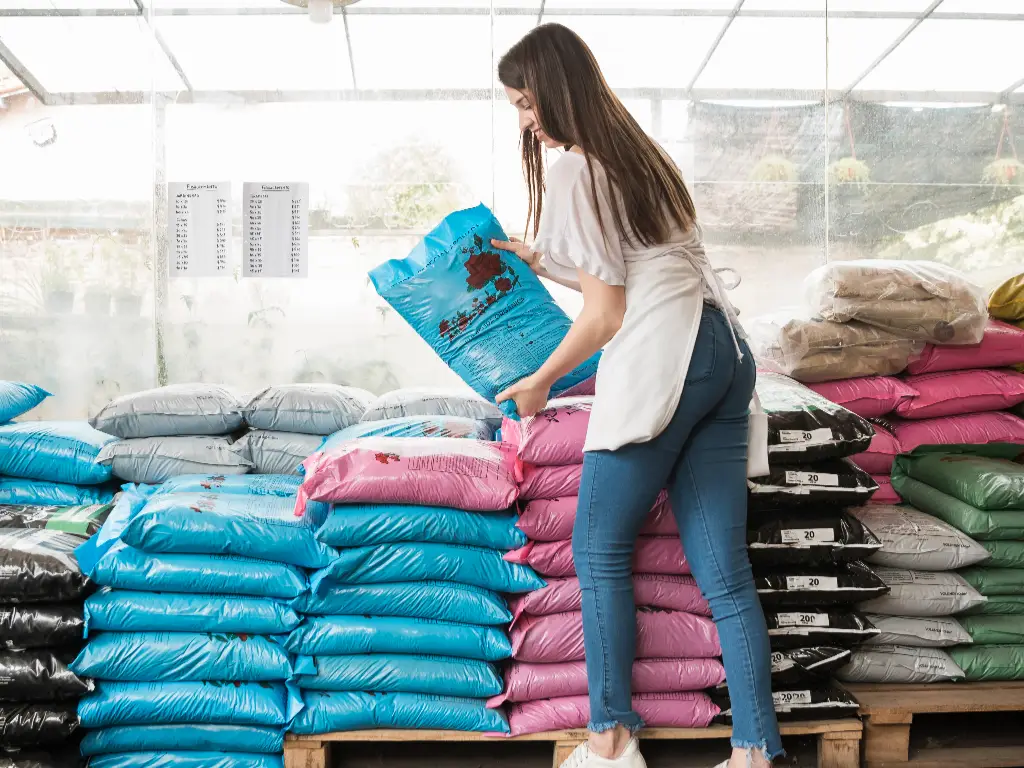
The back and sides of the bag are usually used as solid canvases by designers. But in the case of large bags, there should be designated zones where air should be released. This is done by micro-perforations (small holes that allow air to escape but not moisture) or by individual one-way air valves.
These must be considered in the pet food packaging design file. The barcode or critical text should not be positioned in the part of the area where the valve or perforations are to be applied by a designer. When the valve is positioned over a heavy ink area, it might not fit properly on the film. When holes are made through a barcode, the barcode is no longer readable. These technical markings are supposed to be marked on a different layer in the design file so that the factory can place them in the right position to provide structural integrity.
Zipper Placement for High-Powder Kibble
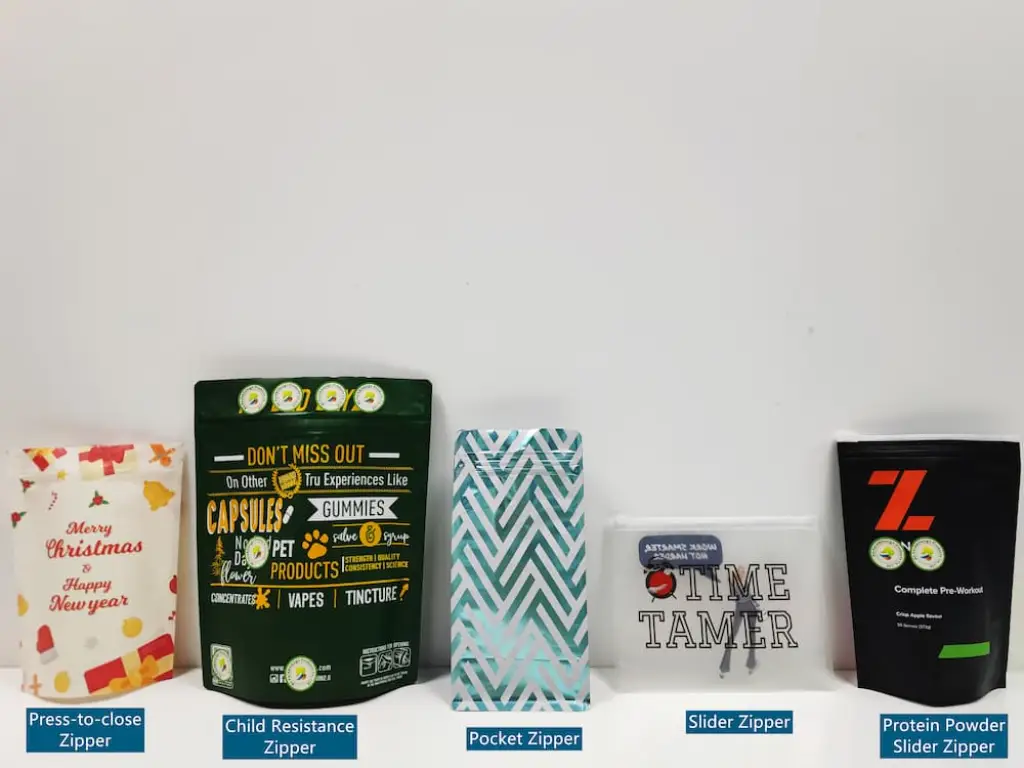
Kibble and freeze-dried food produce dust and powder. This is the powder that is the foe of the standard press-to-close zipper.
As the consumer pours the food, the fat and protein dust cover the zipper tracks. The interlocking tracks are blocked with powder when they attempt to close the bag, making it impossible to securely close the bag. The bag remains open, oxygen gets in and the costly food gets stale. The consumer then accuses the brand of poor packaging, impacting ease of use.
In these products, structural design must state either Hook-to-Hook (Velcro-style) closure or wide-track slider. These are powder-resistant mechanisms; the hooks force the powder out of the way to close.
In visual design terms, these special closures usually need additional vertical space at the top of the bag. A typical zipper may require 30mm of header space; a heavy hook fastening may require 50mm. When the designer puts the logo too near the top edge, the tear notch or the zipper installation will slice right through the brand identity. The Top Header space should be considered as a working area, and the machinery should have enough space to move freely.
Sensory Finishes: Elevating Brand Perception Through Touch
The trend is towards the pet aisle being premiumized. Brands are shifting towards natural and luxurious textures, not glossy and plastic-feeling bags. Such finishes as Soft-Touch Matte (velvet or peach skin), localized UV varnish (glossy highlights on a matte background), and foil stamping are gaining popularity in premium packaging.
Nevertheless, these finishes are physically weak, and designers should expect them to be weak.
The most widespread problem is Black Matte designs. A black, smooth, matte bag is very sleek and looks so fancy on a computer screen. In practice, however, matte surfaces are likely to be scuffed. Vibration during transport leads to the rubbing of the bags against each other or the corrugated shipping box. These scuffs appear as glittering, ugly scratches on black ink. The bag appears to be worn and damaged by the time it gets to the shelf.
To avoid this, we recommend that designers state an Anti-Scuff Varnish. It is a special coating that hardens the surface and prevents damage by friction. It will incur a minimal expense and the brand will not be subjected to high returns.
Reflectivity is another factor. Other designers apply metallic foil substrates to draw attention using vibrant colors. But the lighting in the stores is usually glare and glare. When the metallic effect is positioned behind small text (such as the ingredient list or feeding instructions), the glare may render the text illegible. The first thing is functionality: text should be placed on opaque and high-contrast backgrounds, and decorative design elements or logos should be metallic.
Ensuring Regulatory Compliance in Visual Layouts
Packaging of pet food is a legal document. In the United States, AAFCO (Association of American Feed Control Officials) and the FDA have stringent requirements in the pet food market. These rules not only control what you say, but also where and how loudly you say it. Failure to comply may result in recalls or over-sticking thousands of bags, which will ruin the look you have so carefully achieved.
These regulatory blocks should not be considered as an afterthought by designers. The following table highlights the key compliance aspects that should be incorporated in your layout:
| Regulatory Element | Required Location | Design Constraints & Notes |
| Product Name | Principal Display Panel (PDP) | It must be the most prominent feature. Specific wording rules apply based on ingredients (e.g., “Beef for Dogs” vs. “Beef Dinner”). |
| Net Quantity Statement | Bottom 30% of the PDP | Must be parallel to the base of the package. Requires specific “clear space” (no overlapping graphics/text) around the numbers. |
| Guaranteed Analysis | Information Panel (Rear/Side) | Must follow a strict order: Crude Protein (Min), Crude Fat (Min), Crude Fiber (Max), Moisture (Max). Font must be legible to ensure pet health transparency. |
| Ingredient List | Information Panel | Ingredients must be listed in descending order by weight. All ingredients must be the same font size and style (you cannot bold or highlight “Real Chicken” to make it stand out). |
| Nutritional Adequacy Statement | Information Panel | Must state if the food is “Complete and Balanced” and for which life stage (e.g., “All Life Stages” or “Adult Maintenance”). |
| Calorie Content | Information Panel | Must be stated in specific units (kcal/kg AND kcal/cup or unit). |
| Manufacturer Information | Information Panel | Name and address of the manufacturer or distributor must be clearly visible. |
Note: Regulations vary by country. The above is a general standard that is prevalent in North America. Always seek advice from a regulatory expert in your target audience’s market.
In the lower corners of the bag, designers tend to insert artistic objects, drawings, or advertising statements as key selling points. In case they encroach on the Net Quantity safe zone or the clearance space needed around it, the design will be rejected. A manufacturing partner will supply a die line template, which will contain these safe zones. Adhering to these limits in the initial draft will save weeks of revision.
Cost Optimization: Reducing Waste During the Design Phase
Lastly, we have to discuss the economics of design. Packaging waste is not only physical waste, but it is also a waste of money and increases carbon emissions.
Rotogravure and flexographic printing involve printing the image on a continuous film web. The bag size depends on the circumference of the printing cylinder. Unless your bag height design fits a standard cylinder size or gives poor nesting on the web, you are wasting money.
As an illustration, a pet food pouch with a height of 285mm is to be considered. Assuming that the standard cylinder repeat can be 280mm or 290mm, that special 285mm height may compel the factory to take a bigger cylinder and cut off 5mm of film on each bag made. In a 100,000 bag production run, there is 500 meters of wasted high-barrier film.
A designer may find out by consulting the pet food manufacturers at the outset that by simply reducing the bag by 5mm, or changing the ratio of the flaps, the bag fits exactly a standard tool. This maximizes the use of the material and lowers the unit cost without affecting the perception of the consumer on the volume of the product. This small change contributes to reducing the environmental footprint and greenhouse gas emissions.
Conclusion
The most successful pet food brands do not consider the factory as a supplier that prints the files; they consider the manufacturer as a collaborator in the pet food packaging design process. The combination of creative vision and engineering reality creates a package that appears high-end, preserves the nutritional value of the food, moves easily through the supply chain, and helps the brand achieve its financial objectives while supporting sustainability efforts.
When you are in the process of designing a new package, you should not wait until the artwork is complete before initiating the discussion about production.
Are you unsure if your design is ready for the production line? Upload your concept draft today. Our engineering team at Baishen Pack will provide a complimentary Design for Manufacturing (DFM) assessment within 24 hours, helping you identify potential risks and optimization opportunities before you spend a dollar on tooling, ensuring the best way forward for your brand.