
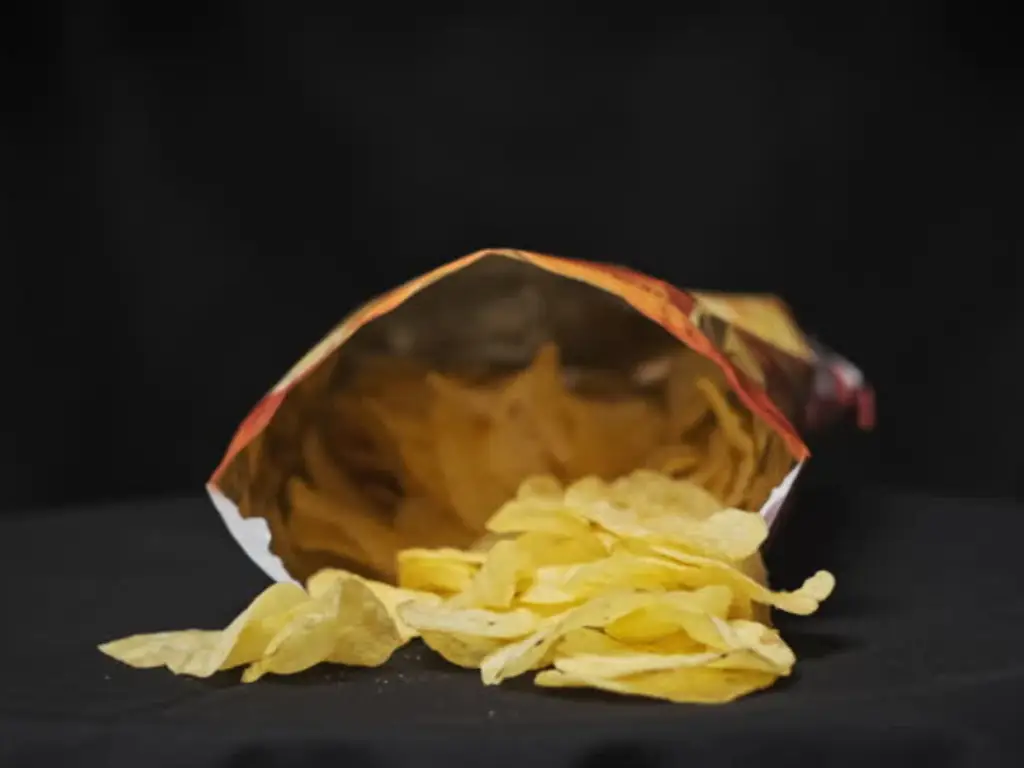
Are Chip Bags Recyclable? Why Most Aren’t — and How the Packaging Industry Is Responding
You’ve just finished a bag of chips. You’re standing at the bin, the empty crinkly pouch in your hand. Recycling bin or trash? It feels like plastic — surely it goes in the blue bin, right?
The short answer: no, chip bags are not recyclable through standard curbside recycling programs. But the full story is worth understanding. Why they aren’t, where they actually end up, and what the packaging industry is doing to fix the problem. Because the answer isn’t just about what you do with your empty bag. It’s about how packaging itself is being redesigned.
What Are Chip Bags Actually Made Of?
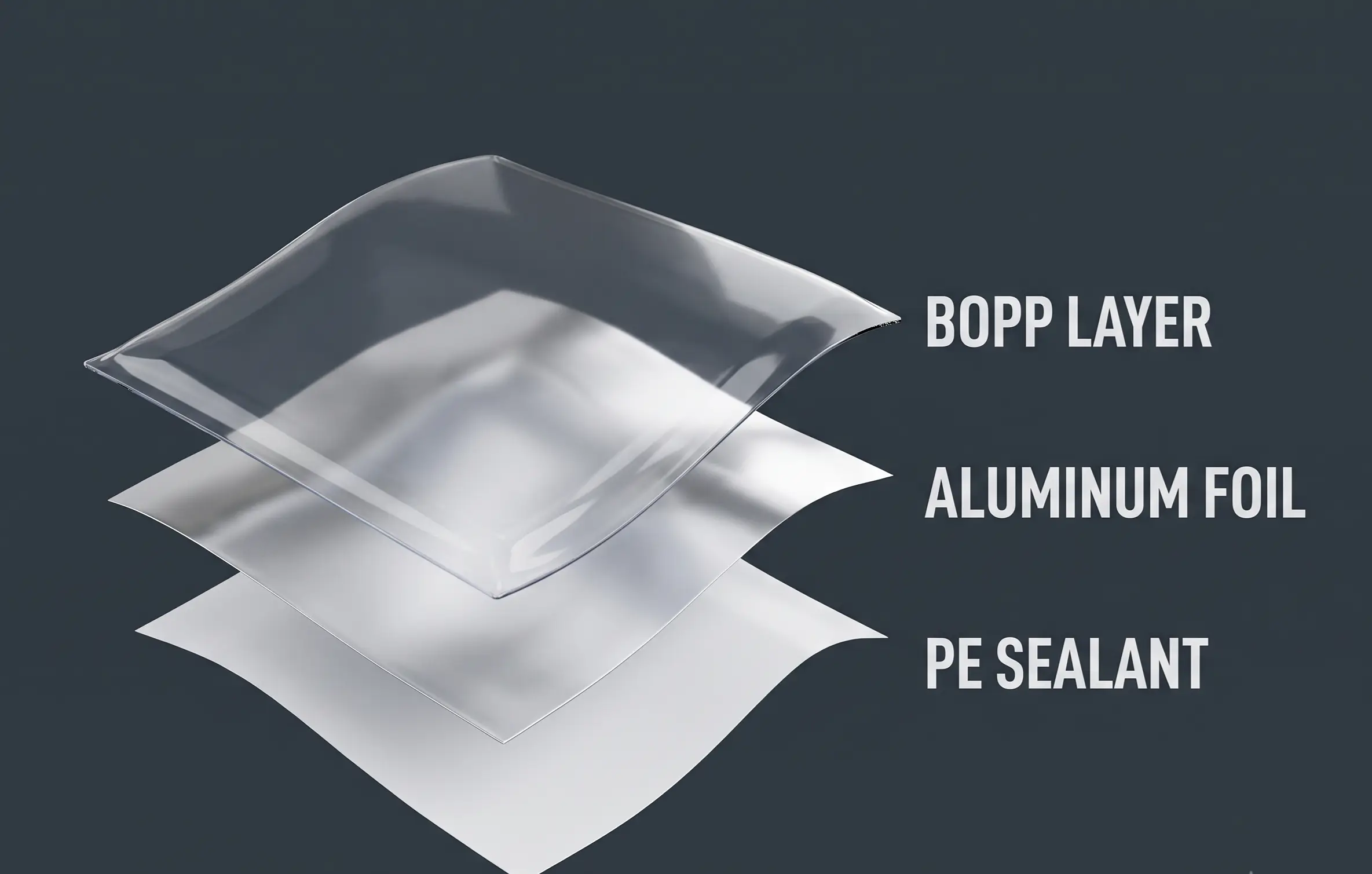
The first thing to understand is that a chip bag is not a single sheet of plastic. It’s a multi-layer laminate: a composite of three distinct materials permanently fused together into one film.
The outer layer is typically BOPP (biaxially-oriented polypropylene) or PET (polyester). This layer provides stiffness and a printable surface for the brand graphics you see. The middle layer is the barrier — usually aluminum foil or a metallized plastic film (a plastic sheet with a microscopically thin layer of aluminum vacuum-deposited onto it). This is the workhorse layer: it blocks oxygen, moisture, and light, which is what keeps chips crispy for months on a shelf. The inner layer is PE (polyethylene) or CPP (cast polypropylene) — food-safe, heat-sealable, and the surface that touches your chips.
These three layers are not stacked like sheets of paper that can be peeled apart. They are bonded with adhesives and fused under heat and pressure into a single, inseparable film. Think of it like laminating a document. Once sealed, the layers become one. This fusion is excellent for preserving snack freshness and terrible for recycling.
Why Multi-Layer Chip Bags Can’t Be Recycled Curbside
The recycling failure isn’t one problem. It’s three separate failure points. Any one of them would be enough to block curbside recycling on its own. Together, they make chip bags among the most reliably rejected items in any municipal recycling stream.
Material Incompatibility: Plastic and Aluminum Fused Forever
Recycling facilities are single-material processors. A plant that handles polypropylene (#5 plastic) cannot process aluminum. A plant that handles aluminum cannot process plastic. Chip bags deliver both materials at once, permanently entangled.
When a chip bag enters a plastic recycling stream, the aluminum layer contaminates the output. Even tiny amounts of aluminum residue — fractions of a percent — degrade the mechanical properties of recycled plastic pellets, making them unusable for most manufacturing applications.
The reverse path is equally doomed. Aluminum melts at roughly 660°C (1,220°F). Polyethylene melts at around 105–115°C, and BOPP at about 160°C. When a chip bag enters an aluminum furnace, the plastic layers burn off long before the metal begins to melt, taking any recoverable material with them and releasing emissions in the process.
It is the packaging equivalent of a cotton-polyester blend shirt. Neither the cotton recycler nor the polyester recycler can use it, because it’s neither one nor the other. The fusion that makes the bag perform is the same fusion that makes it unrecyclable.
Sorting Machinery: Why the Crinkle Test Matters
Even before the material compatibility question arises, chip bags often never reach that stage. Sorting facilities can’t identify what they are.
Modern MRFs (material recovery facilities) use near-infrared (NIR) optical sorters to classify items on conveyor belts. Each polymer type reflects a unique NIR spectral signature, routing PET bottles to one stream and HDPE jugs to another. But the metallized layer in a chip bag scatters the NIR beam unpredictably. The sensor receives a confused signal (part plastic, part metallic) and cannot classify the item. The bag defaults to the residual stream — headed for landfill.
Then there is the mechanical problem. Flexible films — even recyclable ones — are notorious at MRFs for wrapping around rotating disc screens and shaft bearings, much like hair around a vacuum cleaner roller. Chip bags, with their crinkly metalized structure, are especially prone to this. A single bag won’t stop a MRF, but thousands of them arrive every day, tossed in by well-intentioned consumers. Enough stoppages happen that many facilities employ dedicated staff just to pull film from equipment by hand.
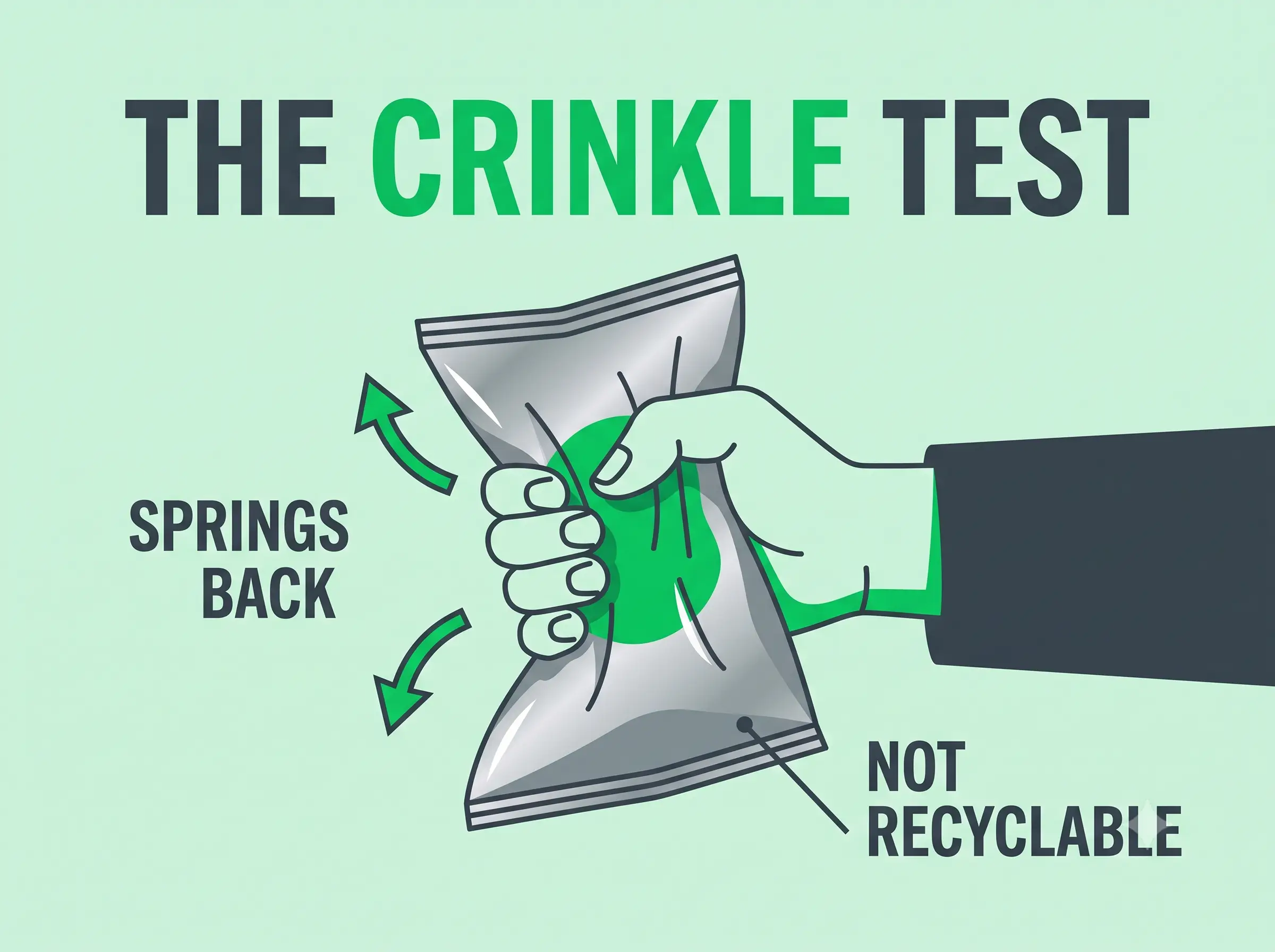
This is the engineering reason behind the crinkle test: take your empty bag and crush it in your hand. If it springs back to its original shape — as chip bags do, thanks to the metal layer’s memory — it contains a metallized or foil barrier and is not curbside recyclable. If it stays crumpled like a plastic shopping bag, it may be a pure polyethylene film, compatible with store drop-off programs. The spring-back is the metal talking.
The Crinkle Test: Crush the empty bag in your hand. Springs back? → Trash. Stays crumpled? → May be recyclable at store drop-off (check for #2 or #4 markings).
Contamination: Why One Wrong Bag Can Ruin a Whole Batch
Perhaps the most underappreciated failure point is the systemic one: individual misplacement scales into collective waste.
When a chip bag survives the sorting process undetected and ends up in a bale of otherwise clean recycled plastic, it becomes a contaminant. Downstream buyers — the reprocessing mills that purchase bales from MRFs — have strict quality tolerances. Most will reject a bale if contamination exceeds 3–5% by weight. A rejected bale doesn’t get re-sorted; it goes to landfill. Every correctly recycled bottle and jug in that batch is lost along with it.
This is the hidden cost of “wishcycling”: the well-intentioned but misguided habit of tossing questionable items into the recycling bin because you hope someone, somewhere will sort it out. Research from The Recycling Partnership’s 2024 State of Recycling report found that only 21% of residential recyclable material in the United States actually gets recycled. Contamination accounts for a significant share of the loss. Some MRFs report inbound contamination rates of 17–25%, and flexible multi-material packaging — items consumers wrongly assumed were recyclable — makes up a substantial portion of that.
The takeaway isn’t that consumers are careless. The system was designed for a previous generation of packaging: simple, single-material containers. The packaging industry innovated faster than the recycling infrastructure could keep up.
Material: Plastic and aluminum are permanently fused — recycling plants process one or the other, never both at once.
Machinery: Optical sorters can’t classify the hybrid plastic-metal signal, and the film wraps around equipment like hair in a vacuum.
System: A single misplaced bag can contaminate an entire bale — buyers reject loads with more than 3–5% contamination.
Where Do Chip Bags Actually End Up?
If chip bags aren’t recycled, where do they go? The answer depends on which bin you chose, but the destination is usually the same.
If you placed the bag in the trash, it goes to a landfill. If you placed it in the recycling bin, it gets sorted out at the MRF and sent to… a landfill. In communities with waste-to-energy incineration, some chip bags are burned for power generation. But the multi-material composition makes the combustion chemistry more complex than single-material plastics.
The scale of the broader plastic waste problem puts chip bags in context. According to the landmark 2017 study by Geyer, Jambeck, and Lavender Law published in Science Advances, of the 8.3 billion metric tons of virgin plastic produced globally as of 2015, only 9% had been recycled, 12% had been incinerated, and 79% had accumulated in landfills or the natural environment. Flexible multi-layer packaging — the category chip bags belong to — is estimated to have a recycling rate well below even that 9% average, likely under 1%. Its composite structure excludes it from virtually all conventional recycling pathways.
The bag you threw away today will outlast you. It will still be structurally intact — faded, perhaps fragmented, but chemically persistent — when your grandchildren are adults.
What Can You Do With Empty Chip Bags Today?
None of the above means you’re powerless. But it does mean your options sit on a spectrum, from the simplest (and least satisfying) to the most involved (and most impactful). Here is an honest assessment:
| Method | Who It’s For | Effort | Real Impact | What to Know |
|---|---|---|---|---|
| Throw it in the trash | Everyone | None | Landfill or incineration | Don’t feel guilty. This isn’t your failure — it’s a packaging design problem that consumers can’t solve at the bin. |
| TerraCycle free mail-in program | US/Canada residents with access to brand-sponsored programs | Collect, pack, print label, ship | Genuine material recovery (shredded into pellets → park benches, decking) | Free when sponsored by brands like Frito-Lay. Participation rate is under 2% of total snack packaging waste — the economics only work with brand subsidies. |
| TerraCycle Zero Waste Box | Anyone willing to pay | Purchase box, fill, ship back (included) | Same as above | Costs vary by box size. Best for committed recyclers who can’t access free programs. |
| Store drop-off (plastic film recycling) | Everyone | Rinse, dry, bring to supermarket | ⚠️ Chip bags are NOT accepted at most store drop-offs | Store drop-off programs only take clean #2 (HDPE) or #4 (LDPE) film. Metallized chip bags contaminate these streams. Do the crinkle test first. |
| Upcycling / DIY | Crafters and hobbyists | Medium to high | Extends useful life, but the material still eventually becomes waste | Fuse with an iron into waterproof fabric for pouches. Cut into strips and crochet into mats (“plarn”). Use colorful bags as gift wrap. |
The honest truth: all of the above are stopgaps. If you want to vote with your wallet, look for brands that use eco-friendly chips packaging — mono-material pouches labeled “Store Drop-Off Recyclable” or compostable bags with a clear industrial composting certification (like BPI or TÜV OK Compost). The label alone isn’t enough, but brands that invest in certified sustainable packaging are the ones pushing the industry forward.
How the Packaging Industry Is Fixing the Chip Bag Problem
If you take one thing away from this article, let it be this: the chip bag recycling problem is not being ignored. The flexible packaging industry has understood for years that multi-material laminates are a dead end for circularity. A significant engineering effort is underway to redesign the humble chip bag from the material up.
The core insight is deceptively simple: instead of building better recycling machines that can separate the un-separable, build a better bag that doesn’t need separating. Two paths have emerged — one focused on making plastic packaging recyclable, the other on replacing plastic altogether.
The Rise of Mono-Material Pouches: One Polymer, Full Recyclability
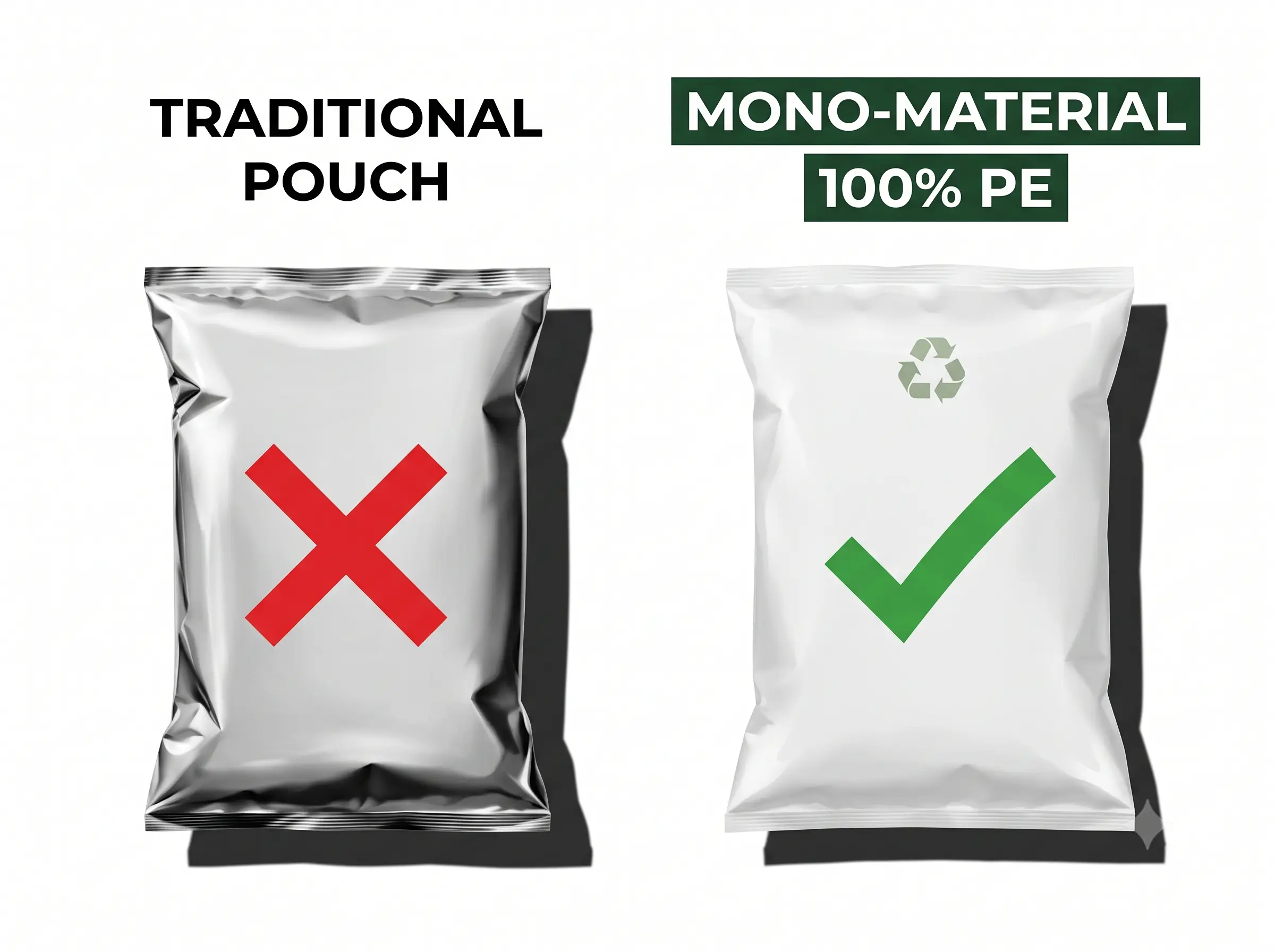
The leading industry solution is the mono-material pouch: a flexible package made entirely from a single polymer family, most commonly 100% polyethylene (PE). Instead of layering BOPP, aluminum foil, and PE, a mono-material structure uses different grades of PE for each functional layer. High-density PE provides stiffness and printability. A thin EVOH (ethylene-vinyl alcohol copolymer) barrier coating replaces the aluminum’s oxygen-blocking function. Low-density PE forms the heat-sealable inner layer.
The breakthrough is that EVOH, when used at less than 5% of the total package weight, does not disrupt polyethylene recycling streams. The entire pouch — print layer, barrier, sealant — is compatible with existing PE film recycling infrastructure. The Association of Plastic Recyclers (APR) has developed formal recognition programs for these structures, and major brands are beginning to adopt them.
There are trade-offs, and it’s important to be honest about them. Mono-material PE pouches currently provide 3–6 months of shelf life versus 9–12 months for traditional aluminum-barrier structures. The reason is straightforward: EVOH is a less effective oxygen barrier than aluminum foil. These pouches also cost an estimated 15–30% more to produce, largely because high-barrier PE grades and EVOH coatings are specialty materials produced at smaller scale than commodity BOPP and foil. And critically, they are not yet accepted in curbside recycling. They are currently compatible with store drop-off programs for PE films; curbside acceptance depends on MRF infrastructure upgrades that are underway but incomplete.
The trajectory, however, is clear. Mono-material is the direction of travel for the entire flexible packaging sector. Each year brings improvements in barrier performance, cost parity, and end-of-life infrastructure.
The bottom line for consumers: In the next few years, the chip bags on store shelves will increasingly carry “Store Drop-Off Recyclable” labels. You’ll know the transition is happening when the bag stops crinkling.
The Compostable Alternative: Eco-Friendly Chips Packaging Without Plastic
The other path — and the one consumers most often associate with the phrase “eco friendly chips packaging” — is compostable and biodegradable materials. Instead of making plastic recyclable, this approach replaces the plastic entirely.
Compostable chip bags are typically made from bio-based polymers like PLA (polylactic acid, derived from corn starch or sugarcane) blended with PBAT (a biodegradable polyester that adds flexibility). These materials are designed to break down into water, CO₂, and biomass under industrial composting conditions — typically 140–160°F (60–70°C) for 45–90 days. The crucial distinction: they require industrial composting facilities, not a backyard compost pile. Only about 8% of the U.S. population has access to such facilities, which limits the real-world impact of compostable packaging today.
Paper-based chip bags represent a third emerging option. Brands like Kind have pioneered paper packaging for snack bars, but chips present a harder challenge — they need stronger moisture and oxygen barriers than uncoated paper can provide. Current paper-based chip bags use thin barrier coatings that complicate the recycling picture in much the same way multi-layer plastics do.
The honest assessment: compostable and paper-based eco-friendly packaging are promising long-term directions, but they face the same infrastructure gap that mono-material PE pouches do. None of these solutions are landfill-degradable in a meaningful timeframe — “biodegradable” on a package with no composting facility access is functionally no different from “recyclable” on a package with no recycling program. The label matters less than the disposal infrastructure available where the package ends up.
What Snack Brand Owners Should Look for in Sustainable Packaging
If you’re on the other side of the equation — a snack brand founder, a procurement manager, or anyone responsible for choosing packaging — the mono-material transition is both an opportunity and a minefield. Here’s what to evaluate when talking to flexible packaging suppliers about sustainable chip bags.
First: certifications. A supplier should be able to produce current, verifiable third-party certifications: ISO 9001 for quality management, BRC or SGS for food safety, and ideally APR recognition or equivalent for recyclability claims. If a supplier uses the word “eco-friendly” or “biodegradable” without being able to name the specific certification standard and testing lab, walk away.
Second: full-structure transparency. Ask for the complete layer-by-layer material specification, including adhesives, inks, zippers, and tear notches. A PE pouch with a PP zipper is not a mono-material pouch — the zipper contaminates the recycling stream. Every component that touches the package must be from the same polymer family for the recyclability claim to hold.
Third: barrier performance data. Request OTR (oxygen transmission rate, in cc/m²·day·atm) and WVTR (water vapor transmission rate, in g/m²·day) measurements for the proposed structure, tested under conditions relevant to your product’s shelf-life requirements. Traditional aluminum foil laminates achieve OTR below 0.1; a good PE+EVOH mono-material structure may deliver OTR in the 1–5 range. That’s adequate for most snack products but insufficient for highly oxygen-sensitive items. Know your product’s tolerance before you commit to a structure.
Fourth: minimum order quantities. Traditional rotogravure printing requires cylinder engraving and typically demands minimum orders of 10,000 units or more to be economical. Digital printing — using presses like the HP Indigo 20000 or 25000 — eliminates cylinders entirely, enabling orders as low as 500–1,000 units. For a startup brand testing a new sustainable packaging SKU, digital print is the difference between a viable pilot and an unsellable inventory of 9,500 leftover bags.
These four checks won’t guarantee a perfect supplier. But they’ll filter out the ones who are selling sustainability as a marketing claim rather than an engineered reality.
For snack brands exploring the switch to recyclable flexible packaging, manufacturers like Baishen Pack — a China-based flexible packaging specialist with in-house digital printing, mono-material PE structure capability, and BRC/SGS-certified production — offer a practical starting point. Their engineering team can provide full material specifications and barrier data for evaluation. You can talk to their packaging engineers through their contact page.
References
- Geyer, R., Jambeck, J. R., & Lavender Law, K. “Production, use, and fate of all plastics ever made.” Science Advances, 3(7), e1700782, 2017. https://www.science.org/doi/10.1126/sciadv.1700782
- The Recycling Partnership. “2024 State of Recycling Report.” 2024. https://recyclingpartnership.org/
- Association of Plastic Recyclers (APR). “APR Design Guide for Plastics Recyclability.” https://plasticsrecycling.org/apr-design-guide
- https://www.bsflexpack.com/contact/
- https://www.bsflexpack.com/